
Everything here was made by AI
This blog is built entirely in a dedicated workspace in Letaido called the Auto Blog workspace. Everything you see on the blog — every single page, image, internal link, word graph, research report, everything — has been created by AI. My role is to create the system that produces these, refine outputs, and provide directional improvements over time. But fundamentally, I have not written a single word or designed a single image. This has been built entirely using Letaido, and through my role as somebody reviewing, nudging, and directing the output, I am building and shaping the system. All of the heavy lifting has been done by generative AI.
And critically, the system doesn't forget. The workspace keeps a living wiki and knowledge base, and every conversation I have with the AI — every decision, correction, and preference I express along the way — gets captured and folded into the guidelines that shape everything else it does. So a note I make about tone, or a call I make on how we approach a topic, doesn't just fix one article; it becomes a standing rule the workspace applies from then on. In effect, the whole system is learning my preferences and my judgment over time, making better and better decisions with each pass. That compounding memory is what turns it from a one-off content generator into something that genuinely gets better the more we work together.
The whole thing is a loop, not a line. Ahrefs data feeds the front of the pipeline; once a post is live, its real traffic — plus every review decision I make — flows back to sharpen the next one:
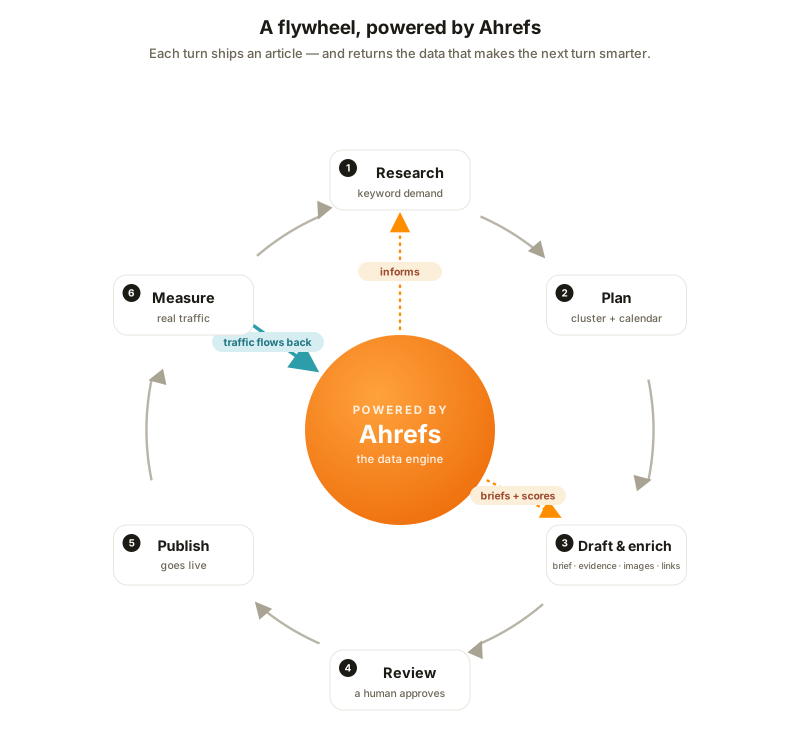
There's no CMS behind this — no WordPress, no page builder, no publishing plugin. The site is a lightweight web app built inside the Letaido workspace and deployed directly by Letaido, with the published version mirrored from the same workspace where every article is researched, drafted, and approved.
Which makes this, fundamentally, an AI-native blog. We're not taking an old-fashioned publishing setup and bolting AI onto the side of it, or translating a human workflow into something a machine can just about follow. This thing is built by AI, for AI — researched, drafted, illustrated, deployed, and edited entirely through generative and agentic AI. I interface with it by talking to an agent, not by logging into a dashboard and filling in fields. That's a genuinely different way of running a publication, and honestly, it's pretty cool.
The data and context behind it
Letaido is wired into a handful of external sources that give the AI real-world grounding, rather than leaving it to write from memory alone. Three matter most:
- Ahrefs. The workspace has a direct connection to Ahrefs' data — the same search dataset that powers the Ahrefs product. It's how the blog knows what people are actually searching for: keyword volumes, how hard a term is to rank for, the traffic a topic can realistically earn, and what's already ranking on the results page. Every topic we pursue and every article's competitive brief is grounded in this, not in guesswork.
- Firehose. Firehose is a real-time stream of events happening across the web — new model releases, funding rounds, policy moves — delivered the moment they happen rather than hours later. We filter it down to what's relevant to AI and marketing, and it feeds our weekly AI news digest, so that recurring post is built on genuinely current events instead of a stale snapshot.
- Apify. Apify is a web-scraping tool that lets the system fetch and read real pages, and capture live screenshots of them. It's how articles can reference and show what's actually on the web today — a real tool's interface, a real source page — rather than describing things from memory.
The workflow that actually powers the blog
Here's the machine underneath it — how a topic goes from idea to a finished, illustrated, internally-linked article waiting for my approval. I'll dig into each of these steps in its own post; this is the overview. And here's that same system running for real:
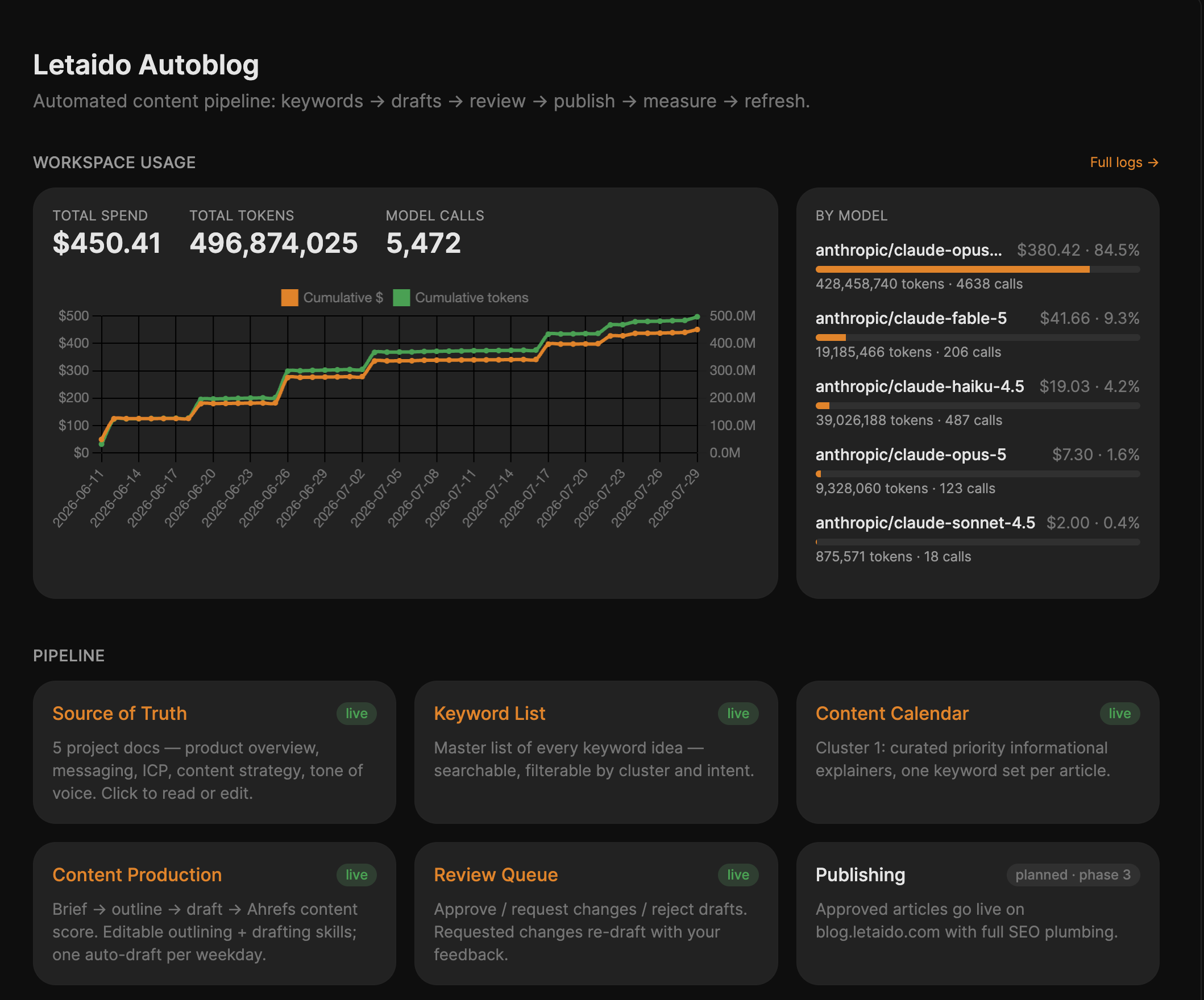
-
Keyword research. It pulls real search demand straight from Ahrefs — volume, difficulty, and traffic potential — then scores every keyword on a blend of relevance, opportunity, and how winnable it is for a young domain. The result is one prioritised master list rather than a spreadsheet nobody reads.
-
Clustering. Related keywords get grouped into a single article each, with one primary keyword and a set of secondaries. The search intent behind the cluster decides the format — definition, comparison, how-to, or listicle — before anything is written.
-
Content calendar. Promising clusters become proposed articles on the calendar, where I approve what we write before a word is drafted. This is the first human checkpoint, and approved items get scheduled into our roughly one-a-weekday cadence.
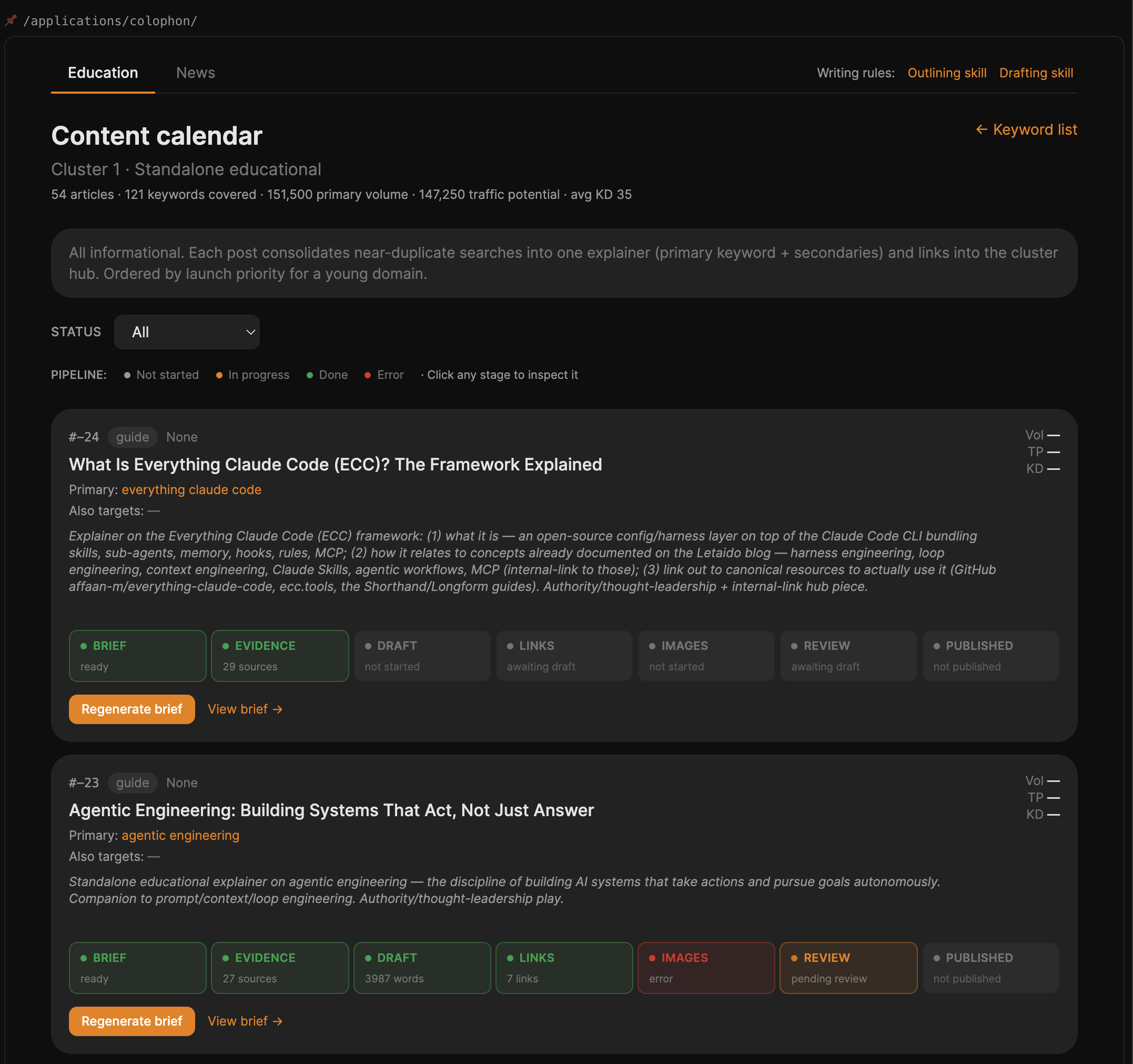
- Drafting and enrichment. Each article moves through distinct stages that each do one job: a competitive brief, a research evidence step that gathers real named sources instead of relying on stale AI memory, the draft itself, a score against the competition, auto-generated on-brand images, and internal + external links. This is what turns "AI wrote a blog post" into something genuinely comprehensive.

- Review and approval. Every article lands in a review queue — drafted, illustrated, and scored, but never published on its own. I approve, comment, or request changes, and my feedback teaches the system so the next article is already better.
That's the whole loop: real search data in, a clustered and prioritised plan, a multi-stage pipeline that researches before it writes, and a human approving the output and improving the system along the way. I'm not writing the blog — I'm running the system that writes it.
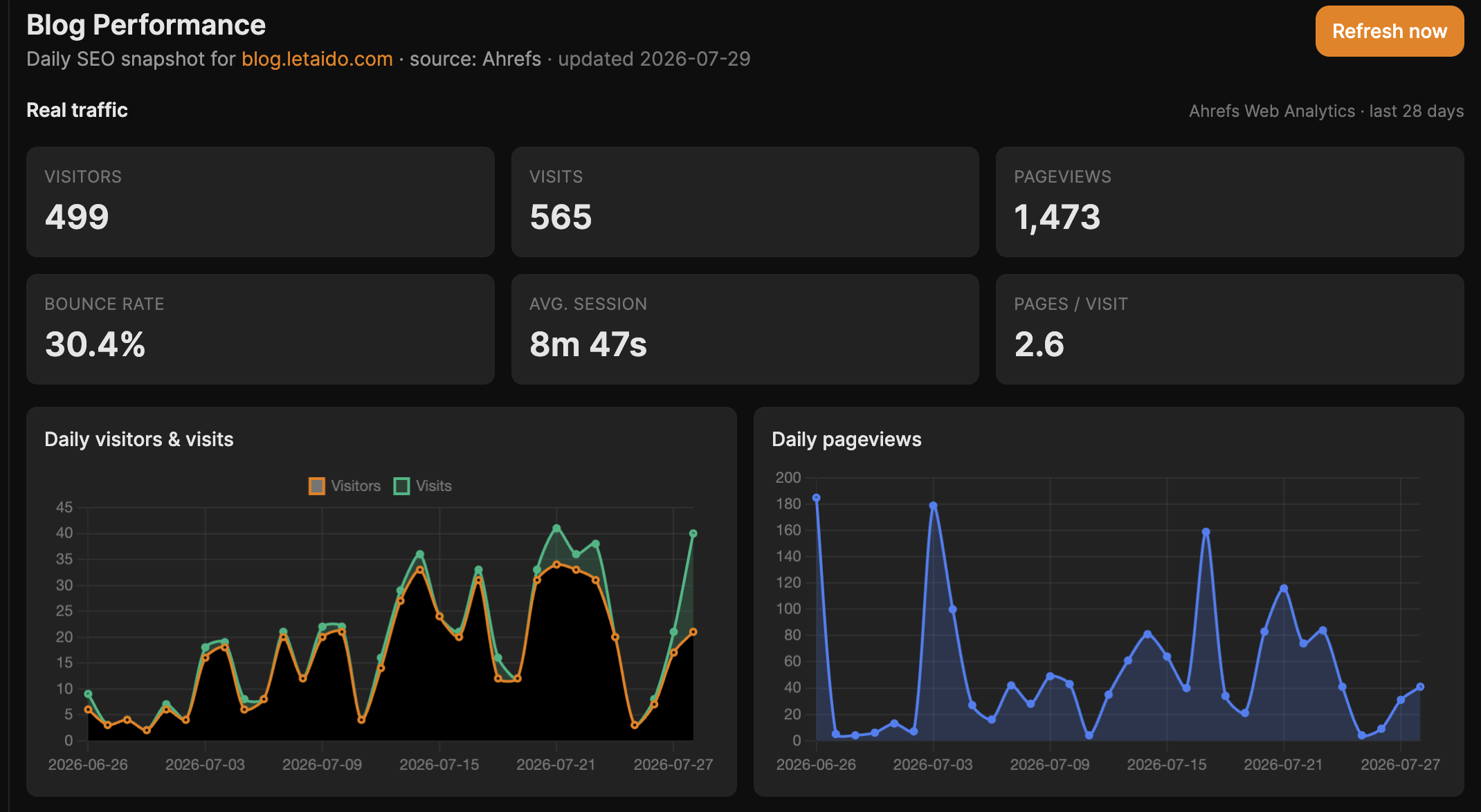
And it works. This is the blog's real traffic, pulled straight from Ahrefs — genuine readers finding genuinely useful pages.
Why I built it this way
I think many conceptions of generative AI are stuck in the kind of old-fashioned chat experience where you ask a question, you get a text response back, and you copy and paste something into another application. I have realized over the past year that we have moved vastly beyond that, thanks to buzzwords that most people think are meaningless or overhyped but actually are very important — particularly agentic AI.
We are now in a position where AI models can be set up in such a way that they act on your behalf. They can reason, they can take decisions, and they can build upon the seed of an idea that you provide and build something genuinely good and sophisticated as a result. Letaido is a great example of this. Fundamentally, the more I've played with Letaido, the more problems I've solved in my other role running the blog for Ahrefs — and the more I've come to realize that a lot of traditional content marketing and SEO can be largely automated, with a skilled human being (a skilled content marketer like myself) at the helm. This blog is fundamentally an exercise to demonstrate that, and to bring you along for the ride.
And here's the thing: none of this is bespoke. If you want to build something like this yourself, you can set it up in Letaido — the same workspace, the same Ahrefs data, the same agent doing the work.
Want to go deeper?
Many of the processes that underpin this system — keyword research, clustering, content briefs, and the rest — are things we write about on the blog itself. If you'd like to understand how any of it works in practice, start with our guides:
- What Are AI Agents? How Autonomous Agents Actually Work
- AI Agents for Marketing: Use Cases, Examples & How to Start
- AI Agents for SEO: What They Can (and Can't) Do Yet
- What Is Prompt Engineering? A Practical Guide for Marketers
Or browse all our guides to learn about the ideas that power this blog.