
Most marketers are getting maybe a third of what their AI tools can actually deliver. Not because the models are weak, but because the instructions they're given are vague, context-free, and unstructured. The output quality of any AI tool is almost entirely determined by how well you prompt it.
Prompt engineering is the practice of deliberately designing, structuring, and iterating on the instructions you give an AI model to produce reliable, high-quality outputs consistently.
This guide covers the core concepts, five practical techniques, the anatomy of a strong prompt, the mistakes that quietly waste hours every week, and a set of copy-paste templates for the marketing tasks you run most often. It's written for SEO, content, and growth marketers — not developers.
Prompt Engineering, Defined
Before diving into technique, it's worth separating two things that often get conflated: what a prompt is, and what engineering it actually means.
What a Prompt Actually Is
A prompt is the instruction you send to a large language model (an AI system trained on text that generates responses based on patterns in that training). It's not a search query, and it's not a casual question.
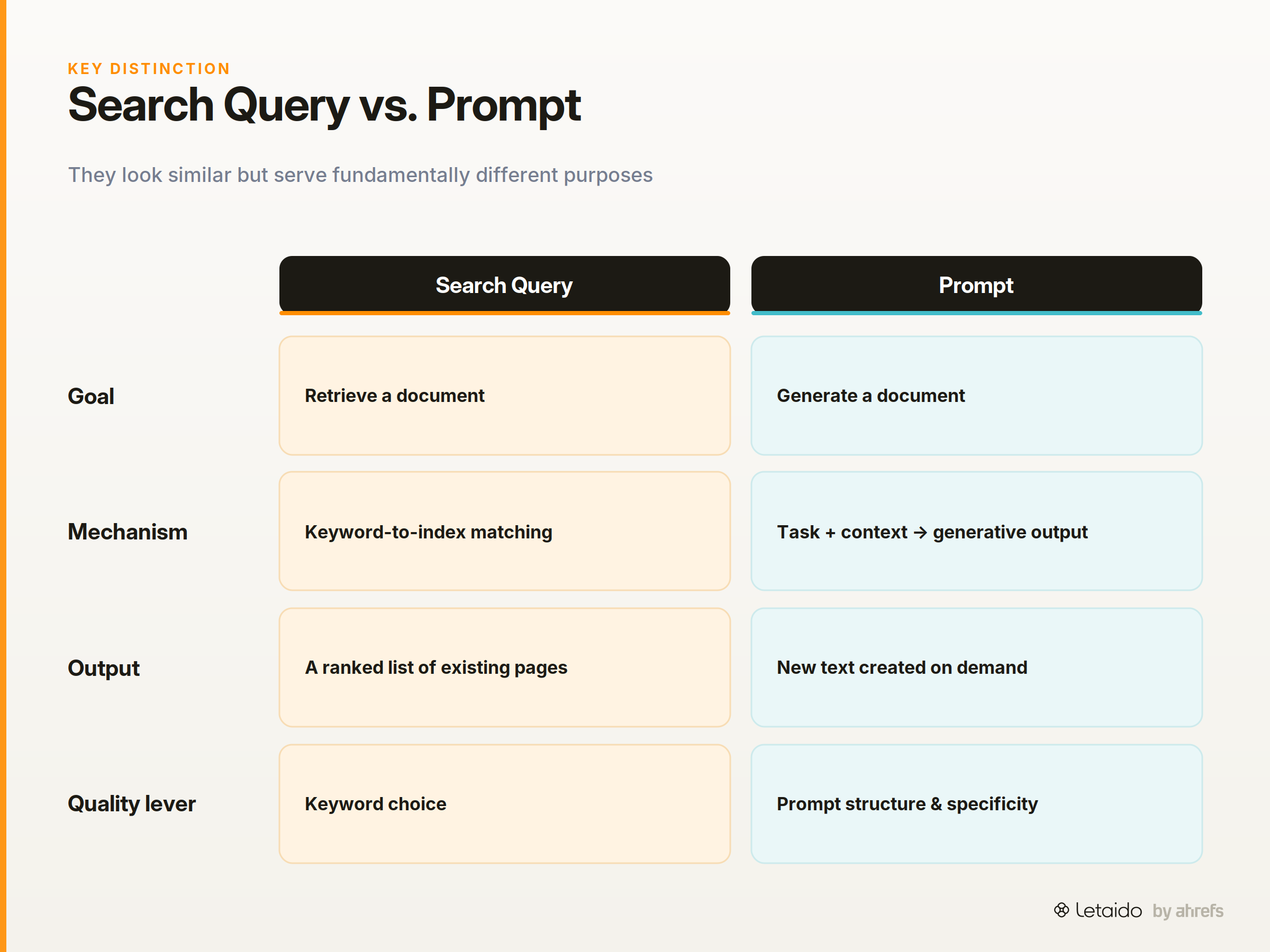
A search query is designed to retrieve a document. A prompt is designed to generate one. The difference matters because you're not matching keywords to an index; you're specifying a task, a context, and an expected output for a generative system. Everything the model produces flows from what you put in.
What "Engineering" Adds to It
Engineering means deliberate, repeatable design. It's the difference between typing "write a content brief" into ChatGPT and constructing an instruction that specifies the role, the target keyword, the audience, the structure you want, and the word count for each section.
Anthropic notes that "there's no single best technique for prompt engineering." The craft is in knowing which approach fits the task, and being consistent enough to reproduce good results without starting from scratch each time.
Why Prompt Quality Is the Biggest Lever Marketers Have
The model is not the variable. GPT-4o, Claude, Gemini — at the level most marketing teams use them, the quality gap between models is smaller than the quality gap between a vague prompt and a well-structured one.
The Same Tool, Wildly Different Outputs
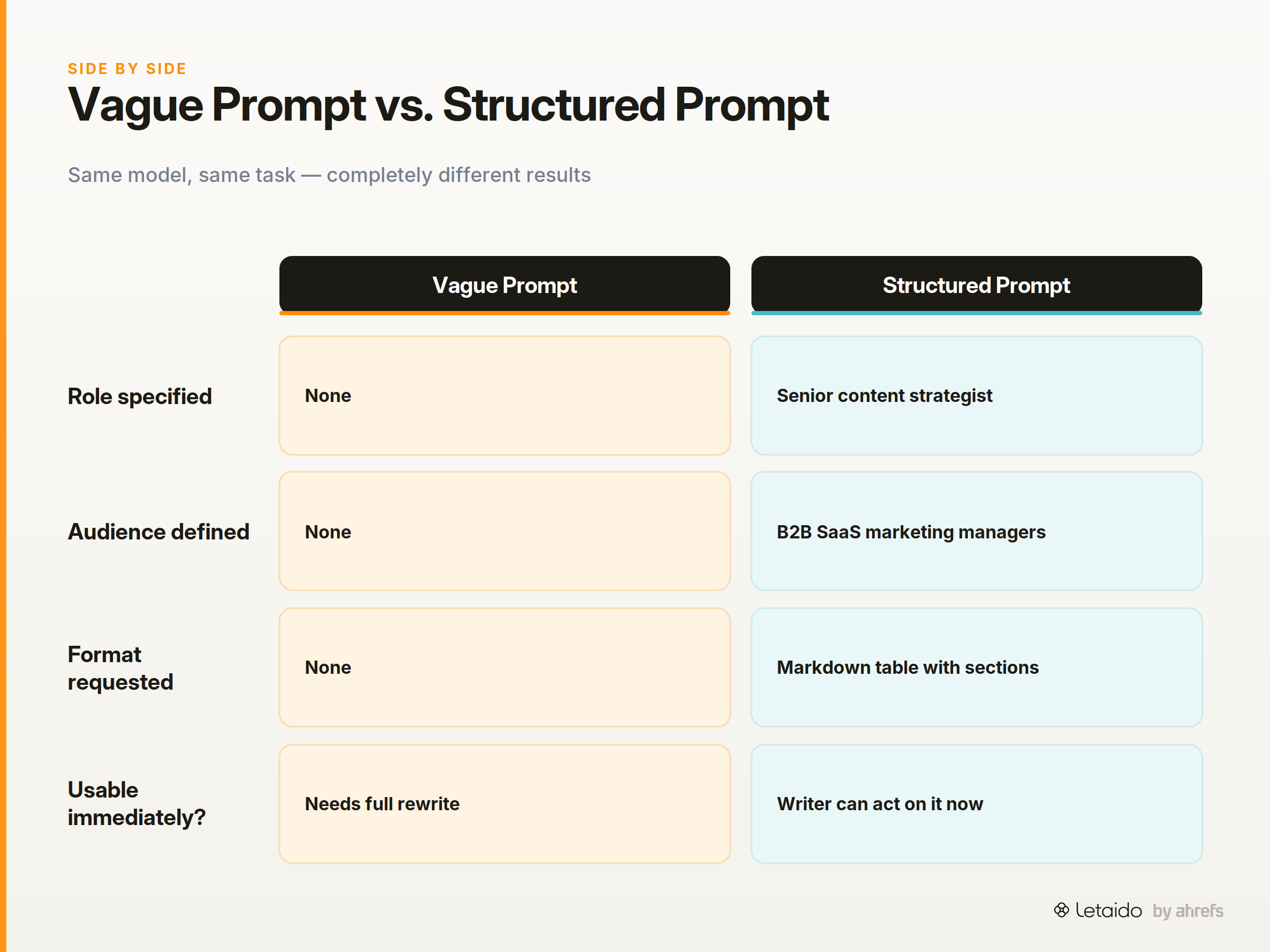
Here's the same task run two ways:
Vague prompt:
Write a content brief for a post about email marketing.
Structured prompt:
You are a senior content strategist. Write a content brief for a 1,500-word blog post
targeting the keyword "email marketing best practices" for an audience of B2B SaaS
marketing managers. Include: a recommended H1, 4–5 H2 sections with one-sentence
descriptions, primary and secondary keywords, a suggested word count per section,
and one internal linking suggestion. Format as a Markdown table.
The first prompt produces a generic outline that needs to be rewritten before it's usable. The second produces something a writer can act on immediately. The model is identical; the prompt is not.
Where Weak Prompts Cost Marketing Teams the Most Time
OpenAI's Academy framing puts it directly: "Today's marketer is equal parts strategist, storyteller, and analyst." Weak prompts break down across all three roles.
Strategically: if you ask for keyword clusters, you often get back a random list of keywords with no grouping or logic -- not the organized, intent-based clusters you actually need to build a content plan. As a storyteller: copy sounds generic because the model had no brand voice, audience, or constraints to work with. As an analyst: performance summaries describe data instead of interpreting it.
Each of those failures costs real time: a brief that needs a full rewrite, a copy batch where only two of twenty outputs are usable, a report that goes back to a writer for interpretation. Prompt engineering eliminates most of that rework.
The Core Prompting Techniques (With Marketing Examples)
There are dozens of prompting approaches in academic literature. These five actually matter in a day-to-day marketing workflow. Here's a quick reference, then each one in depth.
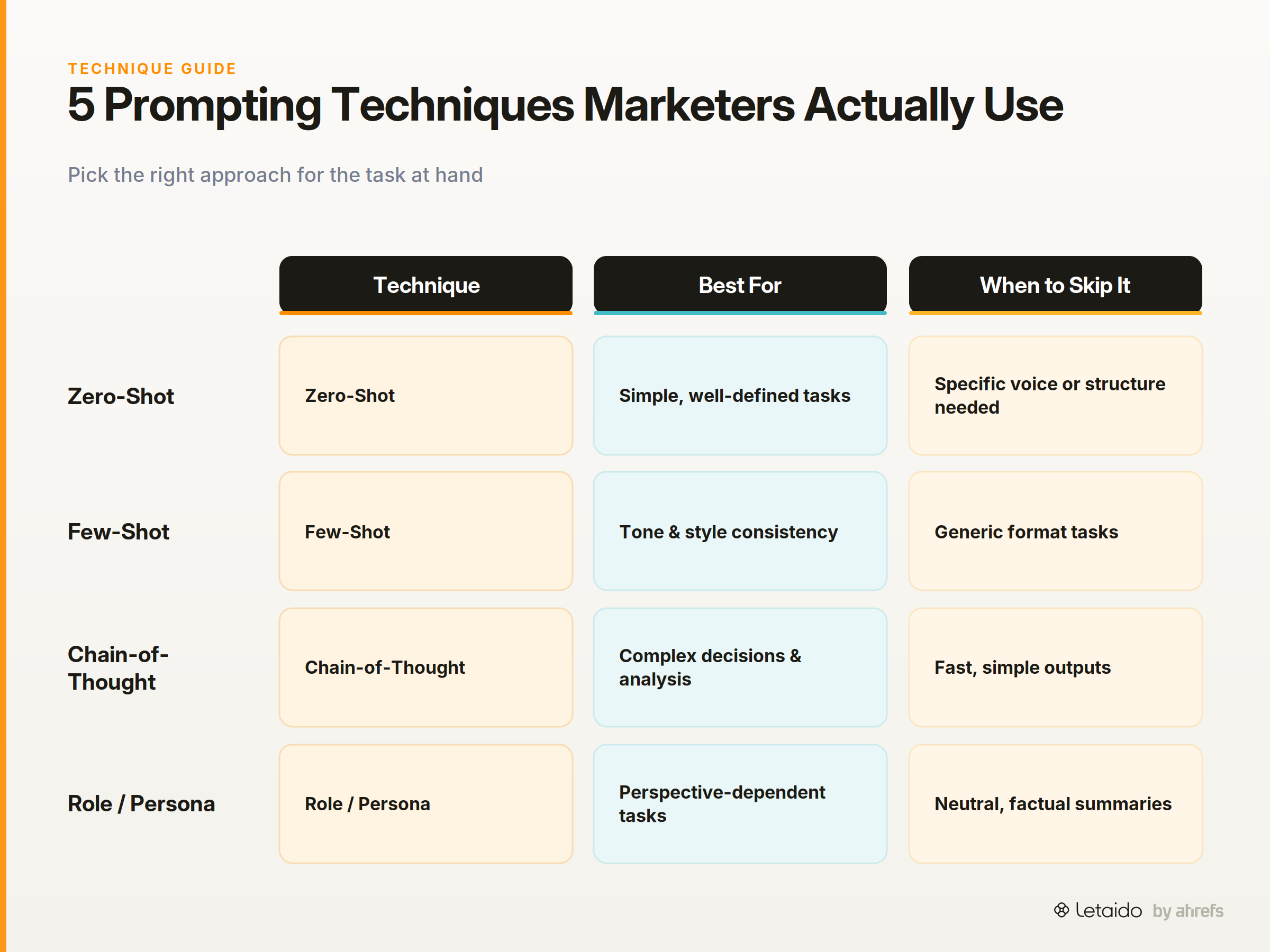
| Technique | One-line definition | Best for |
|---|---|---|
| Zero-shot | No examples; task only | Simple, well-defined tasks |
| Few-shot | Supply 2–3 examples before the ask | Tone, format, style consistency |
| Chain-of-thought | Ask model to reason step by step | Complex decisions, clustering, analysis |
| Role/persona | Assign an expert identity first | Perspective-dependent tasks |
| Prompt chaining | Output of one prompt feeds the next | Multi-step workflows |
Zero-Shot Prompting
Zero-shotZero-shot promptingAsking a model to do a task with no examples at all — instructions only. Fast, and usually enough for well-known tasks.Read: Zero-Shot Prompting: Getting Results Without Examples means giving the model a task with no examples. You rely on the model's existing training to interpret the instruction.
Use it when the task is clear and the output format is standard. Don't use it when you need a specific voice or structure the model has no reason to guess at.
Example:
Write five meta descriptions for a blog post titled "How to Build a B2B Content Calendar."
Each should be under 155 characters, include the phrase "content calendar," and end with
a clear call to action.
Few-Shot Prompting
Few-shotFew-shot promptingIncluding a handful of worked examples in the prompt so the model infers the pattern you want instead of being told it in prose.Read: Few-Shot Prompting: How to Teach AI With Examples means providing two or three examples of the output you want before asking the model to generate more. The examples calibrate tone, length, and format without you having to describe them explicitly.
It's particularly useful for copy tasks where brand voice is specific. One Reddit marketer using ChatGPT for marketing described it well: "It's freaking awesome to be able to write something then ask ChatGPT to change the voice, style, and tone to someone else based on a sample of their writing."
Example:
Here are three approved headline styles for our brand:
1. "The 10-Minute Framework for Writing SEO Headlines That Actually Rank"
2. "Why Your Content Calendar Is Broken (And the Fix Takes One Afternoon)"
3. "Stop Guessing at Keywords: A Data-First Approach for Content Teams"

Using the same tone and structure, generate eight headlines for a post about
email nurture sequences.
Chain-of-Thought Prompting
Chain-of-thought promptingChain-of-thought promptingAsking a model to work through its reasoning in steps before answering, which measurably improves accuracy on multi-step problems.Read: Chain-of-Thought Prompting: Make AI Reason Step by Step asks the model to reason through a problem step by step before producing the final output. This reduces errors on tasks that require judgment, like grouping keywords by intent or evaluating which content gaps to prioritize according to Chain-of-Thought Prompting Elicits Reasoning in Large Language Models.
Google Cloud's production-systems guide notes that "developers spend weeks perfecting prompt engineering, tool calling, and response latency" — chain-of-thought is one of the most reliable ways to improve the accuracy of outputs on complex tasks without fine-tuningFine-tuningFurther training a base model on your own examples so it internalises a style or task, rather than being told about it in the prompt each time. the model.
Example:
Here is a list of 40 keywords related to "project management software."
Step 1: Group them by search intent (informational, commercial, transactional).
Step 2: Within each intent group, identify 3–5 topic clusters.
Step 3: For each cluster, name it and list the keywords it contains.
Show your reasoning for any grouping decision that isn't obvious.
Role and Persona Prompting
Role prompting assigns the model an expert identity before the task. It doesn't change the model's underlying knowledge, but it shifts which knowledge the model draws on and the register it uses.
Example:
You are a senior SEO strategist with 10 years of experience reviewing content briefs
for B2B SaaS companies. Review the following brief and identify: (1) any keyword
targeting issues, (2) gaps in the H2 structure relative to the search intent,
(3) one competitor angle the brief is missing. Be direct and specific.
Prompt Chaining
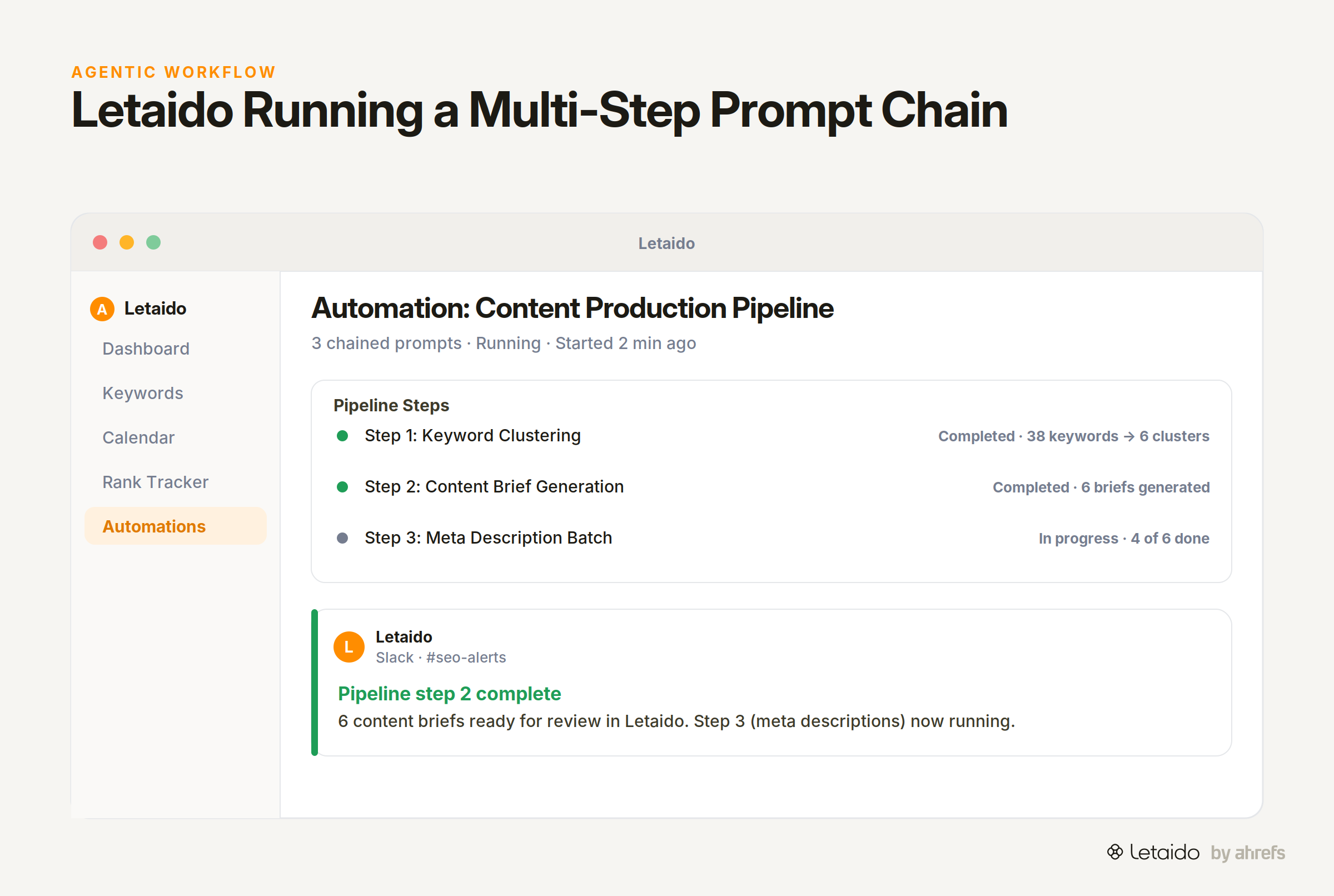
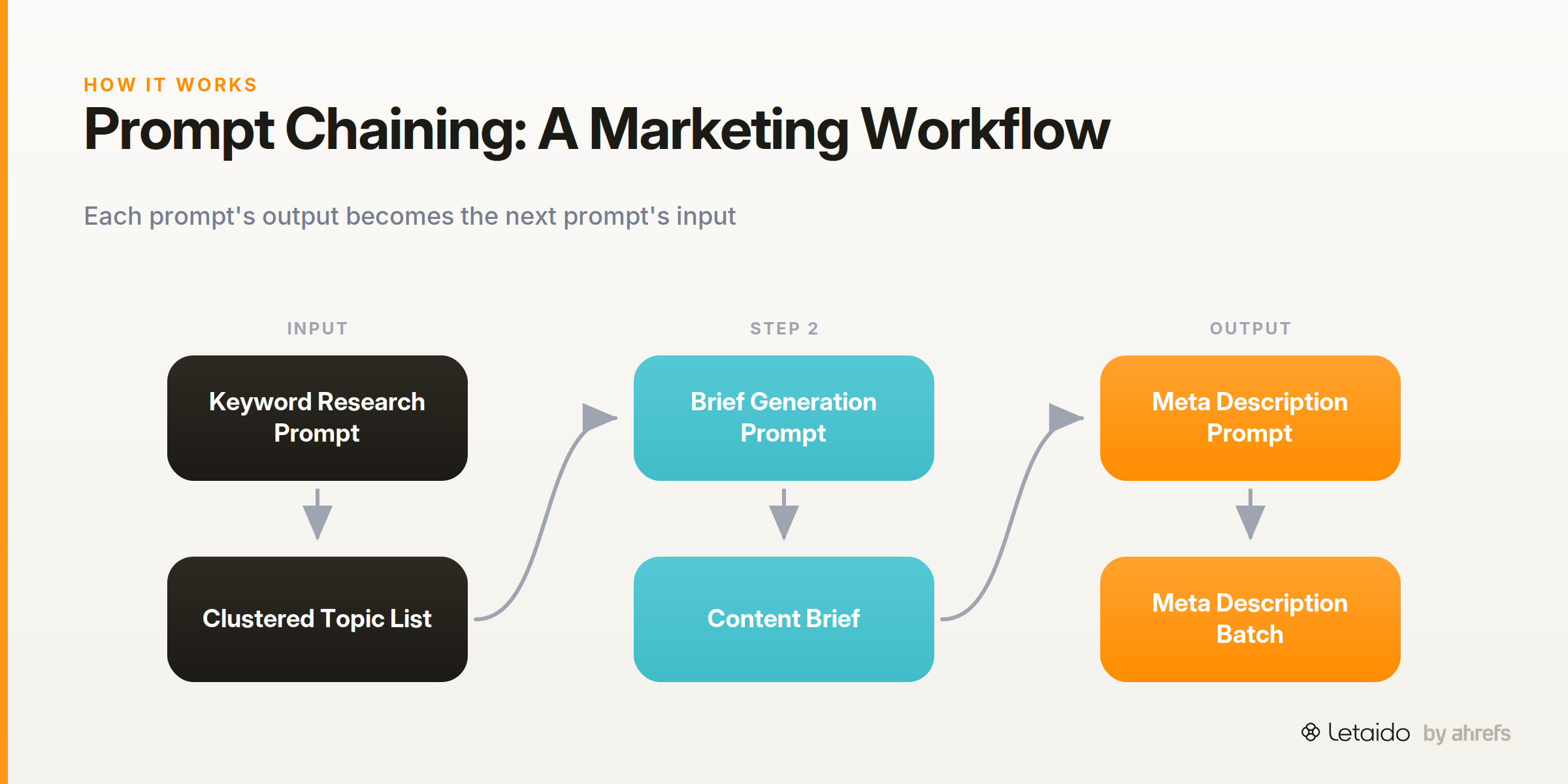
Prompt chainingPrompt chainingSplitting a large task into a sequence of smaller prompts, each consuming the previous output, so every step can be checked and retried on its own.Read: Prompt Chaining: Break Big Tasks Into Reliable Steps means passing the output of one prompt as the input to the next. This is how you turn a single model into a multi-step workflow.
A practical example: a keyword-research prompt produces a list of clustered topics → that list feeds into a brief-generation prompt → the brief feeds into a meta-description batch prompt. Each step is simple; the chain produces something complex. This is also the conceptual foundation of agentic workflows, which we'll return to later.
Anatomy of a High-Quality Prompt
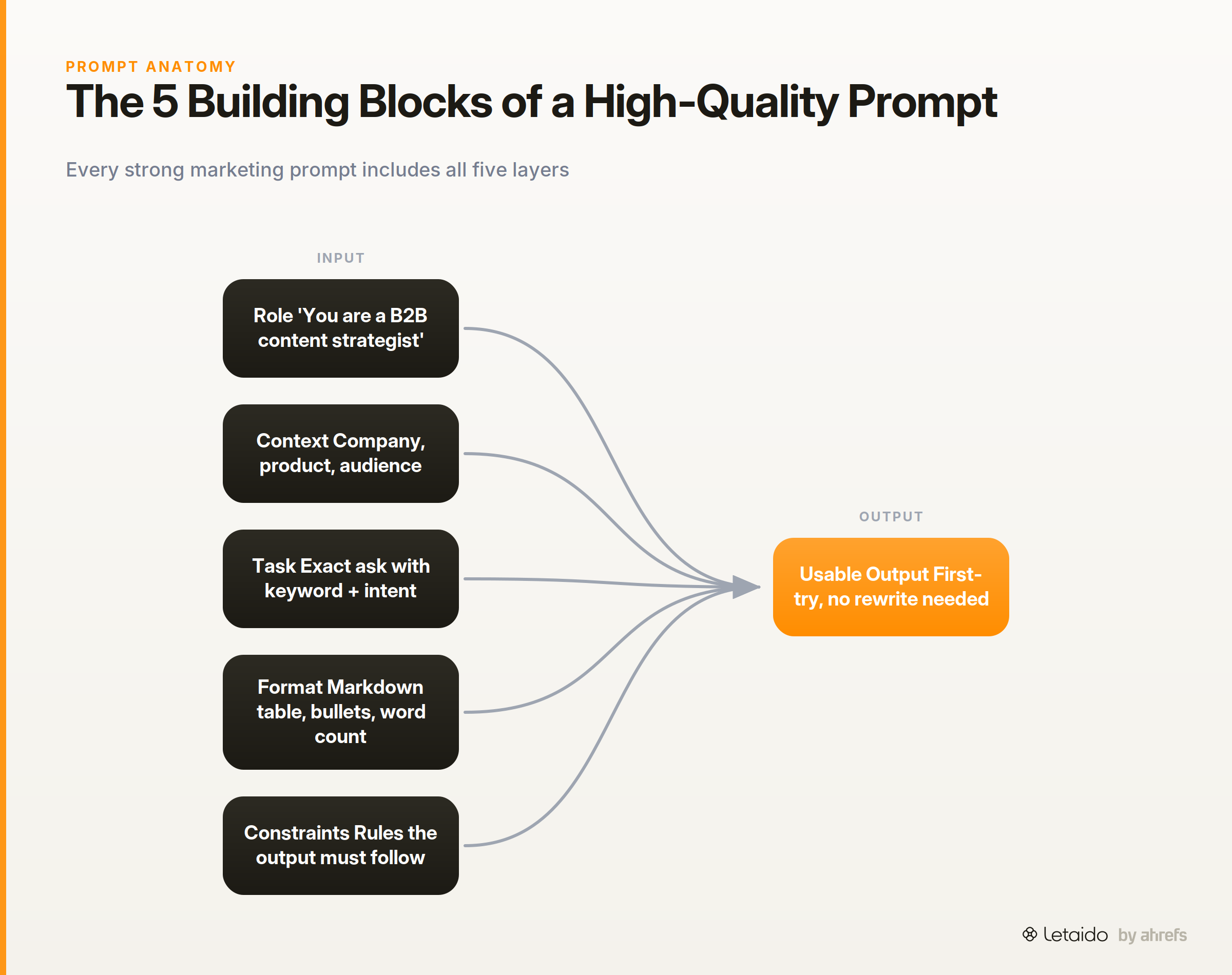
Knowing the techniques is one thing; knowing what to put inside each prompt is another. Most high-quality prompts share the same five building blocks.
The Five Components Every Strong Prompt Has
OpenAI's Academy frames it as four elements; OpenAI's API best practices add a fifth critical layer around format and delimiters. Together they form a complete framework:
- Role: Who is the model acting as? (e.g., "You are a B2B content strategist.")
- Context: What background does the model need? (e.g., "We are a SaaS company targeting mid-market HR teams.")
- Task: What exactly are you asking for? (e.g., "Write a content brief for the keyword 'employee onboarding software'.")
- Format: How should the output be structured? (e.g., "Return a Markdown table with columns: Section, Word Count, Key Points.")
- Constraints: What rules must the output follow? (e.g., "Each section description must be one sentence. Do not include any external tool recommendations.")
Google Cloud's prompt engineering guide recommends using delimiters — such as triple backticks or XML-style tags — to separate instructions from context. This prevents the model from treating your background information as an instruction to follow.
A Worked Example: Building a Content Brief Prompt from Scratch
Start with the task alone:
Write a content brief.
Add the role:
You are a senior content strategist.
Write a content brief.
Add context:
You are a senior content strategist working for a B2B SaaS company that sells
project management software to teams of 10–100 people.
Write a content brief.
Add the full task:
You are a senior content strategist working for a B2B SaaS company that sells
project management software to teams of 10–100 people.
Write a content brief for a blog post targeting the keyword "project management
for remote teams" (monthly search volume: 4,400, informational intent).
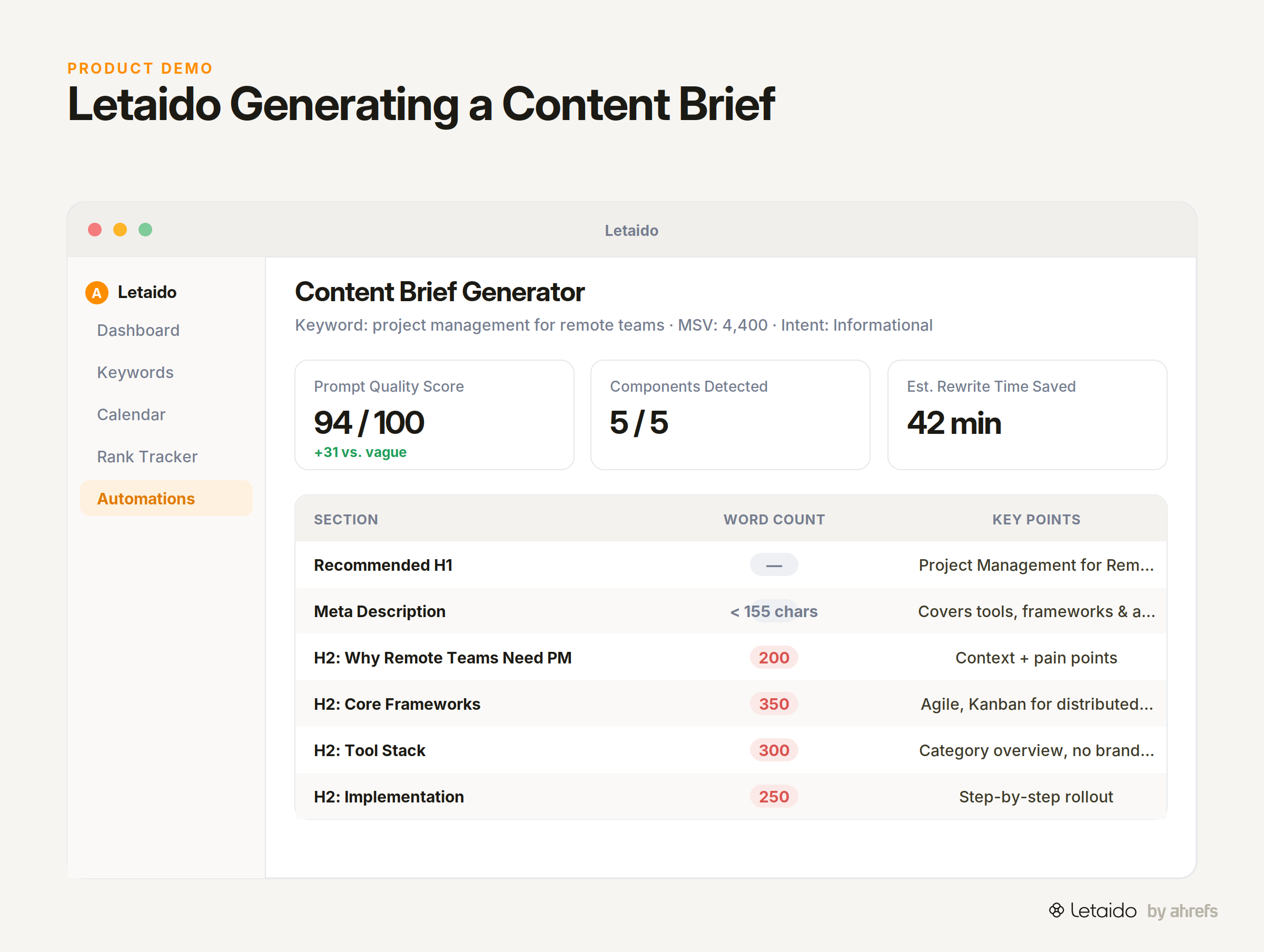
Add format and constraints — the assembled final prompt:
You are a senior content strategist working for a B2B SaaS company that sells
project management software to teams of 10–100 people.

Write a content brief for a blog post targeting the keyword "project management
for remote teams" (monthly search volume: 4,400, informational intent).

Return the brief as a Markdown document with the following sections:
- Recommended H1
- Meta description (under 155 characters)
- Target audience (2 sentences)
- H2 sections (4–5), each with a one-sentence description and suggested word count
- Primary keyword and 3 secondary keywords
- One internal linking suggestion

Constraints:
- Do not recommend any specific third-party software tools by name.
- Keep the total brief under 400 words.
- Write every section description in active voice.
That prompt produces a usable brief on the first try. The vague version does not.
The Most Common Prompting Mistakes (And How to Fix Them)
Even marketers who understand the techniques make predictable errors. Here are the five that cause the most wasted cycles.
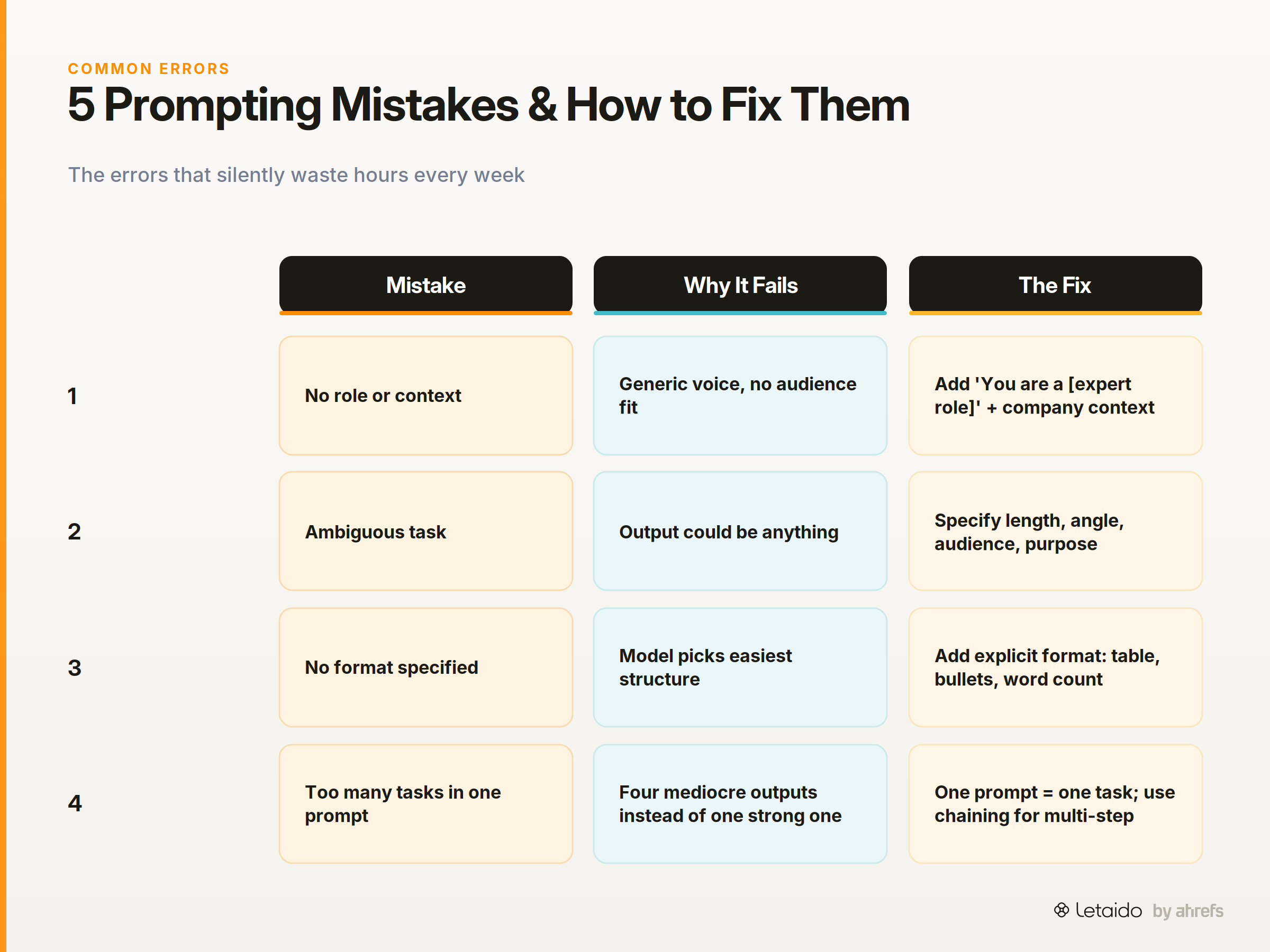
Mistake 1: No role or context.
The model defaults to a generic, middle-of-the-road voice that fits no specific audience.
❌ Write a product description for our CRM software.
✅  You are a B2B copywriter specializing in SaaS. Write a 100-word product
    description for a CRM targeting sales teams at mid-market companies.
    Tone: confident, direct, no jargon.
Mistake 2: The task is ambiguous.
"Write something about X" gives the model no signal about purpose, angle, or audience. The output could be anything.
❌ Write something about email marketing for our blog.
✅  Write an 800-word introduction section for a blog post titled "Email Marketing
    Best Practices for B2B SaaS Teams." The section should define the topic,
    explain why it matters for pipeline, and preview the four main sections of the post.
Mistake 3: No format specified.
Without a format instruction, the model picks whatever structure it finds easiest. That's rarely what you need.
❌ Summarize our Q2 content performance.
✅  Summarize our Q2 content performance in the following format:
    - 3-sentence executive overview
    - Bullet list of top 5 performing posts (title + key metric)
    - Bullet list of 3 underperformers with one-line diagnosis
    - One recommended action for Q3
Mistake 4: Too many tasks in one prompt.
Stacking four unrelated asks into a single prompt produces four mediocre outputs instead of one strong one.
❌  Write a meta description, suggest five related keywords, create a content brief,
    and draft an intro paragraph for this post.
✅  Run these as four separate prompts, or use prompt chaining:
    pass the output of each step as context into the next.
Mistake 5: No constraints, so the model goes off-brief.
Without guardrails, the model will fill gaps with assumptions — wrong tone, wrong length, off-brand recommendations.
❌ Write a comparison of project management tools for our blog.
✅  Write a 600-word comparison of project management approaches (not specific tools)
    for remote software teams. Focus on methodologies: Kanban, Scrum, and GTD.
    Do not recommend or name any commercial software products.
    Audience: engineering managers at 20–100 person companies.
Prompt Engineering vs. Fine-Tuning, RAG, and AI Agents
These terms overlap in conversation but describe different things. Here's a quick separation.
Fine-tuning means retraining a model on a specific dataset to change its default behavior. It's expensive, requires data preparation, and is done once (or infrequently). Prompt engineering achieves a similar effect — steering the model toward a specific output — without touching the model itself.
RAGRetrieval-augmented generationFetching relevant documents at query time and feeding them to the model, so answers are grounded in your own content instead of the model's memory. (Retrieval-Augmented Generation) means giving the model access to a specific knowledge base at query time. Rather than relying on training data, the model retrieves relevant documents and incorporates them into the response. RAG is an architectural choice; prompt engineering is still required to tell the model what to do with the retrieved information.
These aren't competing approaches. In most production systems, all three coexist.
Where Prompts End and Agents Begin
An AI agent is a system that takes a goal, decides how to pursue it, calls external tools (like a search index, a database, or an API), and acts over multiple steps. Prompts are the instruction layer inside that system — the agent executes them, but it doesn't replace them.
OpenAI's research on agentic systems notes that prompt-injection attacks — where malicious content in retrieved documents tries to override the model's instructions — are a real risk in agent pipelines. Well-engineered prompts include constraints that limit what the model can be redirected to do.
Microsoft Advertising's Copilot is a practical example of prompts embedded in a product workflow: advertisers use natural-language prompts to set up campaigns, generate assets, and diagnose tracking issues — all within the platform, all driven by prompt structure under the hood.
When you get prompting right, you can hand the repetitive loop to an agent. Letaido runs on exactly this principle: well-structured prompts, scheduled and always-on, with live Ahrefs data behind them. Write the prompt once; the agent runs it on your defined cadence and posts results to Slack, Notion, or wherever your team works.
Prompt Templates for Common Marketing Tasks
These are designed to be used as-is or adapted to your context. Each one follows the five-component framework: role, context, task, format, constraints.
Keyword Clustering
Use when you have a raw export from Ahrefs or Google Search Console and need to turn it into a content plan.
You are an SEO content strategist. Below is a list of [X] keywords related to [topic].

[PASTE KEYWORD LIST]

Step 1: Group these keywords by search intent: informational, commercial, transactional.
Step 2: Within each intent group, create named topic clusters of 3–8 keywords each.
Step 3: For each cluster, recommend a single primary keyword and a suggested content format
        (blog post, landing page, comparison page, etc.).

Format your response as a Markdown table with columns: Cluster Name | Intent |
Primary Keyword | Supporting Keywords | Recommended Format.
Do not include keywords that are clearly duplicates of each other.
Content Brief Generation
Use after keyword research to create a brief a writer can act on immediately.
You are a senior content strategist. Write a content brief for a blog post
targeting the keyword "[PRIMARY KEYWORD]" (search intent: [informational/commercial]).

Context: [2–3 sentences about your company, product, and target audience.]

Return a Markdown document with:
- Recommended H1
- Meta description (under 155 characters, includes primary keyword)
- Audience definition (2 sentences)
- 4–5 H2 sections, each with a one-sentence description and word count
- Primary keyword + 3–5 secondary keywords
- One internal linking suggestion

Constraints: Keep the total brief under 450 words. Use active voice throughout.
Meta Description Batch Generation
Use when you have a list of posts that need updated or missing meta descriptions.
You are an SEO copywriter. Generate a meta description for each of the following
blog post titles. Each description must:
- Be between 140–155 characters
- Include the primary keyword (listed after each title)
- End with a clear action or benefit statement
- Avoid starting with "Learn how to" or "In this article"

Posts:
1. [Title] — Primary keyword: [keyword]
2. [Title] — Primary keyword: [keyword]
3. [Title] — Primary keyword: [keyword]

Return as a numbered list matching the order above.
Competitor Summary
Use when you need a fast read on what a competitor is doing in a content area.
You are a competitive intelligence analyst. Based on the content at the following URL
[or: based on the text pasted below], summarize the competitor's content strategy
for the topic of [TOPIC].

Include:
- Their primary angle and audience
- The content structure they use (H2s and approximate length)
- 3 topics or angles they cover that we currently don't
- 2 weaknesses or gaps in their coverage

Be specific. Avoid generic observations like "they cover the basics."
Format as a bulleted report.
Monthly Report Narrative
Use to turn raw performance data into a readable summary for stakeholders.
You are a content marketing analyst writing a monthly performance summary for
a marketing director who prefers narrative over tables.

Here is the raw performance data for [MONTH]:
[PASTE DATA — e.g., top/bottom pages by sessions, keyword rank changes,
new links earned, conversions by channel]

Write a 300-word narrative summary that covers:
1. The headline result (one sentence — what was the biggest win or miss?)
2. What drove it (2–3 sentences of analysis, not just description)
3. One area of concern and why it matters
4. One recommended action for next month

Tone: Direct, specific, no padding. Write for a reader who has 90 seconds.
A note on this last template: Letaido can run it on a set schedule, pulling live data from Ahrefs and Google Search Console, and post the narrative directly to a Slack channel. No manual trigger, no copy-paste.
Build the Habit: How to Apply This Starting Today
Knowing the framework and using it consistently are different things. Here are four concrete steps to make prompt engineering part of your actual workflow, not just something you try once.
Step 1: Audit one recurring task and write a structured prompt for it today. Pick something you or your team does at least twice a month: writing briefs, drafting meta descriptions, summarizing a report. Apply the five-component framework to it. Run it. Compare the output to what you've been getting.
Step 2: Start a prompt library. A Notion page or Airtable base works well. Store your best prompts with a title, the use case, the version number, and a short note on what you changed. Treat it like code: version control matters when you're iterating.
Step 3: Iterate with notes, not instinct. When a prompt underperforms, don't just rewrite it. Note what the failure was (wrong format? wrong tone? too vague on constraints?) and change one variable. This is how you build reliable prompts rather than lucky ones.
Step 4: When a prompt runs repeatedly without variation, consider automating it. If you're running the same monthly report prompt every four weeks with the same data sources, that's not a prompt you need to run manually. That's an automation waiting to happen.
If you want to get there, Letaido is built for exactly this: take a prompt that works, connect it to live Ahrefs data and your team's tools, and let Letaido run it on whatever schedule makes sense. The prompt engineering is still your work — the agent just handles the execution.