
If you've been wondering whether AI agents for SEO actually deliver, you're not alone — the top-ranking result for this query is literally a Reddit thread of people asking the same question. So here's the direct answer: yes, AI agents can automate real SEO work today, including keyword research, content brief generation, rank monitoring, and competitive analysis. But they have genuine limits, and understanding where those limits sit is what separates a useful implementation from an expensive disappointment. This guide covers both sides honestly.
What Makes an AI Agent Different from an AI Tool
The tool-versus-agent distinction sounds like marketing vocabulary, but it describes a genuinely different execution model. Getting it clear upfront will help you assess any AI SEO agent claim you encounter.
Reactive tools wait; agents act on a plan
A conventional AI tool, including a ChatGPT prompt or a standalone keyword tool, takes your input and returns an output. One in, one out. If you want the next step, you re-prompt.
An agent works differently. It receives a goal, breaks it into sub-tasks, executes those sub-tasks in sequence, evaluates the results, and adjusts before moving to the next step. The human doesn't need to be present at each handoff. That loop — plan, act, check, loop — is what makes an agent an agent rather than a very fast assistant.
For SEO, the practical difference is whether you're running a workflow or just getting suggestions.
Why multi-step execution changes the SEO stack
When a tool gives you a keyword list, you still need to cluster it, identify gaps against competitors, prioritize by difficulty, and hand that output to someone who writes a brief. Each step is a manual handoff.
An agent can chain those steps. It queries a data source for keyword gaps, clusters by intent, checks SERPSERPThe search engine results page — the full set of organic listings, ads, and features returned for a query. structure, drafts a brief, and delivers the output to your Slack channel — without a human re-prompting at each stage. Multi-agentMulti-agent systemSeveral specialised agents working together on one job, each owning a step, coordinated by a planner or a shared workflow. systems extend this further: one agent handles research, another handles brief generation, a third monitors rankings. They pass outputs to each other via something called MCPModel Context ProtocolAn open standard for connecting AI models to external tools and data sources through one consistent interface instead of bespoke integrations. (Model Context Protocol), a standard for agents sharing context.
ChatGPT agent from OpenAI illustrates the category well. According to OpenAI, it "helps you accomplish complex online tasks by reasoning, researching, and taking actions on your behalf" — using a virtual browser, terminal access, and API connectors to complete multi-step tasks end to end. The SEO implication: an agent like this isn't generating a single response; it's running a pipeline.
What AI Agents Can Do for SEO Right Now
The honest answer is: quite a lot for high-volume, repeatable tasks. The sections below walk through the capabilities that are genuinely reliable today, with concrete examples of how they work in practice.
Keyword research and content gap analysis
Keyword research is one of the strongest use cases for agents because the task is structured, data-intensive, and repetitive. An agent can pull thousands of keywords, cluster them by topic and intent, score them by difficulty and opportunity, and flag gaps your site isn't covering — all without you running a report manually each week.
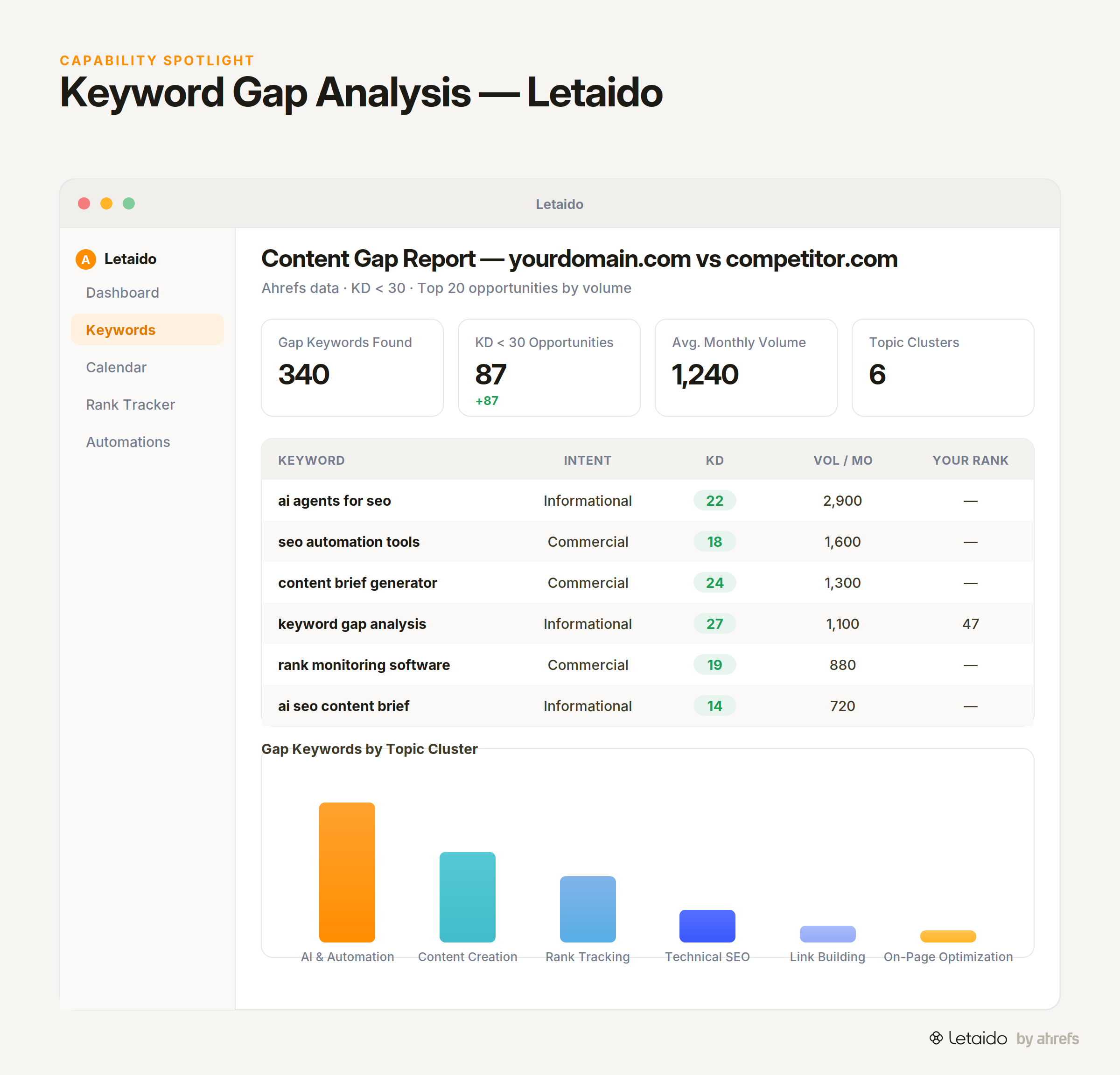
The differentiator is data source quality. Letaido pulls directly from Ahrefs data, which means you're working with the same keyword index, backlink data, and traffic estimates your SEO team already trusts, without consuming API credits on every query. The agent doesn't approximate; it queries actual Ahrefs data on your behalf.
Try this prompt:
Pull a keyword gap analysis comparing my domain [yourdomain.com] against
[competitor.com] using Ahrefs data. Cluster the gaps by topic and intent,
score by keyword difficulty under 30, and summarize the top 20 opportunities
in a table with estimated monthly volume and current ranking position for
each keyword.
KWHero takes a similar structured approach as a standalone tool: it analyzes keywords, entities, and subtopics to generate content plans and briefs. As one Trustpilot reviewer noted, "KWHero is easy to use even for beginners yet it also has some advanced features that seasoned SEO professional will enjoy." The difference between a tool like KWHero and a true agent is that the agent keeps running after the initial analysis — it re-runs the gap check weekly and alerts you when a competitor starts ranking for something new.
Content brief generation from live SERP data
An agent generating a content brief from live SERP structure is meaningfully different from an AI tool generating a template. The agent reads what's actually ranking — the headings, entities, question coverage, and content structure of the top 10 results — and builds a brief grounded in that data, not in a generalized content framework.
Claude Code from Anthropic shows what this looks like in practice. One practitioner on Reddit described the output this way: "it generated meta descriptions, title tags, and even suggested specific h2s and h3s that made way more sense than what i had." That's a general-purpose coding agent applied to SEO — the output quality comes from analyzing actual page structure, not from a prompt template.
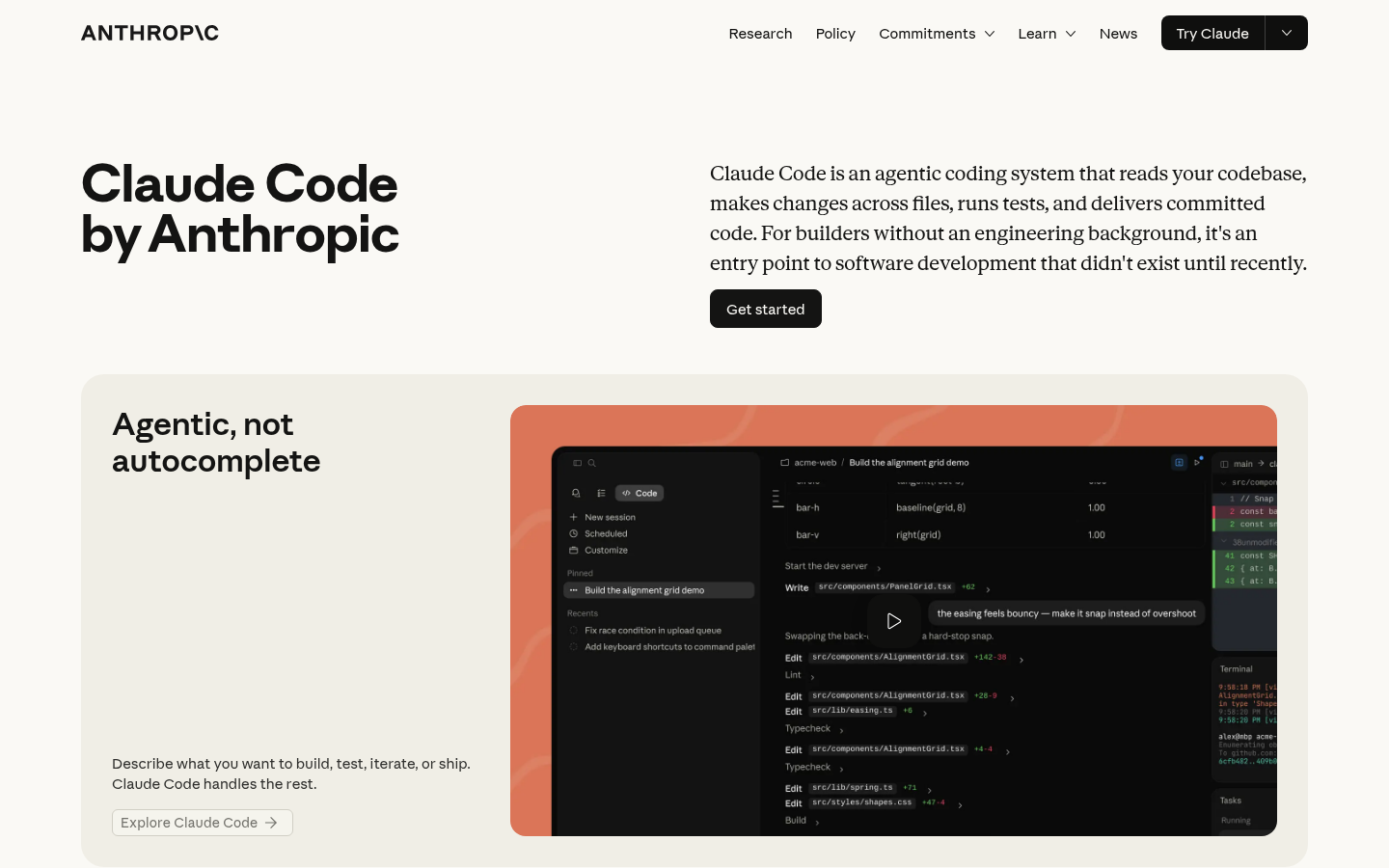
Agencies have taken this further. Duotach built a full internal system using Claude Code agents to automate SEO, GEO, and AEO workflows across multiple clients. Their stated goal was "to create an internal system to offer SEO, GEO (Generative Engine Optimization) and AEO (Answer Engine Optimization) services in a standardized way for multiple clients" — a clear example of an agentic pipeline replacing a manual briefing process at scale.
Letaido applies the same principle with an Ahrefs-backed foundation. Try this prompt to get started:
Analyze the top 10 SERP results for [target keyword] and generate a
content brief that includes: recommended title, meta description, H1,
H2/H3 structure, key entities to cover, questions to answer, and
internal linking opportunities from my existing content at [yourdomain.com].
Rank monitoring and threshold alerts
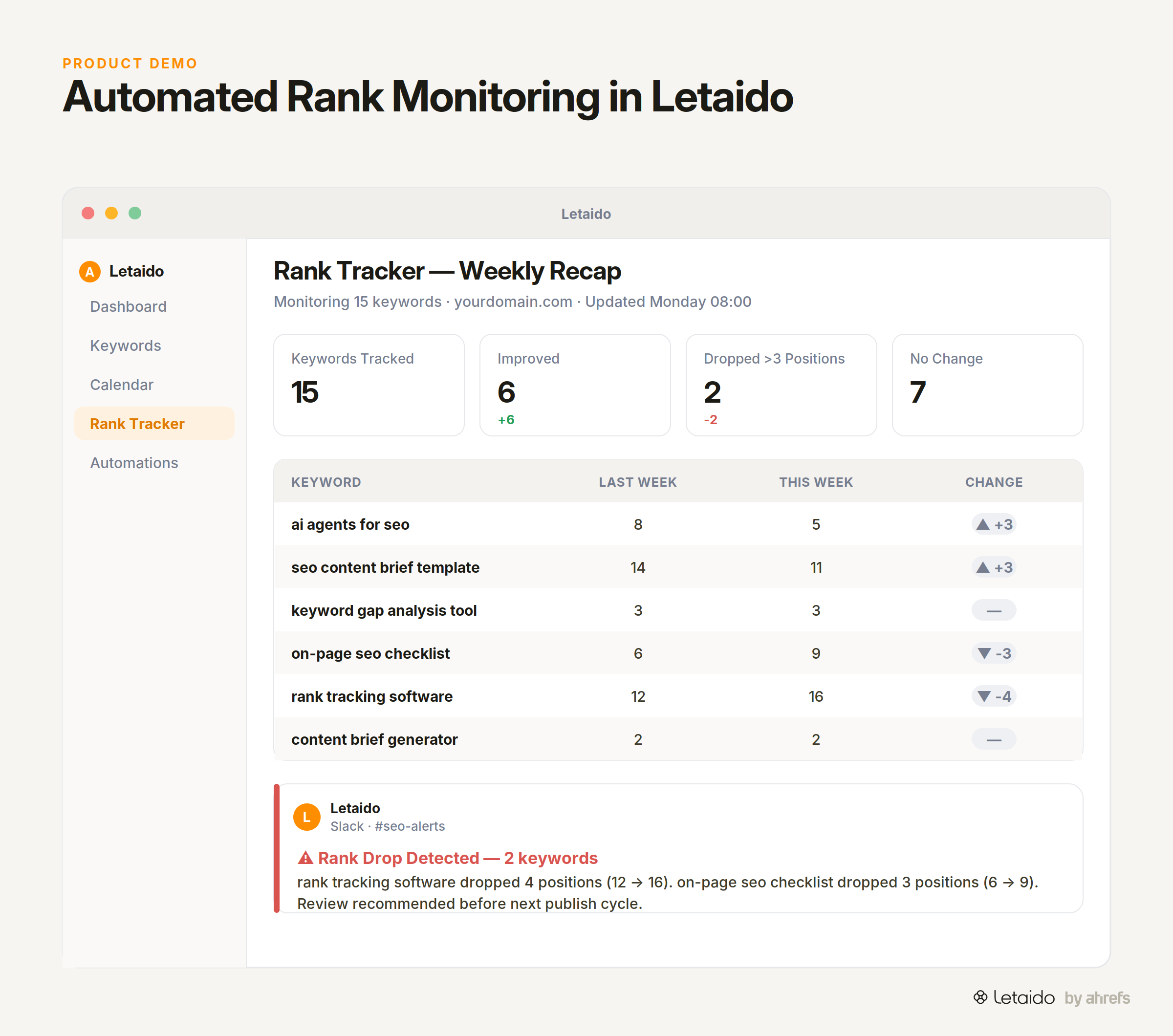
Manual rank checking is a solved problem — agents handle it better than humans by definition, because they don't forget and they don't need to be asked. An agent can monitor a set of target keywords daily, compare current positions against a baseline, and send a Slack alert the moment a page drops below a threshold you define.
Google Search Console remains the canonical free data source for indexing and performance data, and the Search Console API makes that data programmatically accessible. As the API documentation notes, "The Google Search Console API has usage limits for Search Analytics, URL inspection, and all other resources to ensure fair access" — which means high-volume monitoring at scale requires planning around those quota constraints.
Letaido's scheduled automations handle this directly. You set the keywords, the alert threshold, and the delivery channel, and the agent runs the check on whatever cadence you specify. Because Letaido has a native Slack connector, the alert goes directly into your team's workflow channel rather than a report nobody opens.
Try this prompt:
Set up weekly rank monitoring for the following 15 keywords on [yourdomain.com].
Alert me in Slack (#seo-alerts) if any page drops more than 3 positions
week-over-week, and send a Monday morning recap of overall rank movement
with a table showing position changes.
On-page optimization and AI visibility tracking
On-page optimization is where agents add the most value incrementally. An agent can score a page against its target keyword, flag entity gaps, suggest schema markup, and identify thin sections — then queue those recommendations for human review rather than publishing changes autonomously.
A newer and increasingly important layer is AI visibility tracking: monitoring whether your brand and pages appear in AI-generated answers from ChatGPT, Perplexity, or Google's AI Overviews. This is a genuinely emerging capability that most traditional SEO tools weren't built for.
LightSite AI is one specialized agent built specifically for this layer. It scans LLM brand presence and citation share, deploys machine-readable AI SEO infrastructure (JSON-LD, AI sitemaps, Skills API endpoints), and identifies backlink and listicle opportunities to improve AI search visibility. One verified G2 reviewer in marketing and advertising noted: "LightSite AI helps us do something most platforms still do not handle well: improve real AI search visibility, not just track mentions." That distinction — acting on visibility rather than just reporting it — is what makes it agentic.
Letaido can monitor AI brand mentions as a scheduled automation, flagging when your brand appears or disappears from AI answers and surfacing opportunities to improve citation share.
What AI Agents Still Can't Do Well
This section matters. The limits are real, and understanding them is what makes an implementation actually work rather than producing confident-sounding garbage.
Factual hallucinationHallucinationA confident, fluent model output that is simply false. It's a property of next-token prediction, not a bug to be patched out. in briefs and analysis. Agents working without grounded data sources can invent keyword volumes, misattribute competitor rankings, or generate plausible-sounding but incorrect entity relationships. This is why data source quality matters so much — an agent pulling from Ahrefs is working with verified data; an agent generating keyword ideas from model weights alone is guessing.
Nuanced technical SEO remediation. An agent can flag a crawl error or identify a broken link. It can run a site audit and surface a list of issues. What it can't reliably do is tell you whether a 404 should be redirected, left alone, or fixed at the server level — that call requires understanding site architecture, link equity, and business context. Human review before action is non-negotiable for technical fixes.
E-E-A-TE-E-A-TGoogle's quality framing — experience, expertise, authoritativeness, trust — used by its raters to judge whether content deserves to rank. signals and lived expertise. Google's quality guidelines weight Experience, Expertise, Authoritativeness, and Trustworthiness — signals that require real credentials, original research, and first-person experience. An agent can structure content correctly and cover the right entities, but it can't supply the expert perspective that makes content genuinely credible. That layer requires a human author or editor.
Brand voice consistency. Agents drift. Even well-prompted agents will gradually shift tone, vocabulary, and style across a content program. Human editing at the brief-to-draft stage catches this; skipping that step compounds the drift over time.
The honest framing: these are current limits, not permanent ones. The gap between "flags the issue" and "resolves the issue correctly" is closing. But it hasn't closed yet.
A Real Agentic SEO Workflow: How Letaido Does It
Rather than describing what agents can theoretically do, here's a concrete workflow that Letaido runs end to end today. It covers the full pipeline from data pull to human sign-off.
From keyword gap to published brief, step by step
Step 1: Keyword gap pull. Letaido queries Ahrefs for keywords where a named competitor ranks in positions 1–10 and your domain does not. It filters by keyword difficultyKeyword DifficultyAn estimate (0-100) of how hard it is to rank on page one for a keyword, based mainly on the backlinks the current top pages hold. (KD under 30 by default) and estimated monthly volume, then returns a prioritized list.
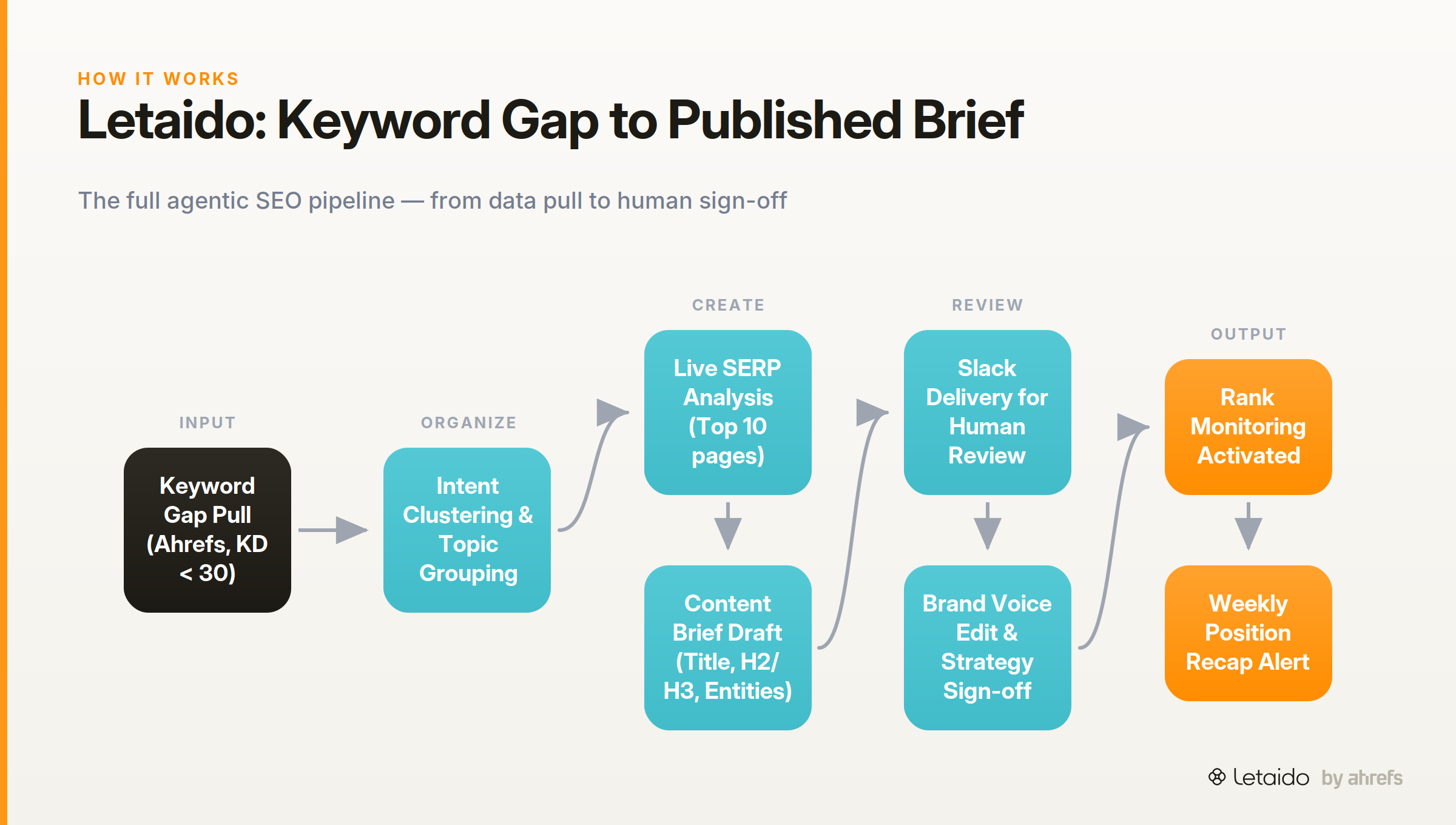
Step 2: Intent clustering. The agent groups the gap keywords by search intent — informational, navigational, commercial, transactional — and by topic cluster, so the output isn't a flat list but an organized content roadmap.
Step 3: SERP-grounded brief generation. For the highest-priority cluster, the agent reads the live SERP — top-ranking page structures, featured snippet format, entity coverage, related questions — and generates a brief. The brief includes a recommended title, meta description, H2/H3 outline, key entities, and internal linking opportunities from existing pages on your domain.
Step 4: Slack delivery for human review. The brief posts to a designated Slack channel. A human reviews it, makes brand-voice and strategy edits, and approves or rejects it. Nothing moves to production without that sign-off.
Step 5: Rank monitoring activation. Once the content is published, Letaido adds the target keywords to the monitoring queue, sets the alert threshold, and sends a weekly position recap.
What runs automatically and what needs a human
| Task | Automated by Letaido | Human Required |
|---|---|---|
| Keyword gap pull from Ahrefs | Yes — runs on schedule | No |
| Intent clustering and prioritization | Yes | Light review |
| SERP structure analysis | Yes | No |
| Content brief draft | Yes | Brand voice edit + strategy sign-off |
| Internal link suggestions | Yes | Confirm accuracy |
| Rank monitoring and Slack alerts | Yes — runs continuously | No |
| Weekly position recap | Yes | No |
| Technical SEO remediation decisions | No | Yes — always |
| Final publish decision | No | Yes — always |
The pattern: everything that's data-retrieval, structuring, or monitoring is automated. Everything that requires judgment, expertise, or brand context stays with a human.
Manual Workflow vs. Agent-Assisted Workflow: A Time Comparison
The efficiency case for AI agents in SEO isn't about replacing headcount. It's about what a two-person SEO team can produce with an agent versus without one.
| Task | Manual time + tools | Agent-assisted time | What the agent produces |
|---|---|---|---|
| Keyword gap analysis | 2–3 hours (export, filter, cluster manually) | 10–15 minutes | Prioritized gap list, clustered by intent, with KD and volume |
| Content brief generation | 1–2 hours per brief (SERP analysis + outline) | 20–30 minutes (human review) | Full brief with outline, entities, meta, internal links |
| Weekly rank check (50 keywords) | 30–45 minutes | 0 minutes active, 5 minutes reviewing the report | Automated position table with week-over-week delta, Slack alert on drops |
| Competitor snapshot | 1–2 hours (manual checks across data sources) | 15–20 minutes | Structured report: competitor keyword gains, new backlinks, content changes |
The cumulative time saving on those four tasks alone is roughly 5–8 hours per week for a single team member. More meaningfully, the monitoring tasks happen continuously — the agent catches a ranking drop at 2am; you see it Monday morning in Slack.
How to Get Started with an AI SEO Agent
Starting with everything at once is the fastest way to lose confidence in the agent. Here's a sequenced approach that builds trust incrementally.
What to automate first
Start with rank tracking and threshold alerts. It's the lowest-risk automation: the agent monitors and reports; it doesn't generate or publish anything. You get immediate value (no more manual rank checks) and you see whether the agent's data matches your expectations before trusting it with more complex tasks.
After two to four weeks of reliable monitoring, add keyword gap analysis on a weekly schedule. Review the output a few times manually to calibrate your confidence in the clustering logic before acting on it directly.
Brief generation comes third. It involves more judgment, so you'll want to establish a clear review workflow before making it part of a regular content production cycle.
How to evaluate any AI SEO agent
Use this checklist when assessing any AI SEO agent, including Letaido:
- Data source quality: Does it pull from verified first-party data (Ahrefs, Google Search Console) or synthesize from model weights?
- Scheduling capability: Can it run tasks on a defined cadence without manual triggering?
- Human-review checkpoints: Does the workflow include explicit approval steps before any output goes to production?
- Native integrations: Does it connect to the tools your team already uses — Slack, Notion, HubSpot, Linear?
- Model flexibility: Can it use different AI models for different tasks (reasoning-heavy vs. speed-optimized) rather than locking you into one?
- Audit trail: Can you see what the agent did, what data it accessed, and what decisions it made?
Ahrefs-native data access is a meaningful differentiator on the first point. An agent describing keyword opportunities from general training data is guessing. An agent querying live Ahrefs data is working with the same numbers your team uses to make strategy decisions.
Fitting an agent into your existing SEO stack
Google Search Console stays as your canonical source of truth for indexing, crawl coverage, and click performance directly from Google. The agent augments it, pulling GSC data via the Search Console API for programmatic access to performance trends — then layers Ahrefs data on top for competitive context that GSC can't provide.
The integration that closes the loop is Slack. Letaido delivers briefs, rank alerts, weekly recaps, and audit findings directly to team channels. If your workflow runs through Notion for content planning or HubSpot for campaign tracking, Letaido's native connectors push outputs to those systems automatically. The goal is that agent output arrives where your team already works, rather than requiring anyone to log into a new dashboard.
Common Questions About AI SEO Agents
Will Google penalize AI-assisted SEO content? Google's guidance focuses on content quality and E-E-A-T signals, not the production method. Agent-generated briefs, outlines, and research are tools; the quality of the final content is what matters. The risk isn't using an agent — it's publishing agent output without human review, which shows.
Can an agent replace an SEO professional? Not today. An agent handles volume and repetition well; an SEO professional handles strategy, client relationships, editorial judgment, and the nuanced calls that require context an agent doesn't have. The realistic near-term scenario is one SEO doing the work of a larger team, with agents handling the high-volume repeatable layer.
How accurate is agent-generated keyword data? It depends entirely on the data source. Agents working from live Ahrefs data are as accurate as Ahrefs data. Agents synthesizing keyword ideas from language model weights should be treated as directional suggestions, not data points to act on directly.
What does this actually cost? Letaido is $99/month flat, which includes $50 in AI credits. You'll need an Ahrefs subscription to access Ahrefs data pulls; the agent itself doesn't add a per-query cost on top of that. For teams already paying for Ahrefs, the incremental cost is the agent layer only.
What happens when the agent gets something wrong? The answer is your review process. Agents produce outputs; humans validate before acting. Build explicit approval steps into every workflow that produces content or recommendations that go public. This isn't a workaround for a broken system — it's the correct operating model for any agent-assisted workflow today.
Does the agent work if I don't have an Ahrefs subscription? Yes, for tasks that don't require Ahrefs data: rank monitoring via Google Search Console, content brief generation from SERP analysis, Slack automations, and scheduled recaps all work without it. The keyword gap and competitive analysis capabilities that use Ahrefs data require an active subscription.
Where This Leaves You
AI agents for SEO are genuinely useful today — not as a replacement for SEO judgment, but as a force multiplier for the high-volume, repeatable work that consumes most of a team's time. Keyword gap analysis, brief generation, rank monitoring, and competitor snapshots are all better as automated, scheduled processes than as manual weekly tasks.
The limits are real too: hallucination risk, technical SEO judgment calls, E-E-A-T, and brand voice all require a human in the loop. That's not a reason to wait — it's a reason to design your workflow with explicit review steps.
The lowest-risk way to start is a single workflow: set up rank tracking and Slack alerts on your target keywords, let it run for a month, and see whether the data matches your expectations. If it does, you'll know where to expand next.
Try Letaido on one workflow before you commit to a full setup. The keyword gap analysis or rank monitoring workflow takes about 15 minutes to configure.