
You paste a single prompt asking the AI to research ten competitor pages, identify content gaps, and write a full brief. The output comes back 90 seconds later. It's… fine. The research is shallow, the gap analysis misses three obvious angles, and the brief reads like it was written by someone who skimmed the research instead of doing it.
The problem isn't the model. It's the task structure.
Split that same job into three focused steps — research first, gap analysis second, brief last — and each output improves dramatically. That structure has a name: prompt chaining. This article explains what it is, why it works, and how to build one for marketing tasks you run today.
What Prompt Chaining Is
Prompt chaining is a technique where you run a sequence of prompts, and the output of each step becomes the input of the next. Instead of asking one prompt to do everything, you break the work into stages, each with a single, scoped job.
Here is how it differs from two things it's often confused with.
A long system promptSystem promptThe standing instruction that sets a model's role, rules, and tone for an entire session, separate from the user's individual messages.Read: System Prompts: What They Are and How to Write Them is a single call with detailed instructions. Everything happens in one inference; the model balances all the instructions simultaneously, which is exactly where quality degrades on complex tasks.
A conversation thread is interactive: you prompt, the model responds, you read the output and decide what to ask next. Prompt chaining can be done manually in a chat interface, but it's defined by the structure, not the interface. The key is that each step's output is deliberately formatted and injected into the next prompt as structured context, not just left as chat history for the model to scroll through.
Why Chaining Produces More Reliable Output
The reliability argument is simple: one step, one job. When a model only has to do one thing, it does that thing better.
Models produce weaker output when they're asked to switch reasoning modes mid-task — from factual retrieval to pattern analysis to creative synthesis, all in one call. Chaining separates those modes into distinct steps, reducing the chance that the model shortcuts or drifts (produces confident-sounding but inaccurate content) because it's juggling too much context at once.
Here's the basic flow:
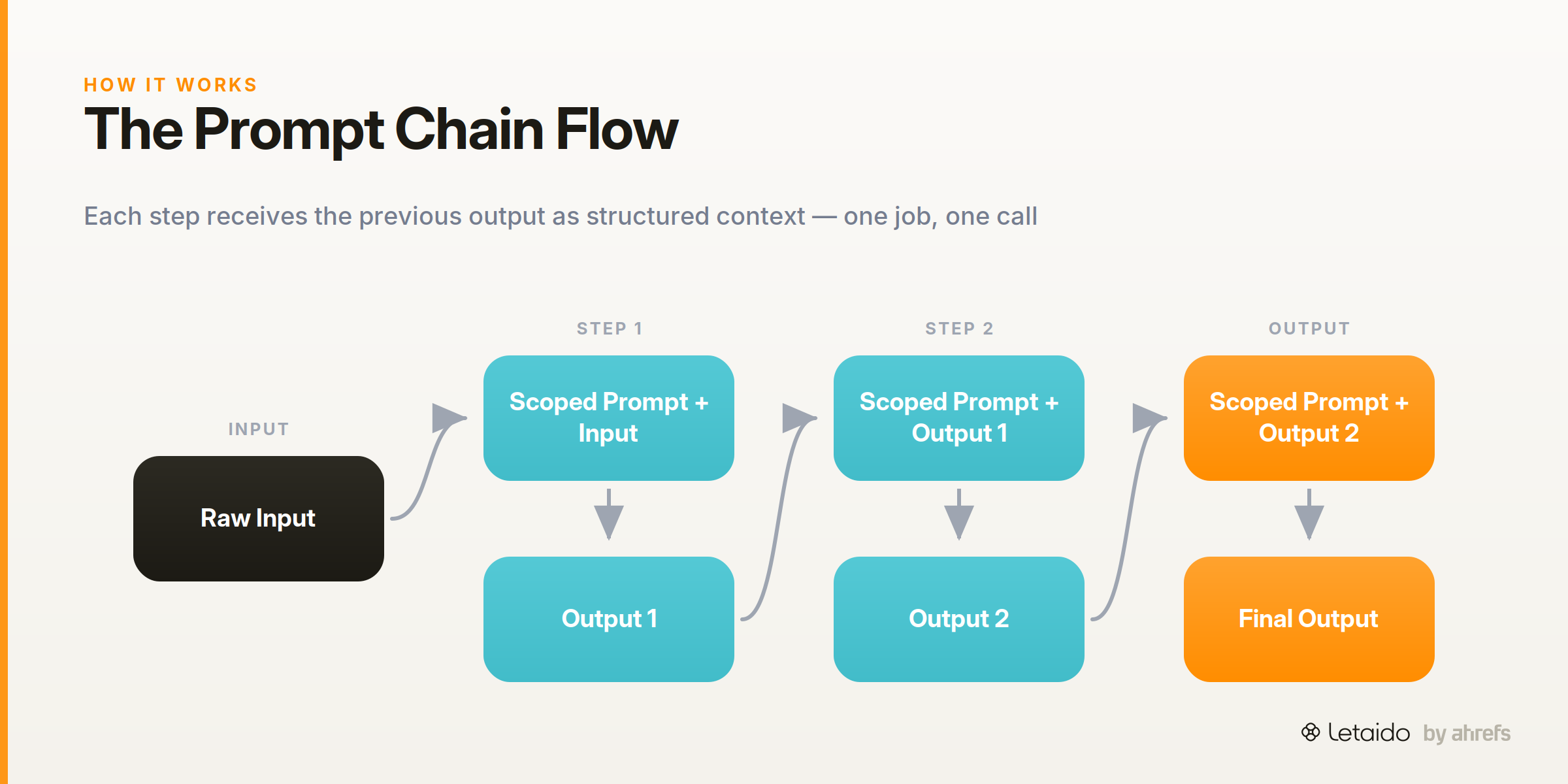
Raw Input
    ↓
[Step 1 Prompt: scoped instruction + input]
    ↓
Output 1
    ↓
[Step 2 Prompt: scoped instruction + Output 1 injected as context]
    ↓
Output 2
    ↓
[Step 3 Prompt: scoped instruction + Output 2 injected as context]
    ↓
Final Output
Each arrow represents a deliberate handoff — you control exactly what passes from one step to the next.
You can also add a gate step between stages. A gate is a validation prompt that checks whether the previous output meets your criteria before it passes forward. For example: "Review this list of topic clusters. Flag any that are too broad to cover in a single article. Output only the clusters that pass." If the gate catches a problem, you fix it at that step rather than discovering it after the final output is already wrong.
Anatomy of a Prompt Chain Step
Every step in a well-built chain has three elements. Understanding them makes the difference between a chain that works and one that breaks at step two.
Scoped instruction. One clear task. Not "research and analyse and summarise" — pick one verb. The instruction tells the model exactly what to do and nothing else.
Injected context from the prior output. This is the structured handoff. You paste (or programmatically insert) the previous step's output into a clearly labelled section of the next prompt. Label it explicitly: "Here is the keyword list from the previous step:" so the model knows what role it plays.
Defined output format. Tell the model exactly how to structure its response — a numbered list, a JSON object, a table with specific columns, a set of labelled paragraphs. Format discipline is critical because the next prompt in your chain needs to parse that output reliably. If the model returns a prose paragraph when you expected a bulleted list, your next prompt's instruction ("for each item in the list below...") breaks immediately.
When to Chain vs. When One Prompt Is Enough
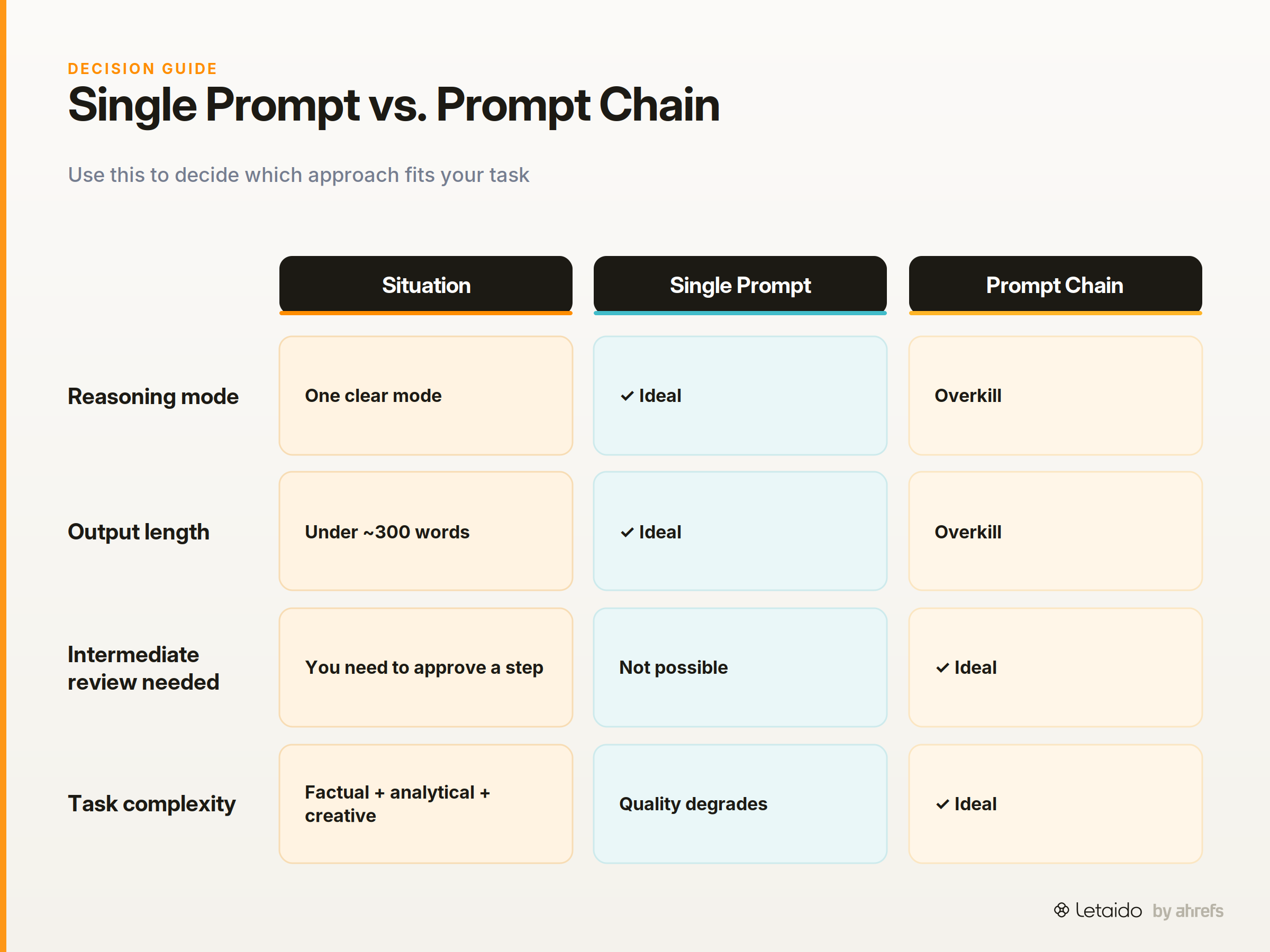
Not every task needs a chain. Use this table to decide.
| Situation | Single prompt | Prompt chain |
|---|---|---|
| Task has one clear reasoning mode | ✓ | |
| Output is short (under ~300 words) | ✓ | |
| You need to review or approve an intermediate result | ✓ | |
| Task involves switching between factual, analytical, and creative thinking | ✓ | |
| Output quality degrades in a single-prompt version | ✓ | |
| You need a reliable, repeatable result across runs | ✓ |
A quick rule of thumb: if your prompt contains more than two distinct verbs describing different types of work ("research and then prioritise and then write"), it probably belongs in a chain.
Three Marketing Chains You Can Run Today
The best way to understand prompt chaining is to see the actual prompt text at each step. Here are three chains built for common marketing tasks.
Chain 1: Keyword List → Topic Clusters → Content Brief
Step 1 — Cluster the keywords
You are an SEO strategist. Here is a list of 40 keywords:
[paste keyword list]

Group these keywords into topic clusters. Each cluster should share
a clear search intent. Output a numbered list of clusters. Each cluster:
- Has a descriptive name (5 words max)
- Lists the 3–5 most relevant keywords from the input
- Has one sentence describing the target audience for that cluster
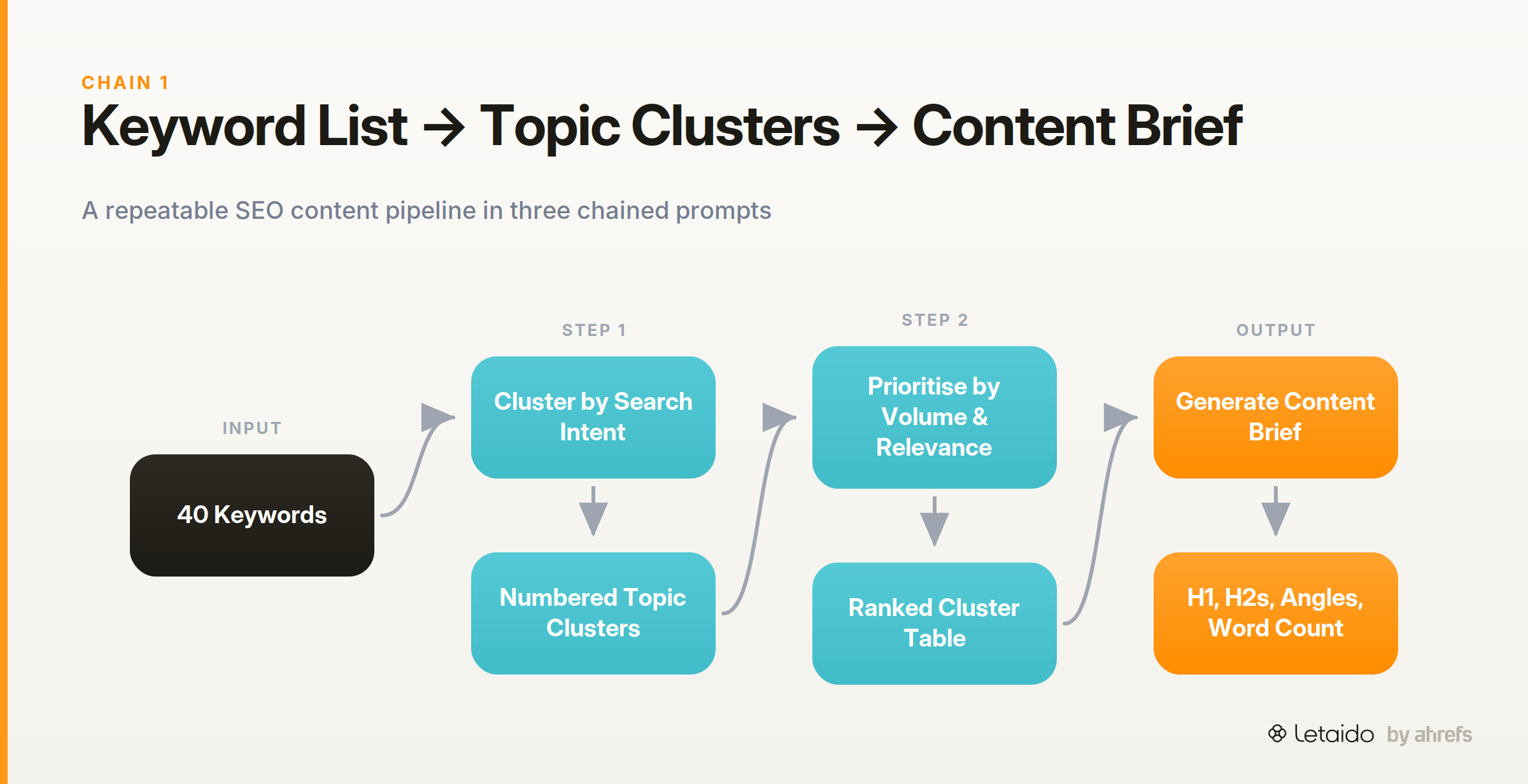
Step 2 — Prioritise the clusters
Here are the topic clusters from the previous step:
[paste Step 1 output]

Rank these clusters from highest to lowest priority based on:
1. Likely search volume (higher = better)
2. Relevance to a B2B SaaS audience focused on marketing operations
3. Whether the topic is timely or evergreen

Output a ranked table with three columns: Rank, Cluster Name, One-line rationale.
Step 3 — Generate a content brief
Here is the top-priority topic cluster:
[paste the #1 ranked cluster from Step 2]

Write a content brief for an article targeting this cluster. Include:
- Recommended H1
- Target reader (one sentence)
- Three H2 sections with a one-sentence description each
- Three competitor angles to differentiate from
- Suggested word count

Output in the format above, using labelled sections.
Chain 2: Raw Analytics Data → Key Insights → Executive Summary
Step 1 — Extract insights from the data
Here is a table of organic traffic data for the past 90 days:
[paste data: page URL, sessions, conversion rate, avg position]

Identify the five most significant patterns or anomalies. For each one,
write a single sentence describing what is happening and which pages
or metrics are involved. Output as a numbered list.
Step 2 — Build the executive summary
Here are five insights about our organic traffic performance:
[paste Step 1 output]

Write a 150-word executive summary suitable for a CMO who does not
work in SEO day-to-day. Use plain language. Lead with the most
important finding. End with one recommended action. Do not use
jargon or reference specific URLs — describe the content category instead.
Chain 3: Competitor URL → Gap Analysis → Positioning Angle
Step 1 — Analyse the competitor page
Here is the content from a competitor's pillar page on [topic]:
[paste scraped text]

Identify:
1. The primary claim or positioning the page makes
2. Three topics it covers in depth
3. Three topics it mentions briefly or ignores entirely
4. The target reader it appears to be written for

Output as a labelled list with those four sections.
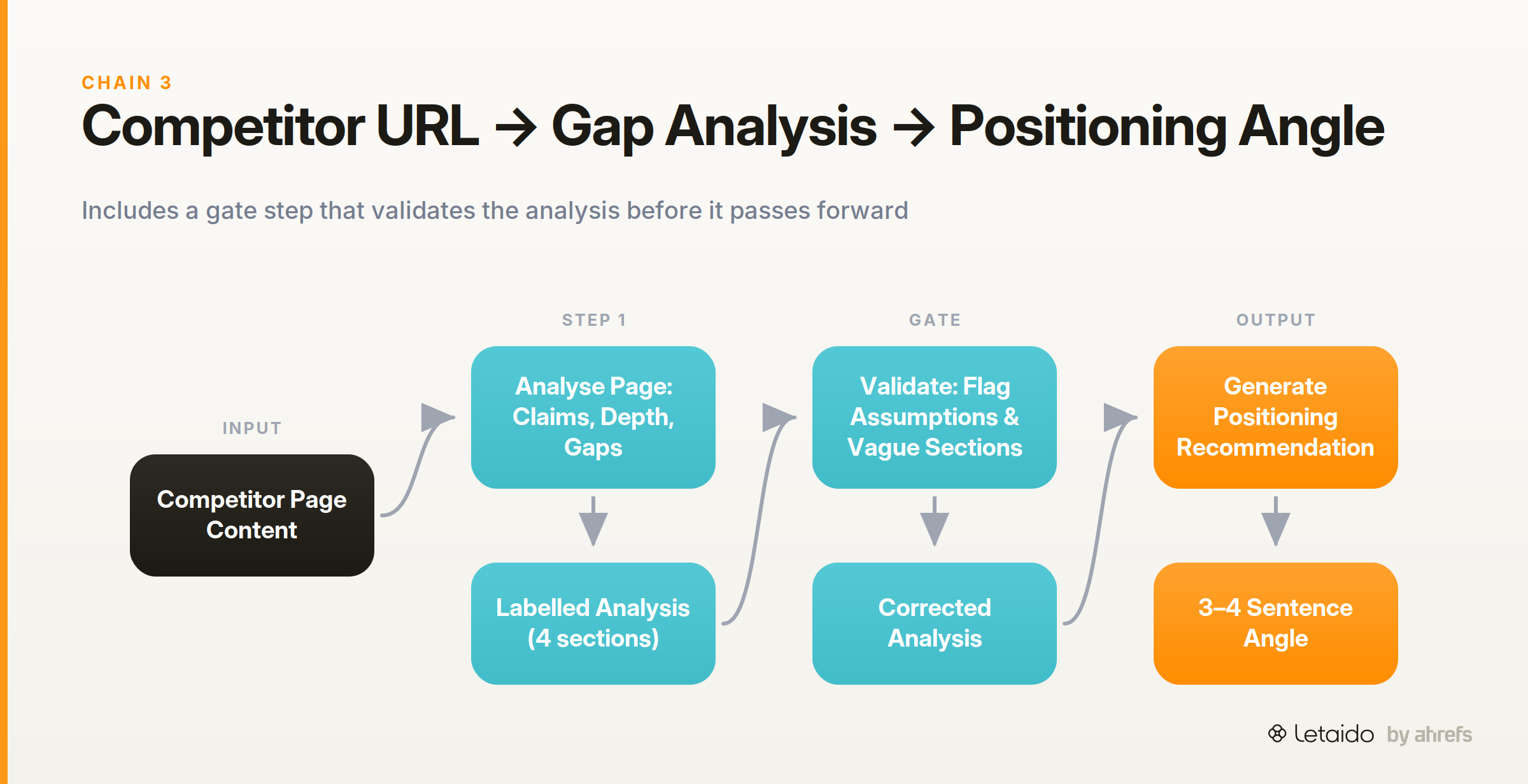
Step 2 — Gate: check the analysis quality
Here is an analysis of a competitor page:
[paste Step 1 output]

Review the analysis. Flag any section that:
- Makes an assumption not supported by the content
- Is too vague to act on

Rewrite any flagged sections with a more specific or evidence-based observation.
Output the corrected analysis in the same format.
Step 3 — Generate a positioning recommendation
Here is a verified analysis of a competitor page:
[paste Step 2 output]

We are a B2B SaaS company selling to marketing ops teams. Based on
the gaps and audience mismatches in this analysis, write one positioning
recommendation (3–4 sentences) that explains how our content on this
topic should differ from the competitor's. Be specific about the angle,
the audience, and the format.
Common Failure Modes and How to Fix Them
Even well-designed chains break in predictable ways. Here are the three most common problems and what to do about them.
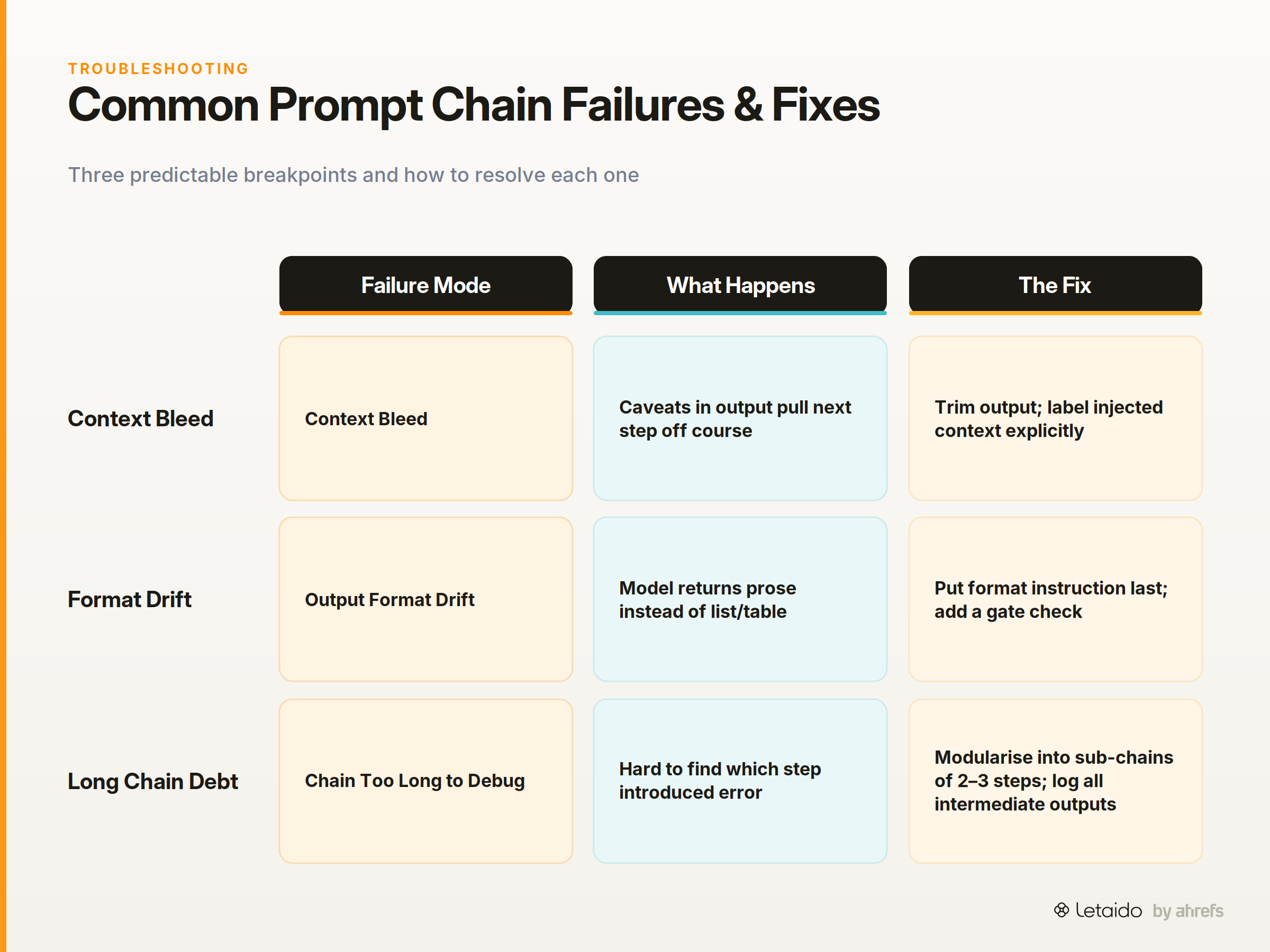
Context Bleed Between Steps
Context bleed happens when the previous output contains irrelevant content that pulls the next step off course. For example, if Step 1 returns a long analysis with caveats and disclaimers, the model in Step 2 may spend tokensTokenThe unit models actually read and generate — roughly a word-piece. Context limits and API pricing are both measured in tokens. reasoning about those caveats instead of the actual task.
The fix is to trim or summarise the injected output before passing it forward. Add an explicit instruction: "Use only the numbered list below as your input. Ignore any surrounding explanation." Alternatively, structure your Step 1 output format so there's no surrounding explanation to begin with.
Output Format Drift
Output format drift is when the model ignores your format instruction and returns prose when you asked for a table, or a paragraph when you asked for a list. The downstream prompt then fails to parse the input correctly.
The fix is twofold: make the format instruction the last line of your prompt (models weight recency), and add a brief gate prompt that checks format before the output passes to the next step. The gate can be a single sentence: "Confirm the output above is a numbered list with exactly five items. If not, rewrite it."
Chains That Grow Too Long to Debug
Past five or six steps, chains become hard to troubleshoot. When the final output is wrong, it's unclear which step introduced the error.
The fix is to modularise: treat groups of two to three steps as a sub-chain, test each sub-chain independently before connecting them, and log every intermediate output so you can inspect the handoffs. If a chain is growing past six steps, it's often a signal that it should be split into two separate chains with a human review point in between.
How to Build a Prompt Chain Right Now
There are three practical paths, each with a different trade-off between effort and scale.
Manual Method: Copy-Paste in ChatGPT or Claude
The simplest approach: run Step 1, copy the output, paste it into a clearly labelled section of your Step 2 prompt, run that, and repeat. This works well for testing a chain before automating it.
The trade-off is that it doesn't scale. Every run is manual, and human copy-paste introduces formatting errors. Use the manual method to validate your chain structure and prompt quality, then move to automation once it's reliable.
No-Code Workflow Tools
General-purpose workflow tools (such as Zapier, Make, or n8n) let you connect AI calls in a sequence, passing outputs from one step to the next as variables. You define the prompts, set the data flow, and trigger the workflow on a schedule or event. This is the middle path: more reliable than manual, less specialized than a dedicated agent.
Automated Agents That Run Chains on a Schedule
If you want a chain to run continuously without your involvement, a dedicated AI agent is the right tool.
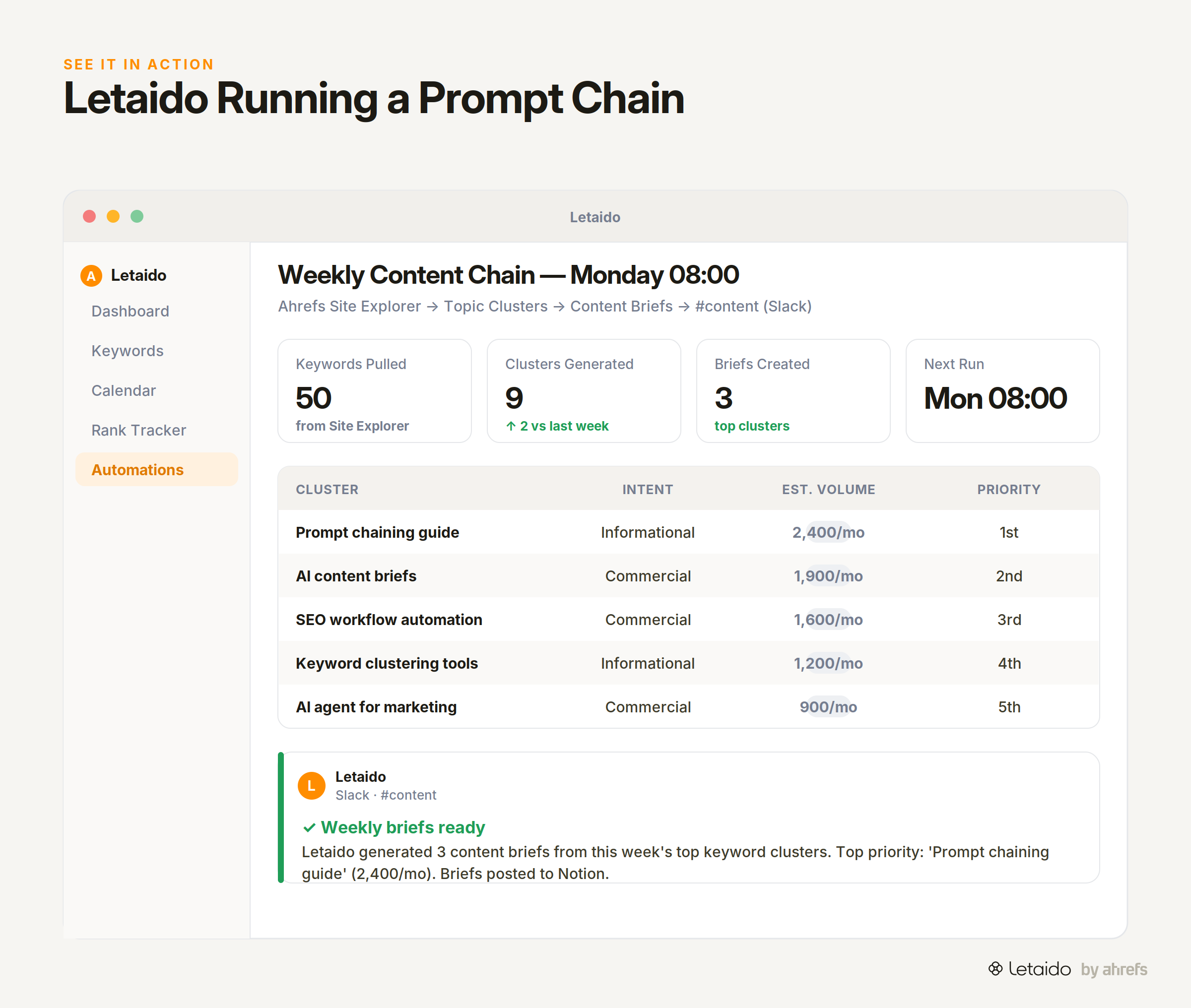
Letaido runs chained marketing workflows automatically using live Ahrefs data — keyword research into clustering into brief generation, site audit data into an insight summary, rank changes into a Slack alert — on whatever cadence you set. You define the chain once; Letaido handles every run, every handoff, and every output.
Try this prompt to get started:
Build me a three-step chain that:
1. Pulls the top 50 keyword opportunities from Ahrefs Site Explorer for [domain]
2. Clusters them by topic and intent
3. Generates a one-paragraph content brief for the top three clusters

Run this every Monday and post the briefs to our Slack #content channel.
Start a Letaido trial to run this chain with live Ahrefs data, no API limits.
Prompt Chaining vs. Related Concepts
If you arrived searching for a related term, here's how prompt chaining sits alongside the techniques it's most often confused with.
| Concept | What it is | Key difference from chaining |
|---|---|---|
| Prompt engineering | Crafting individual prompts for better output | Single-prompt focus; chaining is a structural technique that sits on top |
| RAG (Retrieval-Augmented Generation) | Fetching relevant documents and injecting them into a prompt at runtime | About data sourcing, not task sequencing; chains often use RAG as one step |
| Multi-agent systems | Multiple AI agents working in parallel or handing off to each other | Agents are autonomous actors; chaining is a deterministic, sequential structure that an agent might run internally |
| Single prompt | One instruction, one model call, one output | No handoffs; best for simple or low-stakes tasks |
Keep Complexity Out, Scope In
The core insight behind prompt chaining is straightforward: AI models are good at focused tasks and unreliable at sprawling ones. Chaining doesn't make models smarter. It makes the task structure honest about what each step actually requires.
Start with your next complex AI task. Find the points where you're asking the model to switch reasoning modes, and cut the task at those seams. That's your chain.
If you'd rather have an agent build and run those chains automatically, Letaido is worth a look.