
Chain-of-thought prompting (CoT) is a technique where you instruct an AI model to show its reasoning process before giving a final answer. Instead of jumping straight to a conclusion, the model walks through intermediate steps, which produces more accurate and auditable outputs on complex tasks.
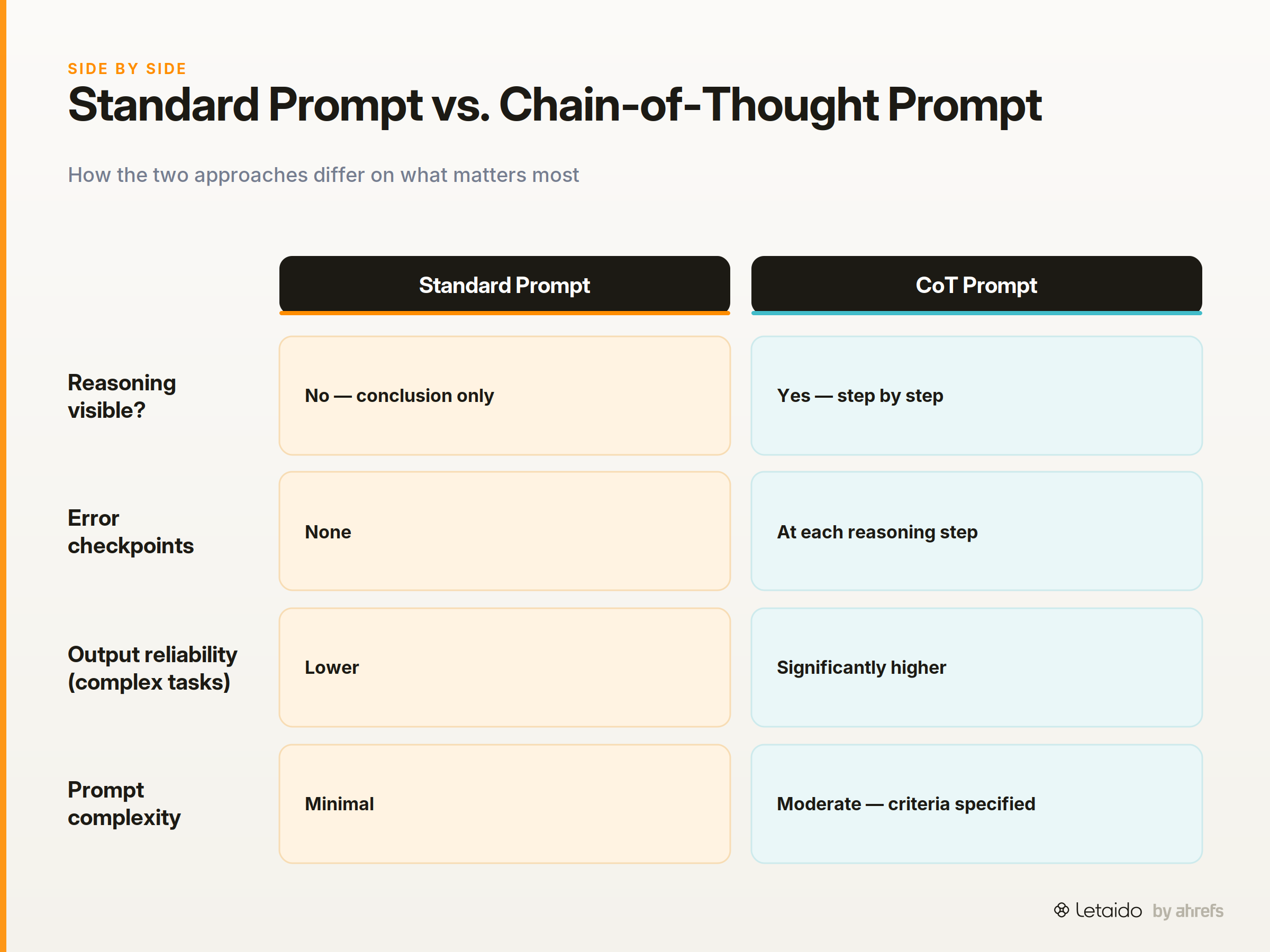
The difference in output quality can be significant. Here's what the technique looks like in practice, and how to apply it to real marketing work.
What Chain-of-Thought Prompting Is
At its core, CoT prompting is a way of asking a model to think out loud. You either tell it explicitly to reason through a problem step by step, or you show it examples of reasoning in your prompt. Either way, the model generates a chain of intermediate steps before reaching its answer, rather than producing a direct response.
This matters because language models generate text one tokenTokenThe unit models actually read and generate — roughly a word-piece. Context limits and API pricing are both measured in tokens. at a time. When they jump straight to an answer, they commit to a direction early and are more likely to get complex reasoning wrong. Showing the work keeps the logic visible and correctable.
Standard prompt vs. CoT prompt — side by side
Here is the same task phrased two ways. The task: prioritize a list of five keywords for a B2B SaaS blog.
Standard prompt:
Here are five keywords for our B2B SaaS blog. Which should we target first?

1. project management software
2. best project management tools
3. project management for remote teams
4. what is a gantt chart
5. project management software pricing
CoT prompt:
Here are five keywords for our B2B SaaS blog. Before giving your final ranking,
reason through each keyword step by step. For each one, assess:
- Search intent (informational, commercial, transactional)
- Likely difficulty based on term specificity
- Fit for a B2B audience trying to evaluate software

Then rank them from highest to lowest priority, and briefly explain your final decision.

Keywords:
1. project management software
2. best project management tools
3. project management for remote teams
4. what is a gantt chart
5. project management software pricing
The second prompt forces the model to evaluate each keyword on specific criteria before committing to a ranking. You can check the reasoning at each step, not just the conclusion.
Where the technique comes from
Jason Wei and colleagues at Google Brain introduced chain-of-thought prompting in a 2022 paper, where they showed that large language modelsLarge language modelA model trained on vast amounts of text to predict the next token, which is what lets it write, summarise, and reason over language. produce significantly better results on multi-step reasoning tasks when prompted to show their reasoning. The finding was that this capability emerged at scale — smaller models didn't benefit much, but larger ones did. Since then, CoT has become a standard technique across almost every serious prompting workflow.
Why It Works: The Mechanism Behind Step-by-Step Reasoning
Think of CoT prompting as giving the model a scratchpad. Before writing the final answer, it has space to work through the problem, catch inconsistencies, and adjust.
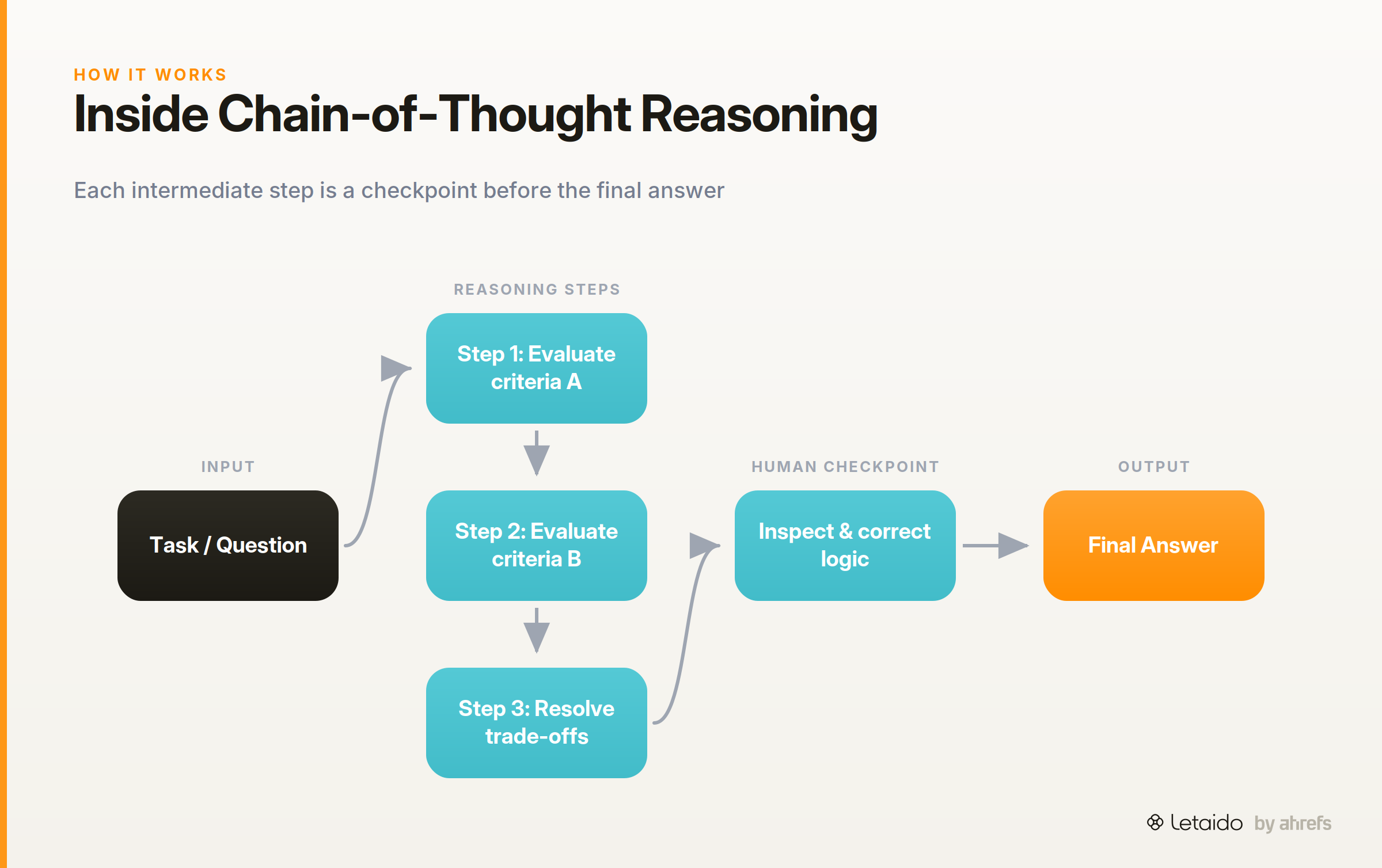
Without that scratchpad, a model generating text token by token can paint itself into a corner. It commits to an early assumption, and because each token is influenced by the previous ones, a wrong turn at step one can compound through the rest of the response. Forcing intermediate steps interrupts that pattern.
Each reasoning step also gives you, the human, a checkpoint. If the model's logic is wrong at step two, you can see it and correct the prompt — instead of receiving a confident-sounding wrong answer with no visible reasoning behind it.
Two Types of CoT Prompting
There are two main approaches, and they differ in how much prompt engineeringPrompt engineeringThe practice of writing and refining model instructions to get reliable, repeatable output — structure, examples, and constraints rather than clever wording.Read: What Is Prompt Engineering? (And Why Marketers Need It) you invest upfront. Zero-shotZero-shot promptingAsking a model to do a task with no examples at all — instructions only. Fast, and usually enough for well-known tasks.Read: Zero-Shot Prompting: Getting Results Without Examples CoT is the faster option; few-shotFew-shot promptingIncluding a handful of worked examples in the prompt so the model infers the pattern you want instead of being told it in prose.Read: Few-Shot Prompting: How to Teach AI With Examples CoT is more precise and consistent for high-stakes tasks.
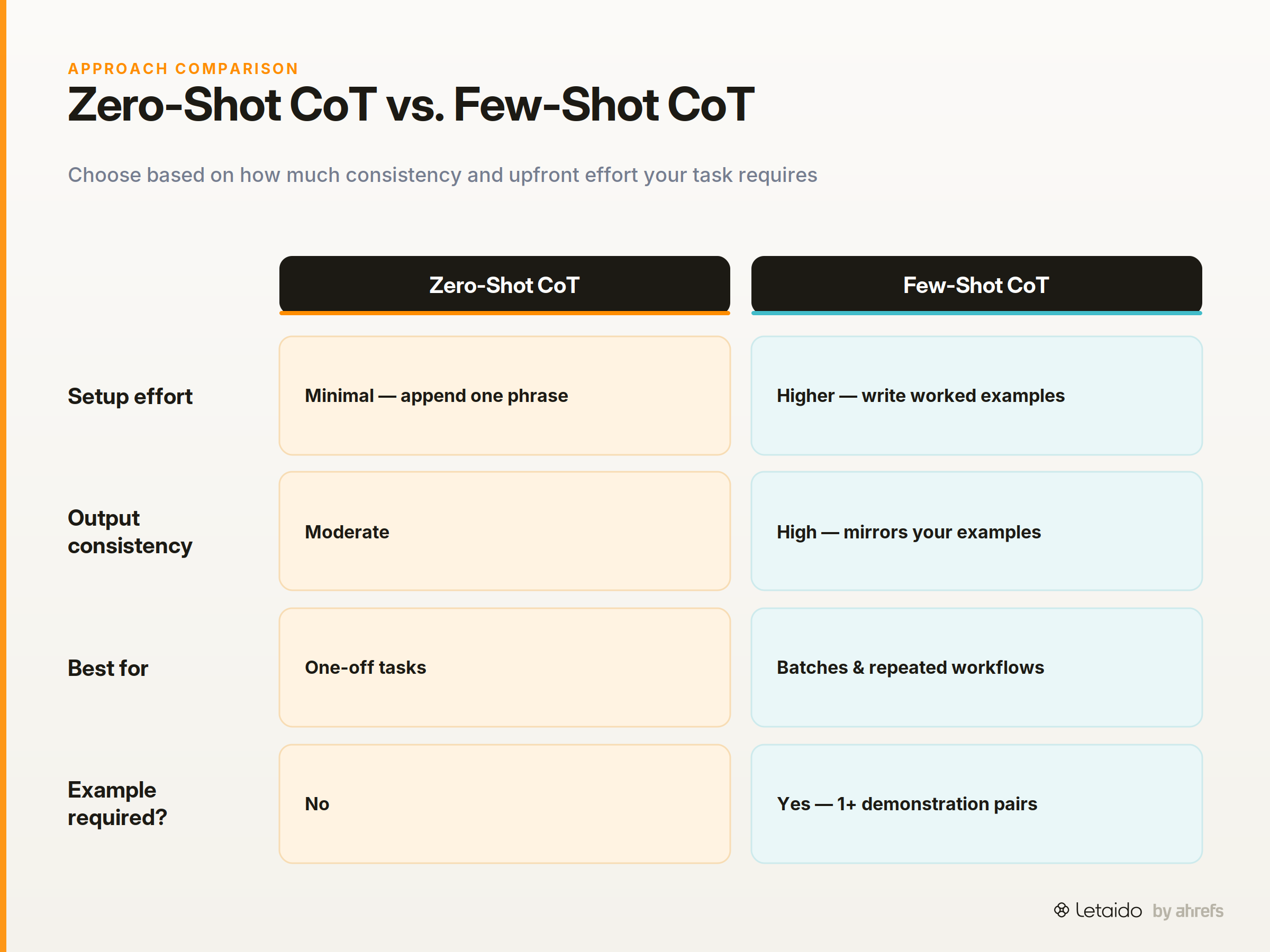
Zero-shot CoT — append a phrase, get reasoning
Zero-shot CoT requires no examples. You simply add an instruction at the end of your prompt that tells the model to reason through the problem before answering.
The classic phrase from the Wei et al. research is "Let's think step by step." In practice, more specific instructions work better.
Zero-shot CoT template:
[Your task or question here.]

Before giving your final answer, think through this step by step.
Show your reasoning for each part of the problem, then state your conclusion.
This works well for one-off tasks where you don't want to write out demonstration examples. The tradeoff is slightly less consistency in how the model structures its reasoning.
Few-shot CoT — teach with worked examples
Few-shot CoT prepends one or more demonstration pairs to your prompt: a problem, followed by step-by-step reasoning, followed by a final answer. The model learns the pattern from your examples and applies the same format to the real task.
Few-shot CoT template:
Here is an example of how to analyze a content idea:

---
Content idea: "How to reduce churn for SaaS companies"
Step 1 — Search intent: Informational. Readers want tactics, not a product page.
Step 2 — Audience fit: Strong. Decision-makers and marketers at SaaS companies.
Step 3 — Existing content: Likely competitive; need a differentiated angle or data.
Conclusion: Worth pursuing with a data-led angle or case study hook.
---

Now apply the same analysis to this content idea:
Content idea: "Best customer success software"
Few-shot CoT takes more upfront work, but it pays off when you need consistent output format across many inputs, such as evaluating a batch of keywords, briefs, or competitor pages. The model mirrors your example's structure reliably.
How to Write a Chain-of-Thought Prompt
A CoT prompt is not just a standard prompt with "step by step" appended. The most reliable results come from being specific about what reasoning the model should show and what format the output should take.
The repeatable formula
Four components, in order:
- Task framing: State what you're analyzing and why. Include any relevant context (audience, goal, constraints).
- Reasoning instruction: Tell the model what dimensions to think through and in what order. The more specific, the better.
- Format constraint: Specify how you want the reasoning presented — numbered steps, labeled sections, a table.
- Output request: Ask for the final answer separately from the reasoning, so it's easy to extract.
4 marketing prompt templates to use now
These are copy-paste ready. Adjust the bracketed placeholders for your context.
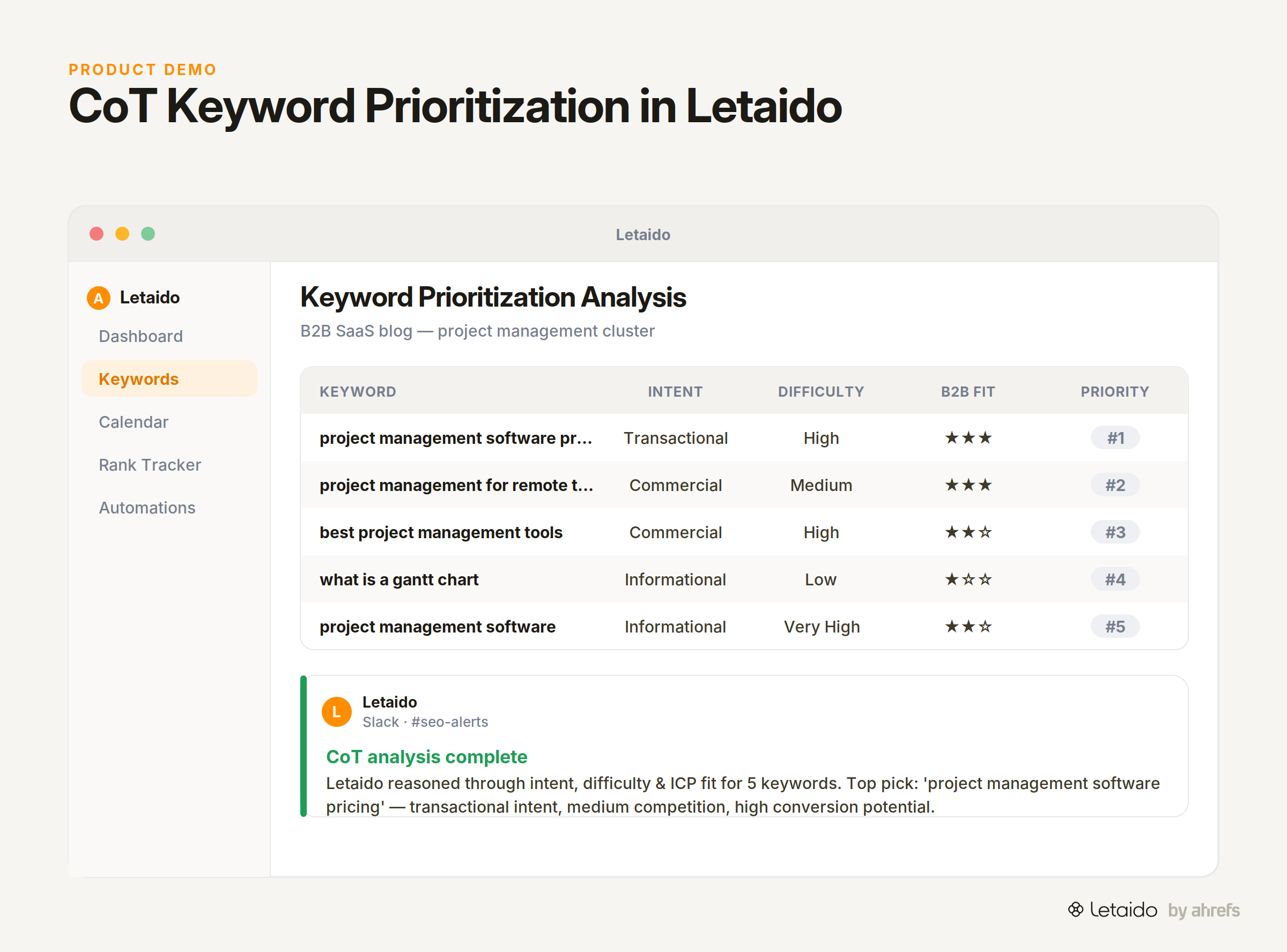
1. Keyword prioritization:
You are an SEO strategist for [company type]. Below is a list of keywords.

For each keyword, reason through:
1. Likely search intent (informational / commercial / transactional)
2. Estimated difficulty based on specificity and competition signals
3. Fit with our audience: [describe ICP]
4. Whether we have a realistic angle to rank (unique data, strong existing authority, etc.)

After evaluating each keyword individually, rank them from highest to lowest priority.
State your final ranking and a one-sentence rationale for the top three.

Keywords:
[paste keyword list]
2. Content gap identification:
Review this content brief and identify gaps before it goes to a writer.

Reason through each section heading and ask:
- Is the search intent fully addressed?
- Is there a key subtopic a competitor might cover that this brief misses?
- Does the recommended word count match the depth required?

Show your analysis section by section. Then give a prioritized list of gaps to fix,
ordered by how much they'd affect rankings or usefulness to the reader.

Brief:
[paste brief]
3. Competitive page comparison:
Compare these two competitor pages targeting the keyword "[keyword]".

For each page, evaluate step by step:
1. How well it matches search intent
2. Content depth and unique value
3. On-page structure (headings, examples, CTAs)
4. What a reader walks away knowing

After evaluating each page individually, score them 1–10 on overall effectiveness.
Explain which page would be harder to outrank and why.

Page A: [paste URL or excerpt]
Page B: [paste URL or excerpt]
4. Multi-source report synthesis:
You have data from three sources below. Synthesize them into a coherent summary
for a marketing director who needs to make a budget decision.

Reason through each source separately first:
- What is the key finding?
- How reliable is it (sample size, recency, methodology)?
- Does it contradict or support the other sources?

Then write a 150-word synthesis that resolves any contradictions and leads with
the single most actionable insight.

Source 1: [paste]
Source 2: [paste]
Source 3: [paste]
When CoT Prompting Helps (and When to Skip It)
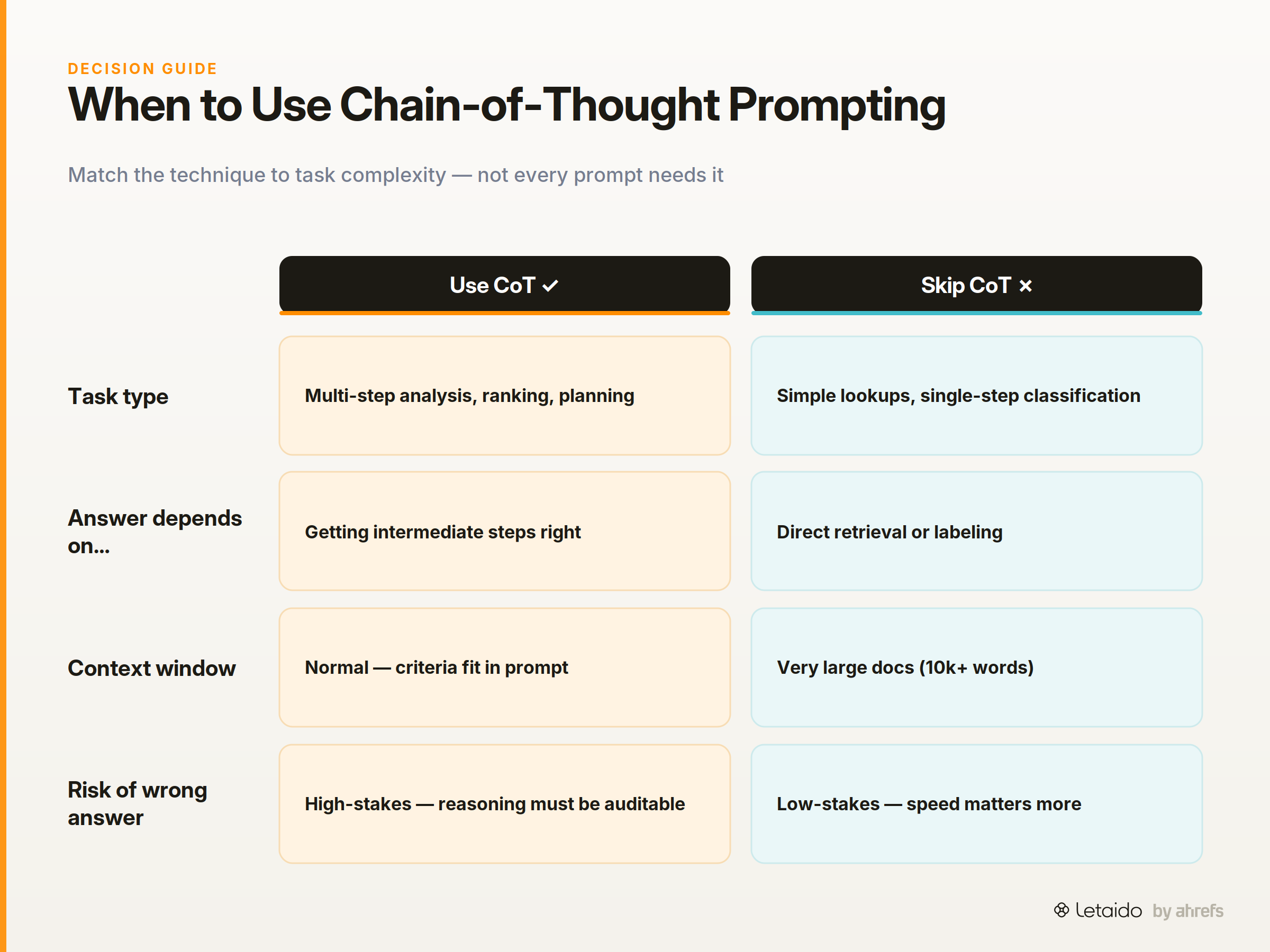
CoT is not the right technique for every prompt. Using it indiscriminately adds tokens and latency without improving output.
Tasks where CoT earns its tokens
CoT pays off whenever the quality of the answer depends on getting intermediate steps right. In marketing work, that includes:
- Multi-step analysis: Auditing a page, evaluating a strategy, scoring a list of opportunities — anything where you'd walk through criteria one by one.
- Comparisons and trade-offs: Choosing between two approaches, ranking options, deciding where to allocate budget.
- Planning tasks: Building a content calendar, outlining a campaign structure, mapping a funnel.
- Scoring and evaluation: Grading content briefs, reviewing copy against a rubric, assessing keyword fit.
In all these cases, the final answer is only trustworthy if the reasoning behind it is sound.
Tasks where CoT adds noise, not signal
CoT hurts performance or wastes resources in several common scenarios:
Simple factual lookups. If you're asking "What year did Google launch Search Console?" adding a reasoning chain produces filler before the answer. The model doesn't need to deliberate; it just needs to retrieve.
Single-step classification. Labeling a URL as informational or transactional, tagging a list of items into categories — these are direct tasks. CoT prompting can actually confuse the output by introducing unnecessary hedging.
Very long-context tasks. When your prompt already contains a 10,000-word document, adding extensive reasoning steps can push you toward context limits and degrade response quality. In these cases, it's often better to chunk the task and apply CoT to each piece separately.
The rule of thumb: if a smart human could answer the question in one sentence without pausing to think, CoT is probably unnecessary.
CoT Variants Worth Knowing
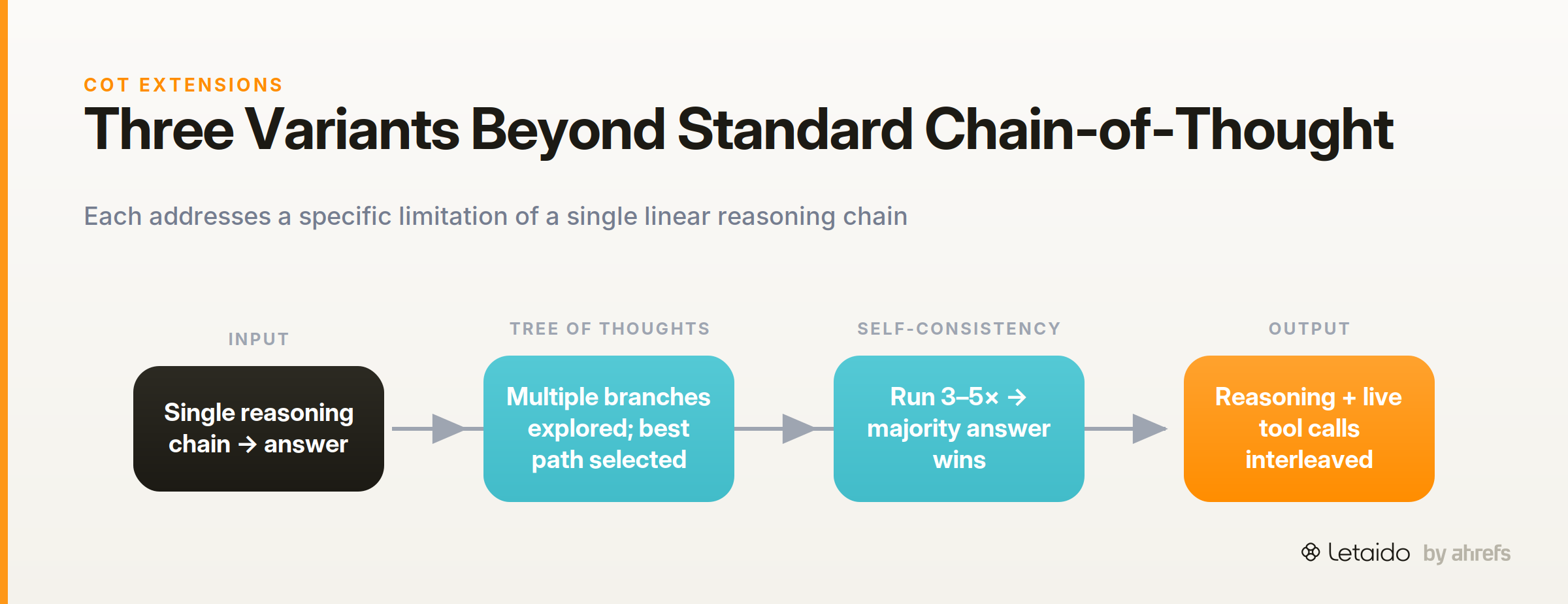
Beyond the two main approaches, several extensions of chain-of-thought reasoning are worth understanding. Each addresses a specific limitation of standard CoT.
Tree of Thoughts
Tree of Thoughts (ToT) extends CoT by having the model generate multiple reasoning paths rather than one linear chain. Think of it as branching rather than a single thread. The model explores several possible approaches to a problem, evaluates each, and selects the most promising one.
ToT is useful for tasks where the right starting assumption is unclear — for example, structuring a complex campaign where several strategic framings are plausible. It requires more tokens and is slower than standard CoT, so it's best reserved for genuinely open-ended planning problems.
Self-Consistency
Self-consistency addresses a reliability problem with CoT: a single reasoning chain can confidently produce a wrong answer. The approach runs the same CoT prompt multiple times (typically three to five times) and takes the majority answer.
This is worth using when the output carries high stakes — a budget recommendation, a go/no-go decision on a content investment, or a scoring output that will drive automation. The cost is higher inference spend; the gain is meaningfully reduced error rates on complex reasoning tasks.
ReAct (Reasoning + Acting)
ReAct interleaves reasoning steps with external tool calls. The model reasons about what to do, takes an action (a web search, a database lookup, an API call), observes the result, and incorporates it into the next reasoning step.
This is the pattern that makes AI agents genuinely useful for multi-step research tasks. Where standard CoT keeps everything inside the model's knowledge, ReAct lets the model retrieve live data mid-chain. It's the direct bridge from prompting technique to agentic workflow.
CoT in Agentic Workflows
When an AI agent handles a multi-step marketing task — crawling a site, identifying technical issues, pulling keyword data, and generating a prioritized action plan — it isn't executing one prompt. It's running a sequence of reasoning steps where each step's output becomes the next step's input.
That's CoT reasoning at the workflow level. Each step has a clear task, explicit reasoning criteria, and a defined output format. The agent's actions become auditable because the reasoning at each stage is visible, not buried inside a single black-box response.
This is how Letaido structures complex marketing workflows. When you ask Letaido to run a content gap analysis — pulling your site's keyword rankings from Ahrefs, comparing them to top-ranking competitors, and generating a prioritized brief list — it breaks the task into explicit reasoning steps rather than attempting one massive prompt. The output at each stage is inspectable, and you can intervene or redirect before the final deliverable is produced.
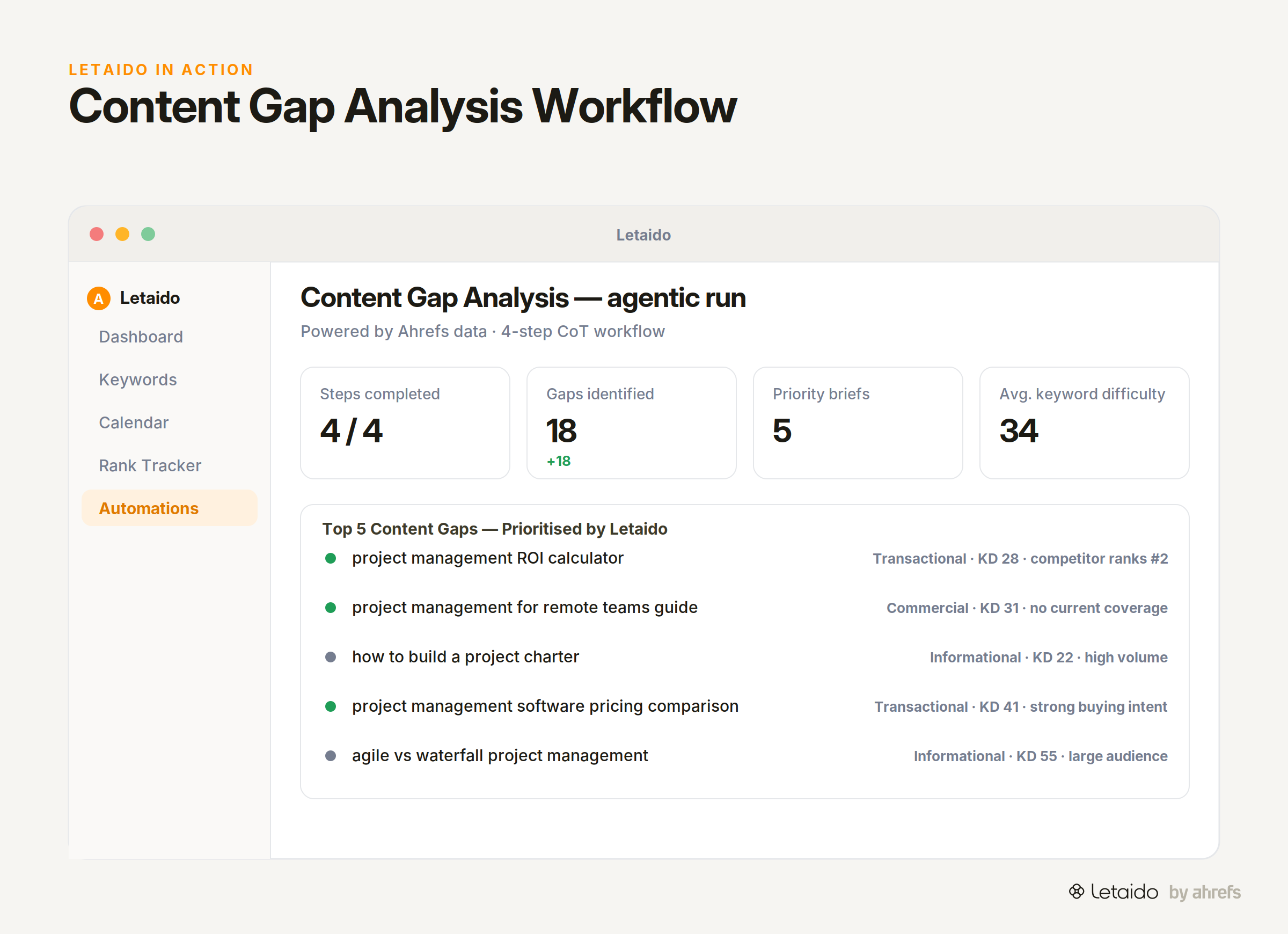
If you want to see how this plays out on a real workflow, Letaido can run a content gap analysis or site audit as a starting point.
Try this prompt in Letaido:
Using our Ahrefs data, identify the top 10 keyword gaps between our site and
[competitor domain]. For each gap, reason through:
1. Whether we have existing content that partially covers this topic
2. The likely effort to rank based on keyword difficulty and our current authority
3. Whether the traffic potential justifies the investment

Then produce a prioritized list of the top 5 gaps to act on first, with a
one-paragraph brief for each.
Key Takeaways
- Chain-of-thought prompting instructs an AI model to show its reasoning before giving a final answer, producing more accurate results on complex tasks.
- Zero-shot CoT adds a reasoning instruction to your prompt ("think through this step by step") with no examples needed.
- Few-shot CoT prepends worked demonstration examples, producing more consistent output format — worth the extra setup for recurring tasks.
- The four-part formula: task framing → reasoning instruction → format constraint → output request. Use it for any CoT prompt.
- Use CoT for multi-step analysis, comparisons, planning, and scoring. Skip it for simple factual lookups, single-step classification, and very long-context tasks.
- In agentic workflows, CoT-style reasoning is the backbone that makes multi-step agent tasks auditable and correctable rather than black-box.