
Most writing about AI agents focuses on the model: which one to use, how to prompt it, what it can reason through. Almost nothing covers what the agent actually runs inside — the tools it can call, the actions it's forbidden from taking, what it remembers between runs, and how it knows when it got something wrong.
That outer structure is the harness. Harness engineering is the discipline of designing it.
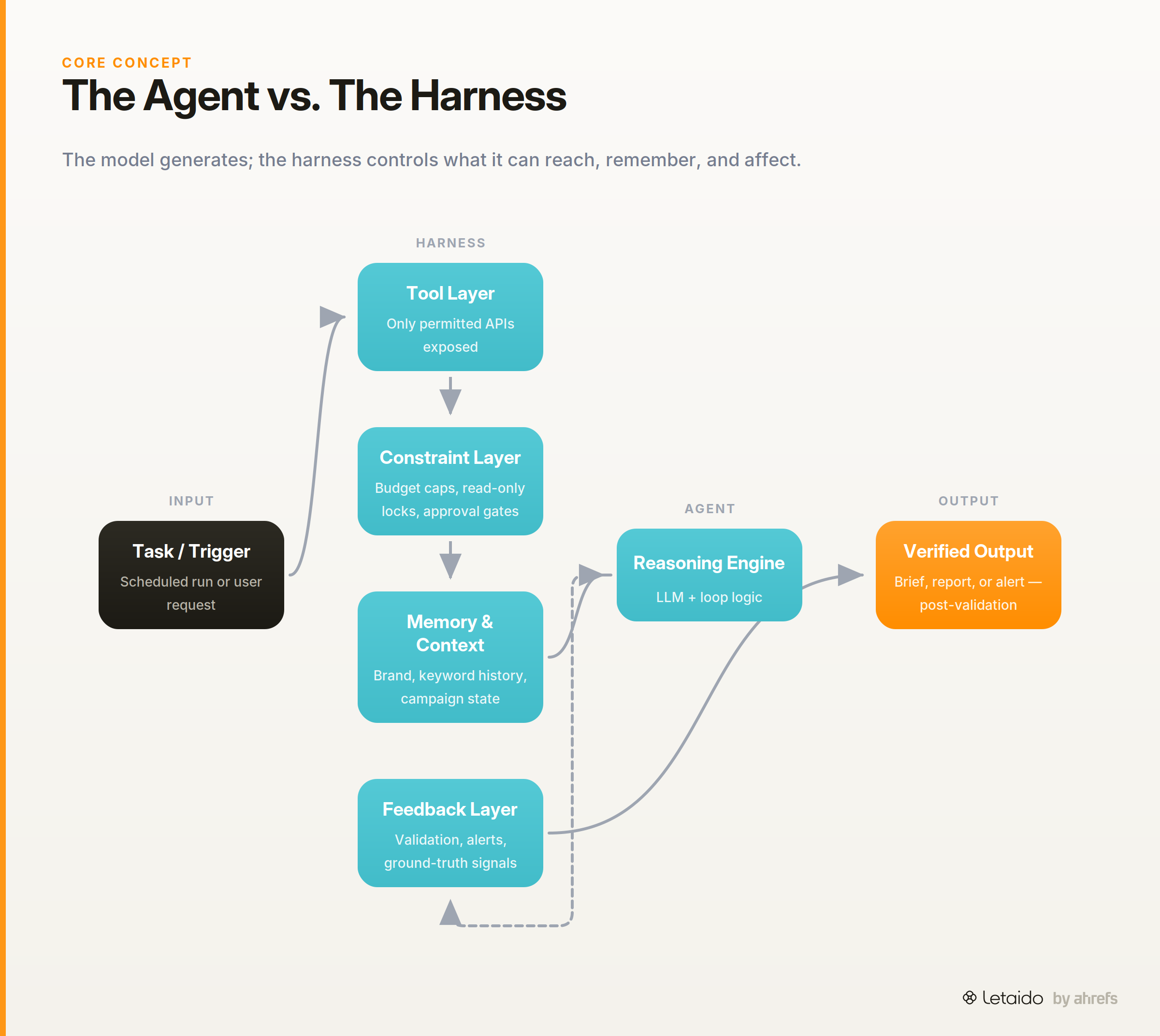
The model is the reasoning engine. The harness is the environment that makes the model safe, reliable, and useful enough to run on real work without supervision. Get the harness wrong and even a capable model becomes a liability.
What Harness Engineering Is
The term comes from electrical and automotive engineering, where a wiring harness bundles cables, connectors, and protective conduit into a single routed structure. The harness doesn't generate power — it controls where the power goes, prevents shorts, and routes current only to the components that should receive it.
An agent harness works the same way. The model is the current. The harness determines where it can flow, how fast, and what stops it when something goes wrong.
Harness engineering, applied to AI agents, is the practice of designing that outer structure: the tools available to the agent, the constraints on its actions, the memory it draws on, and the feedback mechanisms that catch errors before they compound. It's infrastructure work, not model work. You can swap the model inside a well-designed harness; you can't easily swap a poorly designed harness once agents are running in production.
The Harness vs. the Agent — What's What
It helps to draw the boundary clearly.
The agent is the reasoning engine: the large language modelLarge language modelA model trained on vast amounts of text to predict the next token, which is what lets it write, summarise, and reason over language., plus whatever loop logic drives it to take actions, observe results, and iterate. The agent generates text, calls functions, and makes decisions.
The harness is everything the agent operates inside. It determines which functions the agent can call and which are off-limits. It controls what information the agent has access to. It decides which outputs get passed downstream and which trigger a review. It logs what happened and surfaces errors.
A useful way to think about it: if you removed the model and swapped in a different one, the harness would still be there, doing the same work. The harness is not the agent. It's the environment the agent runs in.
How Harness Engineering Relates to Prompt, Context, and Loop Engineering
Three related disciplines often get conflated with harness engineering. The table below shows how they differ.
| Discipline | What it covers | Where it lives | Changes when you swap models? |
|---|---|---|---|
| Prompt engineering | What you say to the agent — instructions, format, persona, task framing | Inside the agent's input | Yes — rewritten for the new model |
| Context engineering | What information surrounds the prompt — retrieved documents, examples, session history | Inside the agent's input | Yes — the context window differs |
| Loop / agentic-loop engineering | The iteration logic — how many steps, when to stop, how results feed the next step | Inside the agent's execution logic | Often yes |
| Harness engineering | The outer shell all three run inside — tools, constraints, memory, feedback | Outside the agent, wrapping all of it | No — the harness persists unchanged |
Prompt engineering improves what the agent says. Context engineeringContext engineeringDesigning everything the model sees at inference — retrieved documents, tools, memory, and instructions — rather than tuning the prompt text alone.Read: Context Engineering vs Prompt Engineering: What Changes improves what the agent knows in the moment. Loop engineering improves how the agent iterates. Harness engineering determines what the agent is allowed to do, what it remembers across runs, and whether anyone finds out when it fails.
All four matter. But the harness is the only one that operates independently of the model's output. It's the layer that enforces behavior even when the model does something unexpected.
The Four Layers of an Agent Harness
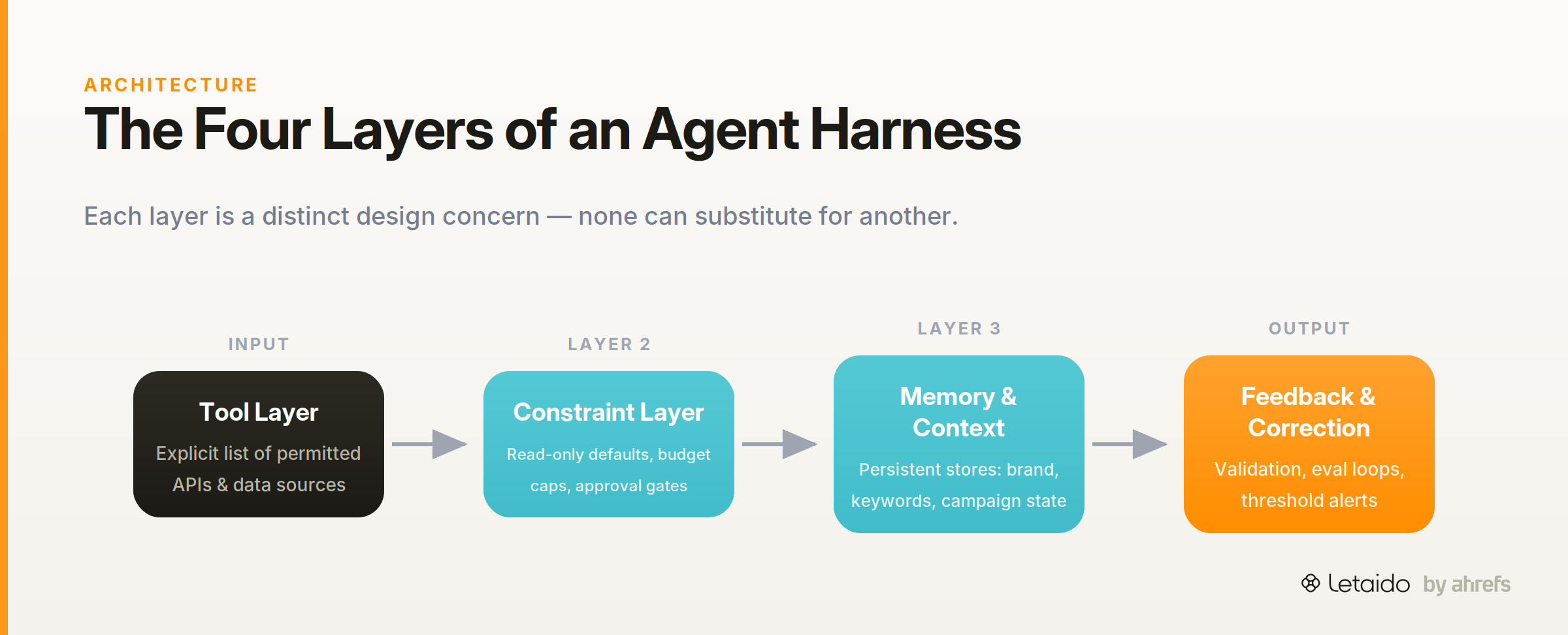
A well-designed harness has four distinct concerns, each requiring its own design decisions. Here's what each one covers and why it can't be skipped.
Layer 1 — The Tool Layer
The tool layer defines what the agent can reach: every API it can call, every data source it can query, every write-back action it can trigger.
In practice, this means making an explicit list of integrations and exposing only those integrations. An agent that can query Ahrefs keyword data, pull pages from Google Search Console, and read a CMS draft has a narrow tool surface. An agent that can also send emails, post to social accounts, modify DNS records, and call billing APIs has a much wider one — and a much larger surface for mistakes.
Wider tool access doesn't make agents more capable in a useful sense. It introduces ambiguity. When an agent has 40 tools available, it has to choose among them on every action. That choice degrades reliability. Tight tool selection is a design decision, not a limitation.
Layer 2 — The Constraint Layer
The constraint layer defines what the agent cannot do, even if the tool technically allows it.
Common constraints include: read-only defaults for data sources that shouldn't be modified, budget caps limiting how many API calls or token-heavy operations a single run can trigger, action permissions that require human review before irreversible steps (such as publishing, sending, or deleting), and scope limits that prevent the agent from wandering into tasks outside its defined job.
The constraint layer is where human-in-the-loop gates live. For any action that can't be undone, a confirmation step before execution is the minimum viable constraint. Without it, you're trusting the model never to make an irreversible mistake.
Layer 3 — The Memory & Context Layer
The memory layer determines what the agent knows across runs, not just within a single prompt.
Most agents have access to a working memory: everything in the current context windowContext windowThe maximum amount of text a model can consider at once, counted in tokens. Everything outside it is invisible to the model. for this run. That's usually enough for a single task. But agents that run on a schedule — daily audits, weekly reports, ongoing monitoring — need more.
Long-term memory stores information that persists between runs: brand guidelines, past outputs, approved keywords, client preferences, ongoing campaign state. Retrieved context pulls relevant subsets of that stored knowledge into the working context at the start of each run, rather than loading everything every time.
The design question is what should persist and what should reset. Shared memory across every task type tends to create noise. A cleaner approach is purpose-specific memory stores: one for brand context, one for keyword history, one for campaign state. Each task draws from the relevant store, not everything at once.
Layer 4 — The Feedback & Correction Layer
The feedback layer is how the agent (and the team running it) finds out when something went wrong.
Output validation checks agent outputs against defined criteria before they reach downstream systems. An eval loop (a structured check of output quality) can flag responses that fall below a threshold without requiring a human to read every output. Threshold alerts fire when a monitored metric moves outside an expected range — for example, a page dropping significantly in rankings, or an agent consuming three times its normal tokenTokenThe unit models actually read and generate — roughly a word-piece. Context limits and API pricing are both measured in tokens. budget in a single run.
The feedback layer is also the mechanism for continuous improvement. Ground-truth signals — actual ranking data, click-through rates, conversion numbers — tell the harness whether the agent's work produced the expected result. Without this layer, the agent can run confidently in the wrong direction for weeks before anyone notices.
Why the Harness Is Where Reliability Lives
The model is increasingly a commodity. OpenAI, Anthropic, and Google release new frontier models on a cadence measured in months, and each new release tends to outperform the last on standard benchmarks. The model you choose today will be replaced within a year, according to McKinsey's Technology Trends.
The harness is not a commodity. It encodes specific decisions about what this agent is allowed to do in this environment for this team. Those decisions take time to design, test, and refine. A well-engineered harness is where the real competitive moat lives.
Two failure modes make this concrete.
The first is a missing constraint layer. An agent with access to an API but no budget cap will consume credits at whatever rate the task demands. If the task is unexpectedly expensive — a runaway loop, a wider-than-expected query, a scheduling error that fires the agent ten times instead of once — you find out when the bill arrives. There's no in-run signal that anything is wrong.
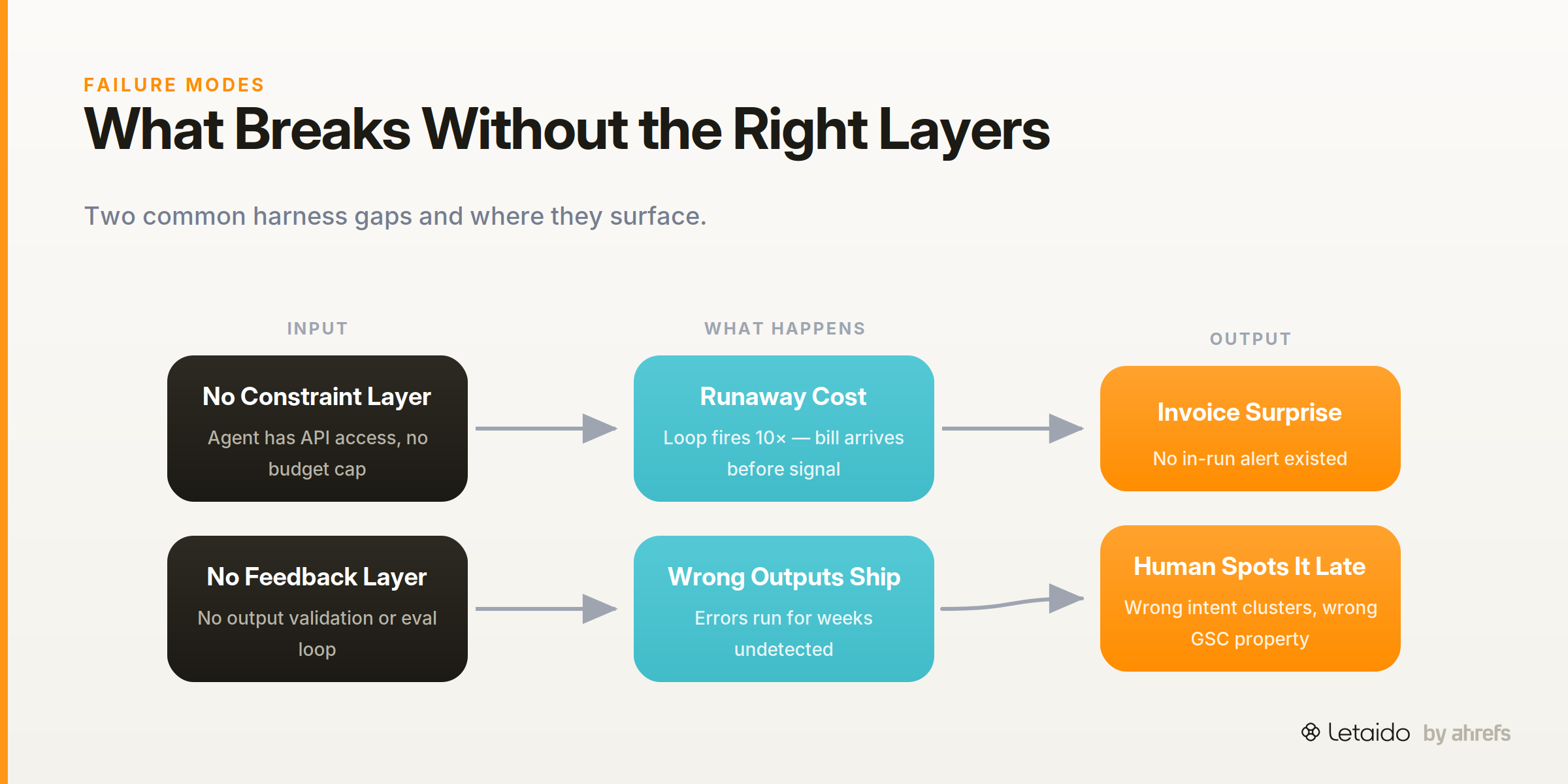
The second is a missing feedback layer. An agent generating content, briefing documents, or data summaries with no output validation will produce wrong outputs with exactly the same confidence it produces correct ones. Large language models don't flag uncertainty reliably. If no evaluation mechanism exists to catch errors, wrong outputs ship. They may run for weeks before a human notices that the keyword clusters are built on the wrong intent, or that the rank-tracking report has been pulling data from the wrong property.
A capable model with no harness is a demo. A capable model with a well-engineered harness is a workflow.
Design a Harness for a Real Job — A Marketing Agent
Walking through a concrete example makes the four layers tangible. A marketing agent that handles ongoing SEO and content work is a natural fit: the job is well-defined, the data sources are known, and the failure modes are visible.
Choose the Tool Layer
For a marketing agent, the tool surface should cover the data sources the agent actually needs and nothing else.
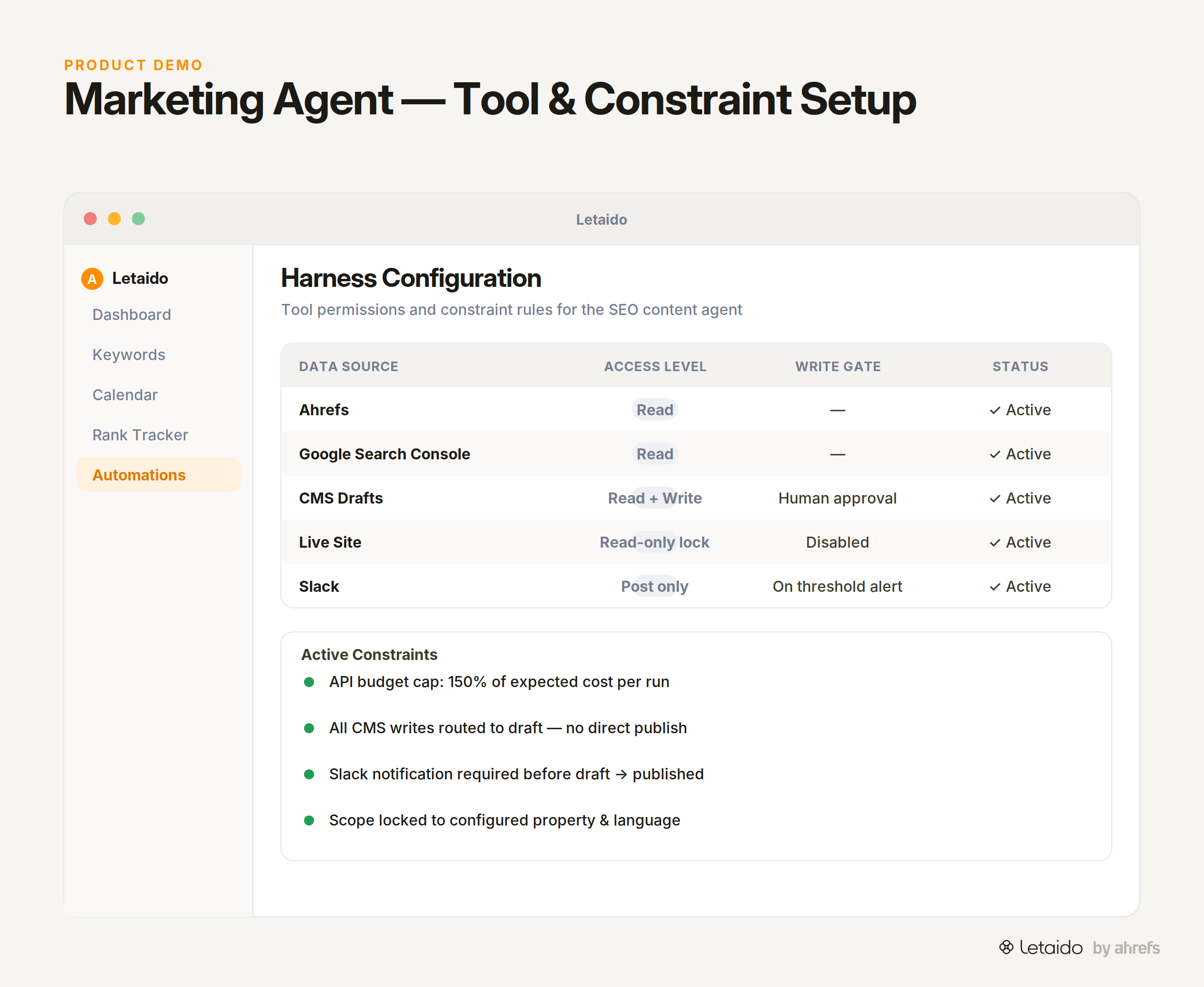
For SEO work, that typically means: Ahrefs data (keyword research, backlink analysis, site health), Google Search Console (click and impression data, index coverage), and a CMS endpoint for reading drafts and, with explicit permission, writing updates.
Keeping the tool layer to those three categories eliminates the ambiguity of a broader tool set. The agent knows where to look for keyword data. It knows where to check traffic. It knows where content lives. It doesn't need to decide among 20 possible data sources because only the relevant ones are available.
Write the Constraint Layer
Read-only access should be the default for every data source. Write-back permissions — updating a page, publishing a draft, sending an alert — should require explicit enablement and, for irreversible actions, a human approval gate.
For a marketing agent running on a schedule, practical constraints include:
- A token or API-call budget cap per run, set to 150% of the expected normal cost so genuine overruns trigger an alert before they become expensive
- A read-only lock on the live site; all write actions route to draft status for review
- Slack notification required before any content moves from draft to published
- Scope restriction to the property and language configured at setup; no cross-domain or cross-language actions without explicit reconfiguration
Structure Memory
Three memory stores cover most marketing agent needs.
Brand context: company name, tone guidelines, product descriptions, terms to avoid, approved topic areas. This should persist across every run and be updated manually when positioning changes.
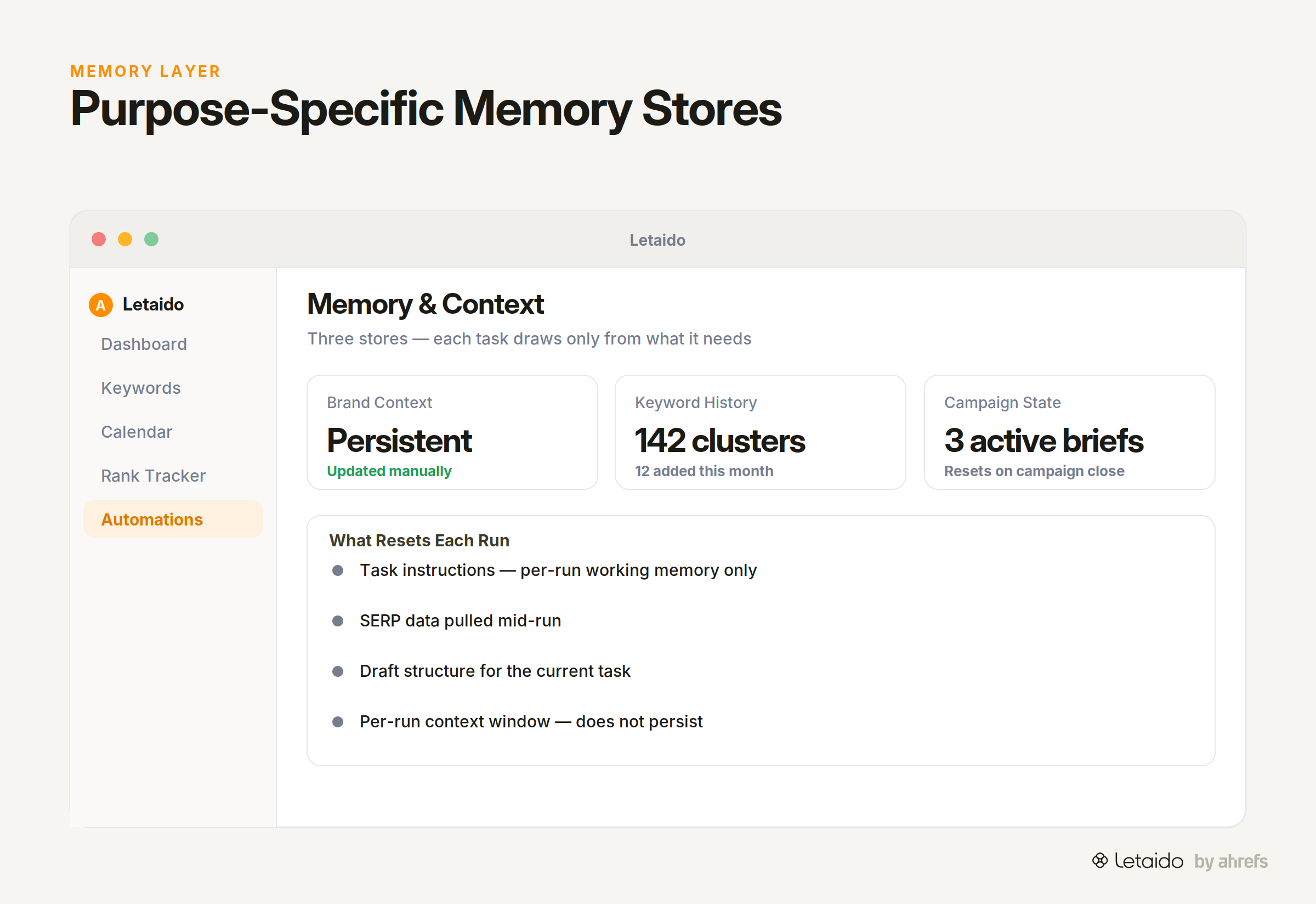
Keyword history: clusters that have been researched, prioritized, or published against. Prevents the agent from re-surfacing the same keyword ideas in every weekly brief.
Campaign state: active briefs, pages currently in draft, ongoing link-building targets. Resets or archives when a campaign closes; doesn't carry over stale context into new work.
Per-run working memory — the specific task instructions, the SERPSERPThe search engine results page — the full set of organic listings, ads, and features returned for a query. data pulled mid-run, the draft structure — resets at the end of each run. It doesn't need to persist.
Close the Feedback Loop
Rank tracking is the natural ground-truth signal for a marketing agent. If a page that the agent briefed, optimized, or recommended for a link is dropping in rankings, that's an objective signal that something didn't work.
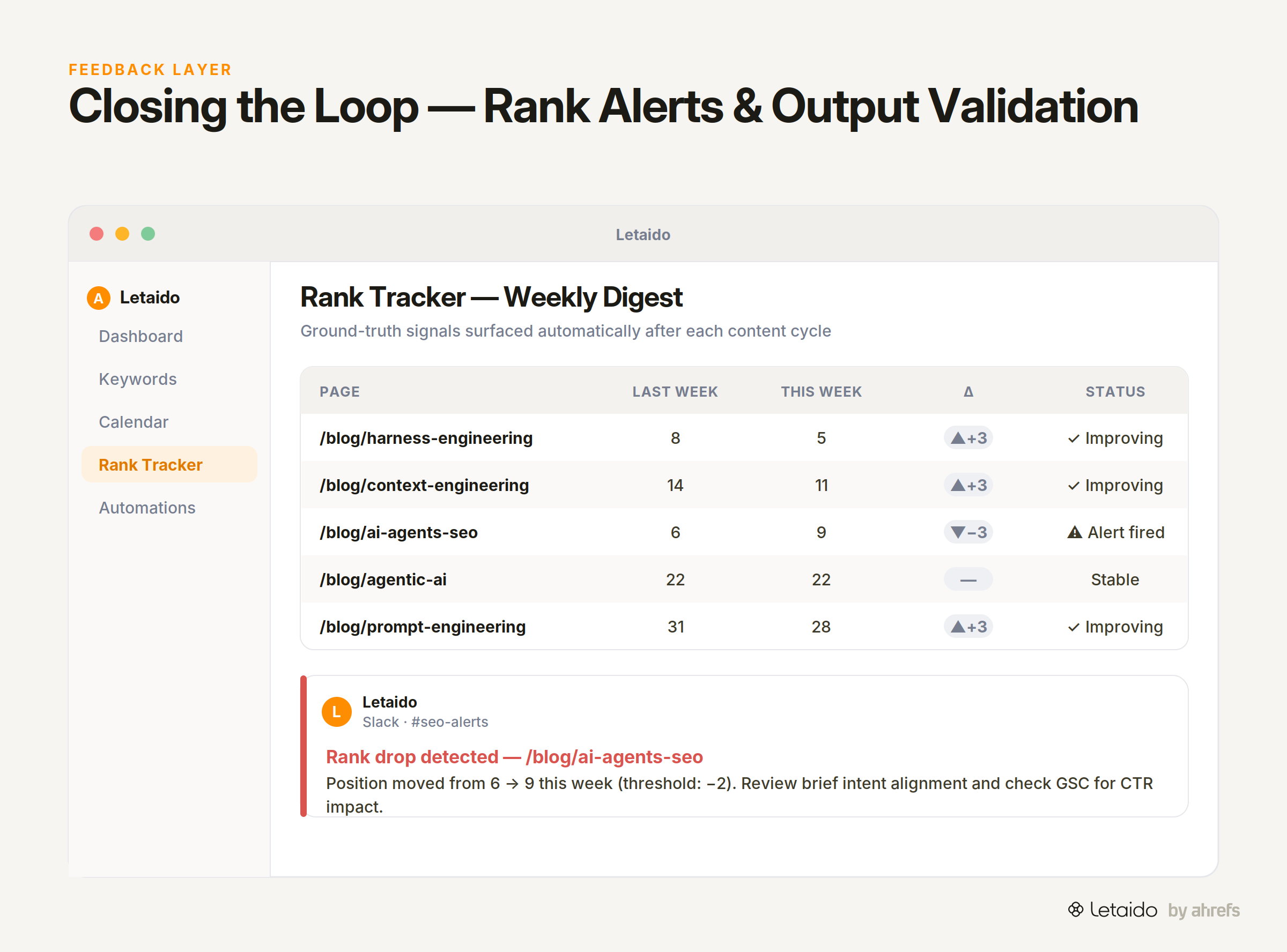
Closing the feedback loop in practice means:
- Scheduled rank checks at a cadence that matches the work cycle (weekly for most content programs)
- Slack alerts when a page drops beyond a defined threshold, so the team isn't discovering problems in monthly review meetings
- Output validation before any brief or report is delivered: does the keyword cluster reflect the right intent? Does the recommended structure match the actual top-ranking pages? Does the content map avoid overlap with existing pages?
Letaido handles all four of these layers as a pre-built harness designed specifically for marketing work. The Ahrefs data integration, tool permissions, rank-tracking alerts, and Slack connector are configured at setup rather than engineered from scratch. The worked example above describes exactly the harness structure Letaido ships with.
Common Harness Engineering Mistakes
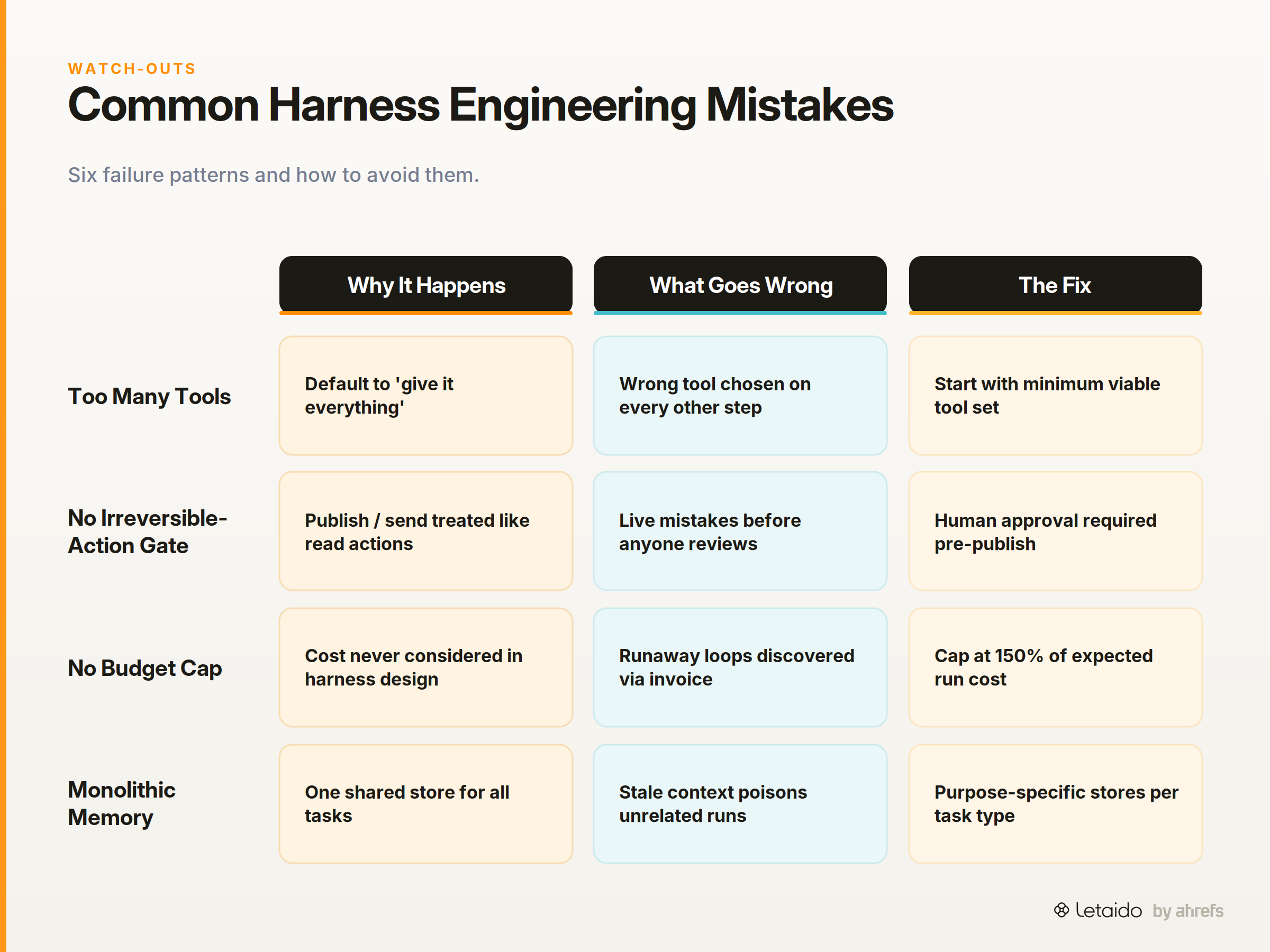
Here are six specific mistakes that show up repeatedly when teams build or extend agent harnesses.
-
Giving the agent too many tools. When an agent has 30 or 40 available functions, it must choose among them on every action step. More choices introduce more opportunities for the wrong choice. Start with the minimum viable tool set; add tools only when a specific task requires them.
-
No human-in-the-loop gate on irreversible actions. Publishing, sending, deleting, and posting are all one-way doors. If the agent can trigger any of these without a confirmation step, a single bad run can create real-world consequences that a prompt fix can't undo.
-
Skipping output validation because the output sounds confident. Large language models generate fluent, well-structured text even when the underlying reasoning is wrong. Confidence of tone is not an accuracy signal. Eval checks on factual claims, keyword intent alignment, and structural completeness are not optional.
-
Using a single flat memory store for every task type. When everything the agent has ever done lives in one undifferentiated store, retrieval degrades. The agent pulls irrelevant context from unrelated tasks. Separate memory stores by purpose: brand context, keyword history, campaign state.
-
No budget cap on scheduled automations. An agent running on a daily or weekly schedule will fire whether or not the conditions are right for a normal run. A scheduling error, a runaway loop, or an unexpectedly large data pull can consume credits at multiples of the expected rate. A budget cap with an alert is the minimum protection.
-
Treating prompt improvement as a substitute for harness improvement. When an agent produces bad outputs, the first instinct is to refine the prompt. Sometimes that's right. But if the root cause is missing context, a missing tool, or missing output validation, a better prompt won't fix it. Diagnose the layer before choosing the fix.
Build a Harness or Use One?
The honest answer depends on two factors: whether your use case is already solved, and whether your team has the engineering capacity to build and maintain infrastructure.
When to Build from Scratch
Building a custom harness makes sense when the use case is genuinely novel, proprietary, or in a regulated environment where off-the-shelf tool integrations and data handling can't be verified or audited.
In practice, a minimal harness for a single agent — one tool layer, one constraint set, basic memory, one eval mechanism — takes a small engineering team roughly two to six weeks to build and test. That estimate doesn't include ongoing maintenance, monitoring infrastructure, or the iteration required when the agent's behavior in production differs from behavior in testing.
Teams with dedicated ML or backend engineering capacity, building for an internal proprietary data environment, or operating under strict compliance requirements (healthcare, finance, legal) should evaluate building.
When a Pre-Built Harness Is the Right Call
For marketing, content, and growth teams, the use case is already solved: keyword research, content briefs, rank tracking, site audits, backlink analysis, and competitor research, according to Gartner Peer Insights. These are defined jobs with known data sources and known output formats.
The engineering time required to build a harness for these jobs exceeds the time the harness would save in its first several months of operation. That calculation flips once the harness is running reliably — but the build cost is real, and most marketing teams don't have the engineering capacity to absorb it.
This is where Letaido is designed to fit. The harness ships pre-built: Ahrefs data access, Google Search Console integration, Slack and HubSpot and WordPress connectors, scheduled automations, rank-tracking alerts, and constraint defaults that prevent write-back actions without review. The job of harness engineering has already been done for the marketing use case, according to HubSpot's WordPress plugin. The team configures rather than builds.
For teams whose primary goal is doing marketing work rather than building agent infrastructure, a pre-built harness is the right call. You can explore Letaido's harness at letaido.com.
The Unglamorous Work That Makes Agents Real
Models are becoming more interchangeable every quarter. The engineering work that actually determines whether an agent is useful — the tools it can call, the actions it's prevented from taking, the memory it draws on, the feedback that catches its mistakes — lives in the harness.
That work isn't glamorous. It doesn't fit neatly into demos. But it's the difference between an agent that runs reliably on real work and one that runs confidently in the wrong direction.
The harness is where the work happens. Engineering it well is what makes agents worth running.