
Most AI failures in real marketing workflows aren't caused by a badly written prompt. They're caused by bad context — the wrong information reaching the model at the wrong time, or no persistent memory across a multi-step task, or a system promptSystem promptThe standing instruction that sets a model's role, rules, and tone for an entire session, separate from the user's individual messages.Read: System Prompts: What They Are and How to Write Them that holds together fine in testing but collapses on the fifteenth edge case.
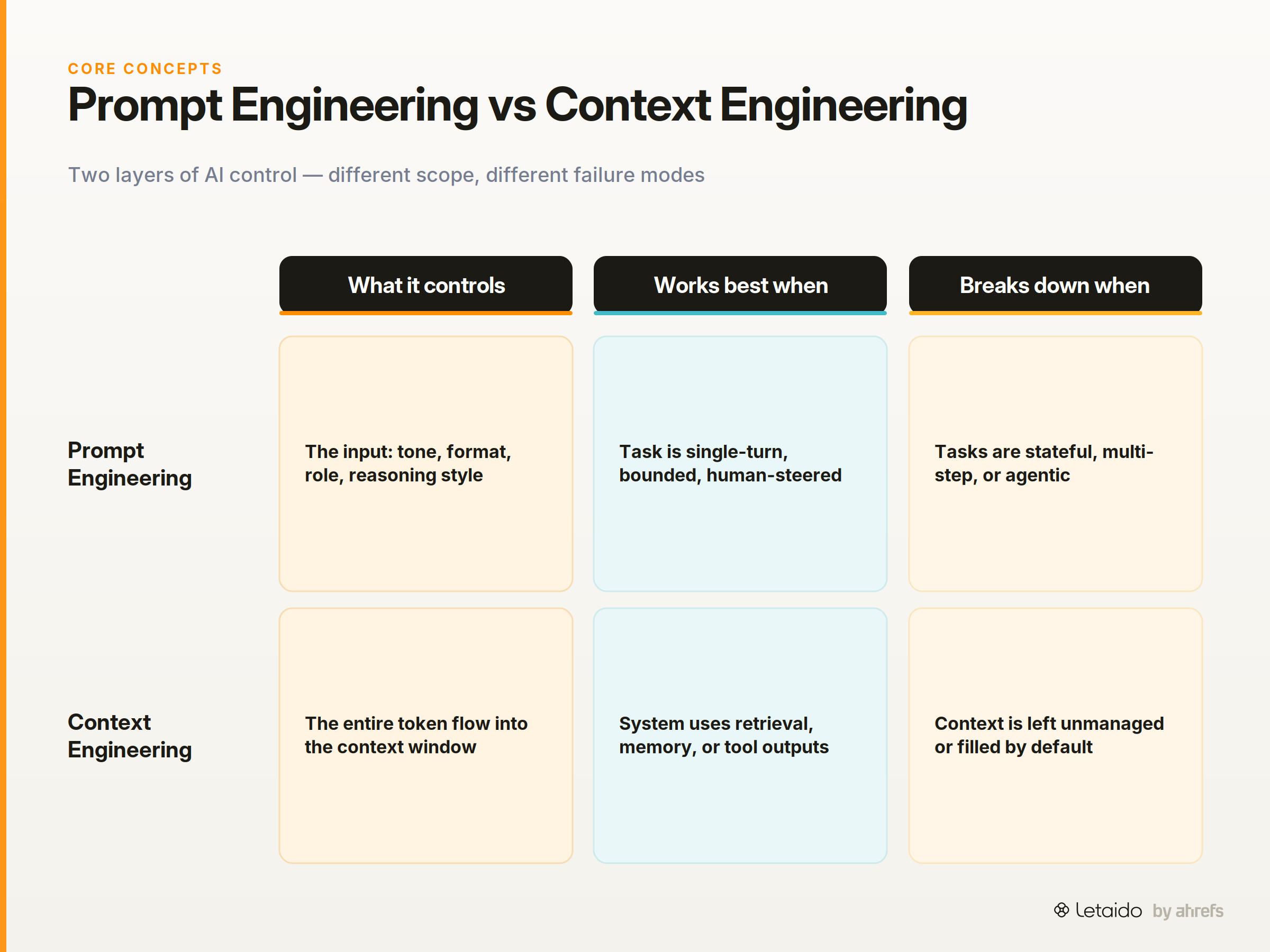
The distinction between prompt engineering and context engineering has moved from academic to urgent as AI systems grow more agentic. This article defines both terms precisely, explains what actually breaks when you rely on prompt engineering alone at scale, and gives you a usable framework for deciding which approach — or combination — your work actually requires.
Prompt Engineering: What It Controls and Where It Works
Prompt engineering is the craft of shaping the input you send to a language model. The tools it uses include system prompts (standing instructions that define the model's role and behavior), structural markup like XML tags or Markdown headers that organize the model's "reading" of a request, few-shotFew-shot promptingIncluding a handful of worked examples in the prompt so the model infers the pattern you want instead of being told it in prose.Read: Few-Shot Prompting: How to Teach AI With Examples examples (sample input-output pairs that demonstrate the desired format or reasoning style), chain-of-thoughtChain-of-thought promptingAsking a model to work through its reasoning in steps before answering, which measurably improves accuracy on multi-step problems.Read: Chain-of-Thought Prompting: Make AI Reason Step by Step instructions that ask the model to reason step-by-step before answering, and role assignment that tells the model what persona or expertise it should apply.
Done well, prompt engineering is powerful and precise. It gives you fine-grained control over tone, format, reasoning style, and task scope — all within a single interaction.
It works best on well-scoped, single-turn tasks where a human is steering each exchange. A prompt that instructs a model to extract product features from a webpage, write a meta description in a specific format, or classify a support ticket into one of five categories is exactly the kind of task prompt engineering handles cleanly. The input is bounded, the output is defined, and a human can review and iterate.
Context Engineering: What It Controls and Why It's Different
Context engineering operates at a different level. Rather than shaping one input, it controls the entire flow of tokensTokenThe unit models actually read and generate — roughly a word-piece. Context limits and API pricing are both measured in tokens. into the model's context windowContext windowThe maximum amount of text a model can consider at once, counted in tokens. Everything outside it is invisible to the model. — what information enters, when it enters, and in what form. That includes conversation history, retrieved documents, tool outputs, memory slots holding information from earlier in a session, and the outputs of other agents or sub-processes.
The context window is the model's working memory for any given task. Everything the model can "see" during inference lives there, and it is finite. Context engineering treats that space as a design surface: a scarce resource to be filled deliberately, not by default.
The clearest way to see the difference is a concrete example.
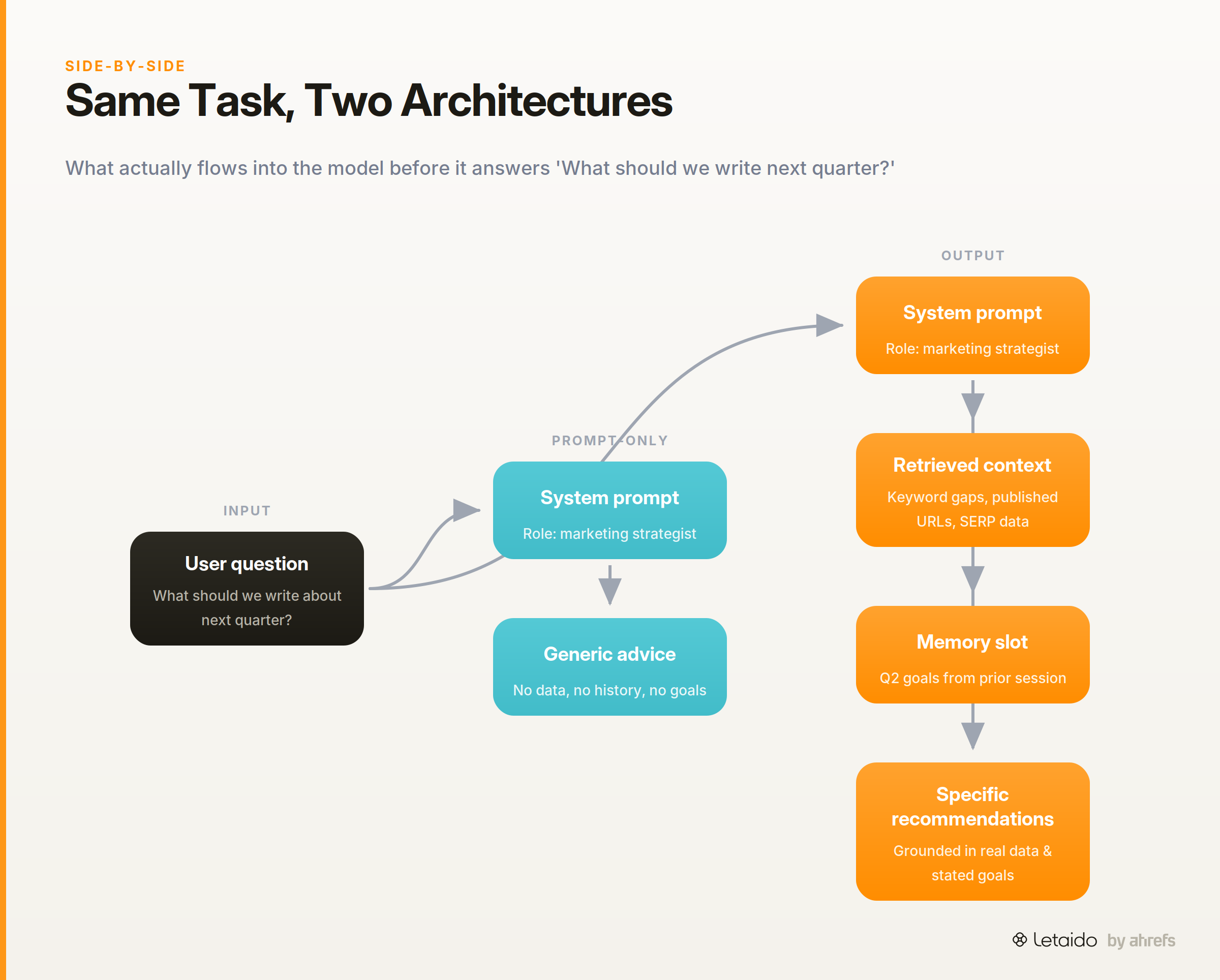
Same task, two approaches:
PROMPT ENGINEERING ONLY
System prompt: "You are a marketing strategist. Answer questions about
our content strategy."
User: "What should we write about next quarter?"

Model output: Generic advice based only on the system prompt and
the user's question. No product data, no competitor gap information,
no knowledge of what has already been published.
WITH CONTEXT ENGINEERING
System prompt: "You are a marketing strategist."
Context window also includes:
  - Retrieved: top 20 keyword gaps from Ahrefs (pulled just-in-time)
  - Retrieved: the last 6 months of published URLs + their traffic
  - Memory slot: Q2 content goals set in the prior session
  - Tool output: current SERP structure for three target topics

User: "What should we write about next quarter?"

Model output: Specific recommendations grounded in actual gap data,
current performance, stated goals, and live SERP context — not
generic advice.
The prompt in the second example isn't dramatically better. The context is.
What Breaks When You Only Do Prompt Engineering at Scale
As tasks grow longer, more stateful, or more agentic, prompt engineering alone hits a ceiling. Here are the failure modes that appear — each with a plain explanation of how it shows up in practice.
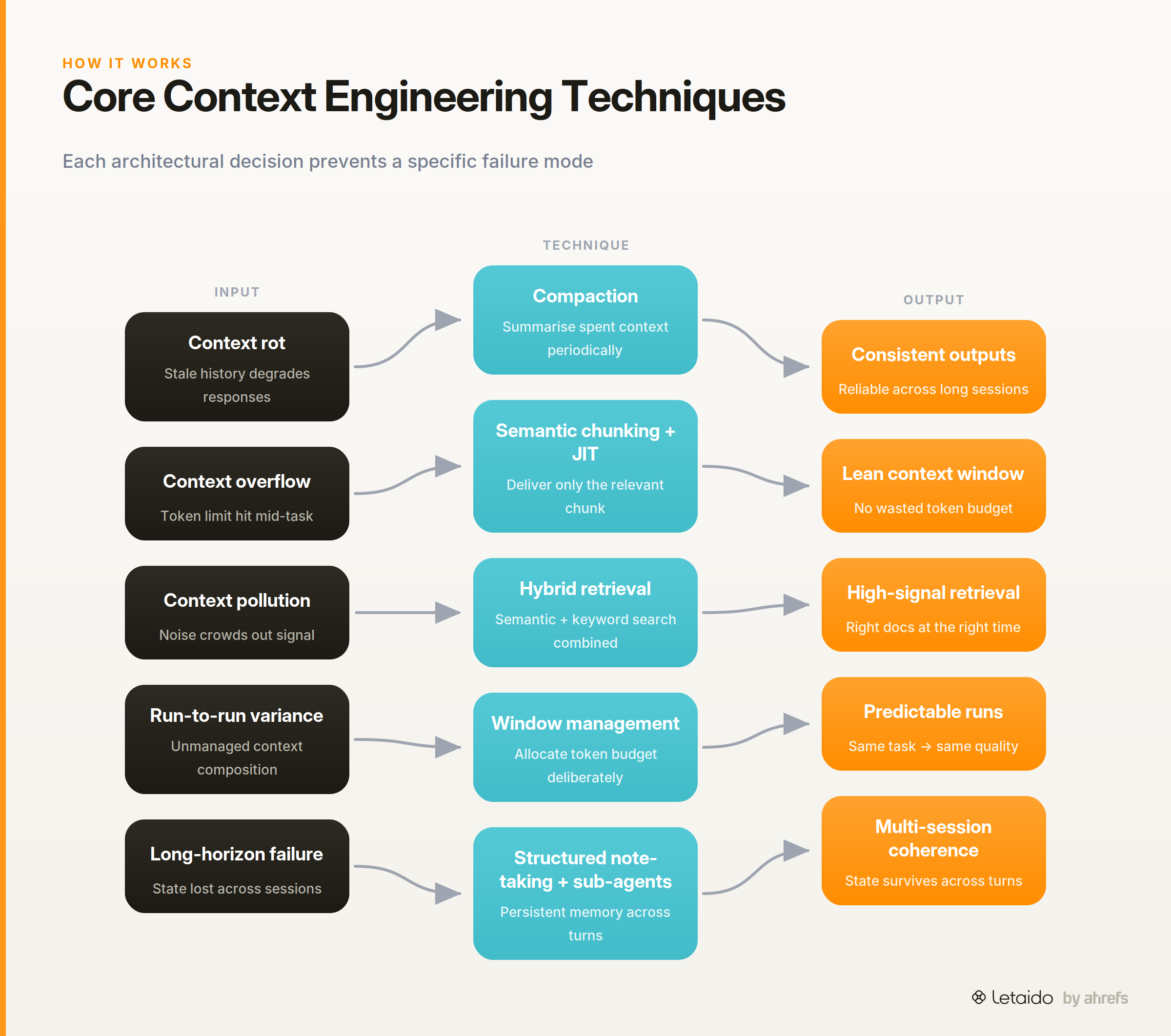
Context rot is when stale or irrelevant information accumulates in the conversation history and starts degrading responses. The model gives answers that were reasonable three turns ago but are now out of step with where the task has moved. It isn't hallucinating; it's reasoning from outdated signal.
Context overflow happens when the token limit is hit mid-task. The model loses access to earlier instructions, retrieved data, or tool outputs — whichever happened to fall outside the window. Outputs become incomplete or inconsistent without any clear error message to explain why.
Brittle logic comes from hardcoded prompts that work on the average case but crack on edge cases. A prompt tuned for a product description task breaks when the product has no description, or when the input is in a different language, or when a field that the prompt assumes is populated turns out to be empty. Each edge case requires a new prompt variation, and the library of prompt patches grows faster than you can maintain it.
Misinterpretation across multi-turn flows occurs when the model loses track of context that was established several turns earlier. Without a structured mechanism for carrying forward relevant state, the model treats each turn as near-fresh, and nuance established early in the conversation evaporates.
Run-to-run unpredictability is the scalability ceiling in its clearest form. Two identical prompts sent on different days, with slightly different conversation histories or tool states, produce meaningfully different outputs. For one-off tasks this is tolerable. For a workflow that runs on a schedule, it's a reliability problem.
Hitting the prompt ceiling looks like this: you've iterated your system prompt a dozen times, added elaborate conditional instructions, and the agent still behaves differently across runs. At that point, the problem is usually not the prompt — it's that the architecture isn't managing what the model sees and when.
Core Context Engineering Techniques (and What Each One Fixes)
Context engineering is a set of architectural decisions, not a single technique. Here are the core approaches, each earning its place by preventing a specific failure.
Context Retrieval and Hybrid Retrieval
Rather than pasting entire documents into the prompt, context retrieval pulls only the relevant information at the moment the model needs it. Hybrid retrieval combines semantic search (finding conceptually related content via embeddings) with keyword search (finding exact matches), because neither alone is reliable across all query types. This fixes retrieval problems where a purely semantic search misses precise terms and a purely keyword search misses paraphrased intent.
Semantic Chunking and Just-in-Time Context
Semantic chunking splits source material at meaningful boundaries — paragraph breaks, topic shifts, section headings — rather than at arbitrary character or token counts. Just-in-time context means delivering only the relevant chunk when the model needs it, not the full document upfront. Together they fix both context overflow (by keeping the window lean) and context pollution (by preventing unrelated content from diluting the signal).
Context Window Management and Finite Attention Budgets
A language model's attention is not uniform across its context window. Content near the beginning and end of the window receives more reliable attention than content buried in the middle — a documented phenomenon sometimes called the "lost in the middle" problem. Context window management means deliberately allocating token space: deciding how much goes to history, how much to retrieved documents, how much to tool outputs, and in what order. Treating attention as a finite budget — rather than filling the window and hoping — fixes the run-to-run unpredictability that comes from unmanaged context composition.
Compaction and Context Pollution
Compaction is the process of summarizing or discarding spent context before it degrades downstream outputs. Instead of carrying a full conversation history forward, the system periodically compresses earlier turns into a structured summary. Context pollution, the failure compaction prevents, is when irrelevant prior content crowds out current task-relevant information. Without compaction, long-running agents accumulate noise until their outputs become unreliable.
Structured Note-Taking and Sub-Agent Architectures
For tasks that span many steps or sessions, a single context window isn't enough to hold everything a system needs to remember. Structured note-taking gives agents a persistent, formatted memory store — written to and read from across turns — rather than relying on conversation history alone. Sub-agent architectures go further: a coordinating agent delegates specific subtasks to specialized agents, each with its own focused context window. This fixes long-horizon task failure by ensuring no single context window has to hold the entire task state.
Choose the Right Approach: A Practical Decision Framework
The choice between prompt engineering and context engineering isn't binary — it's a function of what your task actually requires.
| Task type | Stateful? | Uses external tools or memory? | Recommended approach |
|---|---|---|---|
| Single-turn generation (write a meta description) | No | No | Prompt engineering |
| Classification or extraction (one input → one output) | No | No | Prompt engineering |
| Multi-turn conversation with no persistent memory | Lightly | No | Prompt engineering + conversation history |
| RAG-based Q&A (retrieval-augmented generation) | No | Yes (retrieval) | Context engineering required |
| Agentic workflow with tool use (search, write, post) | Yes | Yes | Context engineering required |
| Multi-agent system with memory across sessions | Yes | Yes | Full context engineering |
Three plain-language signals that you've hit the prompt ceiling and need context engineering:
- Your agent behaves differently run to run on the same task — outputs vary in ways your prompt doesn't explain.
- You're adding tools, external memory, or retrieval to the system — the moment you have more than one data source feeding the model, you need to architect what enters and when.
- You're building multi-turn or long-horizon flows — anything the model needs to remember across more than a few turns requires deliberate memory management, not just conversation history.
One design principle worth naming: the minimal viable tool set. Adding every available tool to an agent's context doesn't improve it — it adds noise, increases token consumption, and introduces more ways for the model to make the wrong choice. Context engineering means being selective: give the model access to the tools it needs for this task, not every tool that exists.
How Prompt Engineering and Context Engineering Work Together
These are not competing approaches. Prompt engineering is the craft layer that operates inside whatever context engineering architecture you've built.
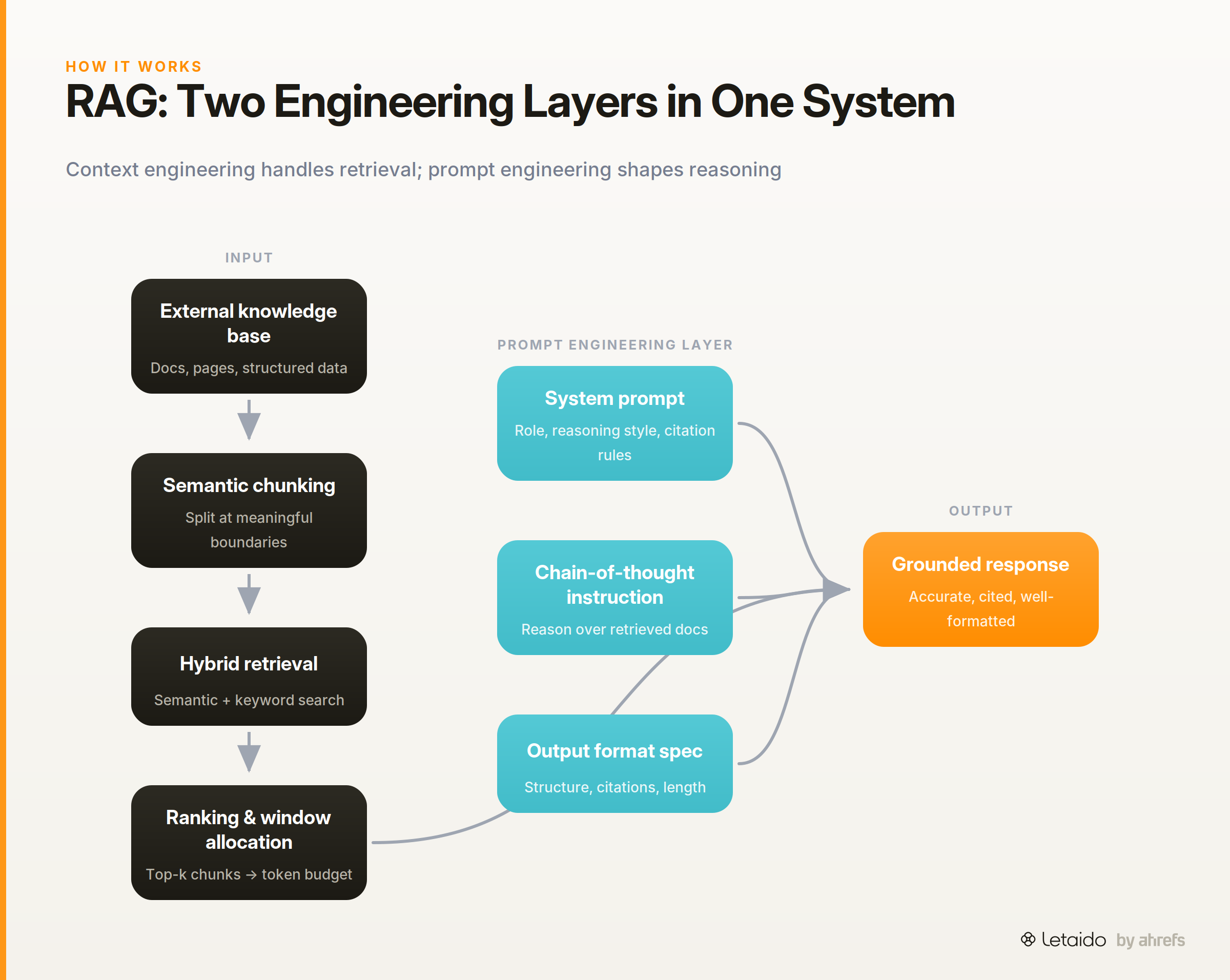
Chain-of-thought prompting, role assignment, and system prompts remain essential — they shape how the model reasons within the context it receives. A well-structured system prompt inside a poorly designed context architecture still underperforms. A perfectly engineered context window with a vague, poorly structured system prompt still produces loose outputs. Both layers have to work.
A retrieval-augmented generation (RAGRetrieval-augmented generationFetching relevant documents at query time and feeding them to the model, so answers are grounded in your own content instead of the model's memory.) system makes this concrete. RAG is a technique where a model's response is grounded in documents retrieved from an external knowledge base at query time, rather than relying only on what the model learned during training, according to NIST CSRC. In a RAG system, the retrieval design is a context engineering problem: what gets retrieved, how it's chunked, how it's ranked, how much of it enters the window. The prompt design is a prompt engineering problem: how the model is instructed to reason over what it retrieved, how citations are handled, what format the output should take. If either layer is weak, the system fails. Retrieval without good prompting produces poorly formatted, unreferenced outputs. Good prompting over bad retrieval produces confident answers grounded in the wrong documents.
Position encoding — the mechanism that tells a model where in the sequence each token appears — and compaction work as connective tissue between the two layers. Position encoding determines how the model interprets the order of information in the window; compaction determines which information survives long enough to influence later steps.
What This Means If You're Not Building the Infrastructure Yourself
Most SEO, content, and growth marketers are not deploying Claude infrastructure or writing retrieval pipelines. They're using AI agents — and increasingly, the context engineering problem is being solved at the platform layer, not by the end user.
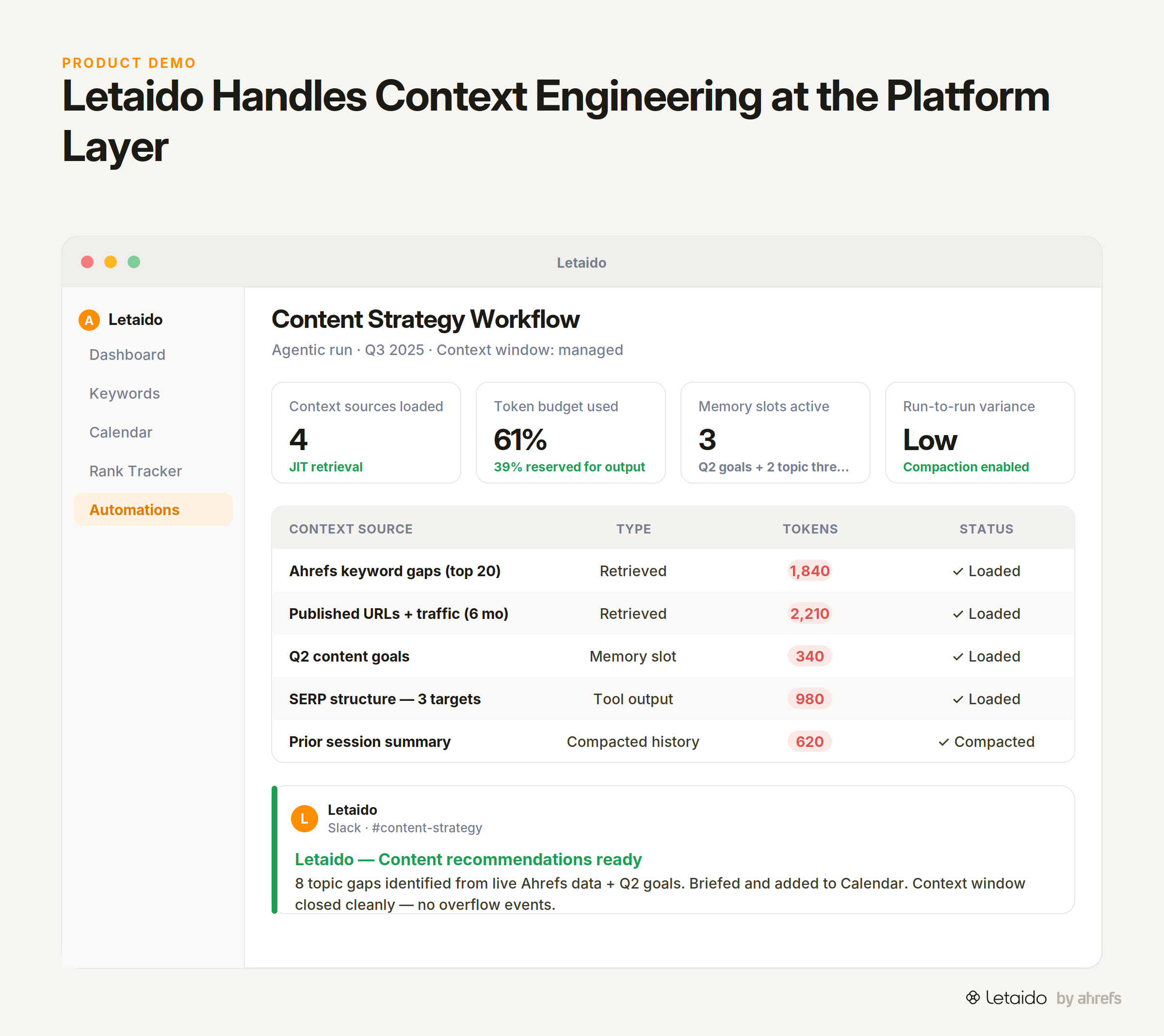
This is precisely what Letaido is built to do. Letaido handles context retrieval (pulling live Ahrefs keyword data, SERP structure, site audit results), memory management across sessions, and tool orchestration across integrations including Slack, HubSpot, and WordPress. The user writes the goal — "build a content brief for this keyword cluster," "alert me when any tracked page drops below position 10," "run a site audit and summarize the critical issues" — and Letaido handles the architecture of what context the model needs to do that well. The context engineering is built into the platform, not delegated to the user.
For teams that want to go deeper on the prompting craft layer — system prompt design, chain-of-thought structuring, few-shot example construction — those techniques still matter and are worth understanding on their own terms.
Conclusion
Prompt engineering shapes what you ask. Context engineering controls what the model can see when it answers. For bounded, single-turn tasks, prompt engineering is sufficient — and worth doing well. For agentic workflows, multi-turn memory, RAG, and tool-using systems, context engineering is the architecture that makes those workflows reliable.
The two aren't rivals. Prompt engineering lives inside context engineering, and both have to be right for complex AI systems to perform consistently. The practical question isn't which one to choose — it's recognizing when you've graduated from one to the other.