Most AI tools are built around a single exchange: you ask, they answer, they stop. That's useful, but it's not engineering. Agentic engineering is the discipline of building AI systems that pursue goals across multiple steps, use tools, remember context, and keep running without a human prompting each move.
This guide is written for marketers and ops practitioners who are becoming the operators of these systems, not just the beneficiaries. By the end, you'll have a working model of how agentic systems are structured, a framework for deciding what to automate and what to keep human, and a clear picture of what governance actually requires.
What Agentic Engineering Actually Means
The word "agentic" gets attached to a lot of things. The sections below unpack the core shift, offer a usable definition, and show specifically what plain LLMLarge language modelA model trained on vast amounts of text to predict the next token, which is what lets it write, summarise, and reason over language. use cannot do on its own.
The Core Shift: From Prompts to Agents
When you send a prompt to an LLM, you get a response. The model reads your input, generates output, and the loop closes. Every new task requires a new prompt.
An agentic system works differently. The system receives a goal, breaks it into steps, selects tools to act on each step, observes what happened, and replans based on the result. The loop stays open until the goal is met or a stopping condition is reached.
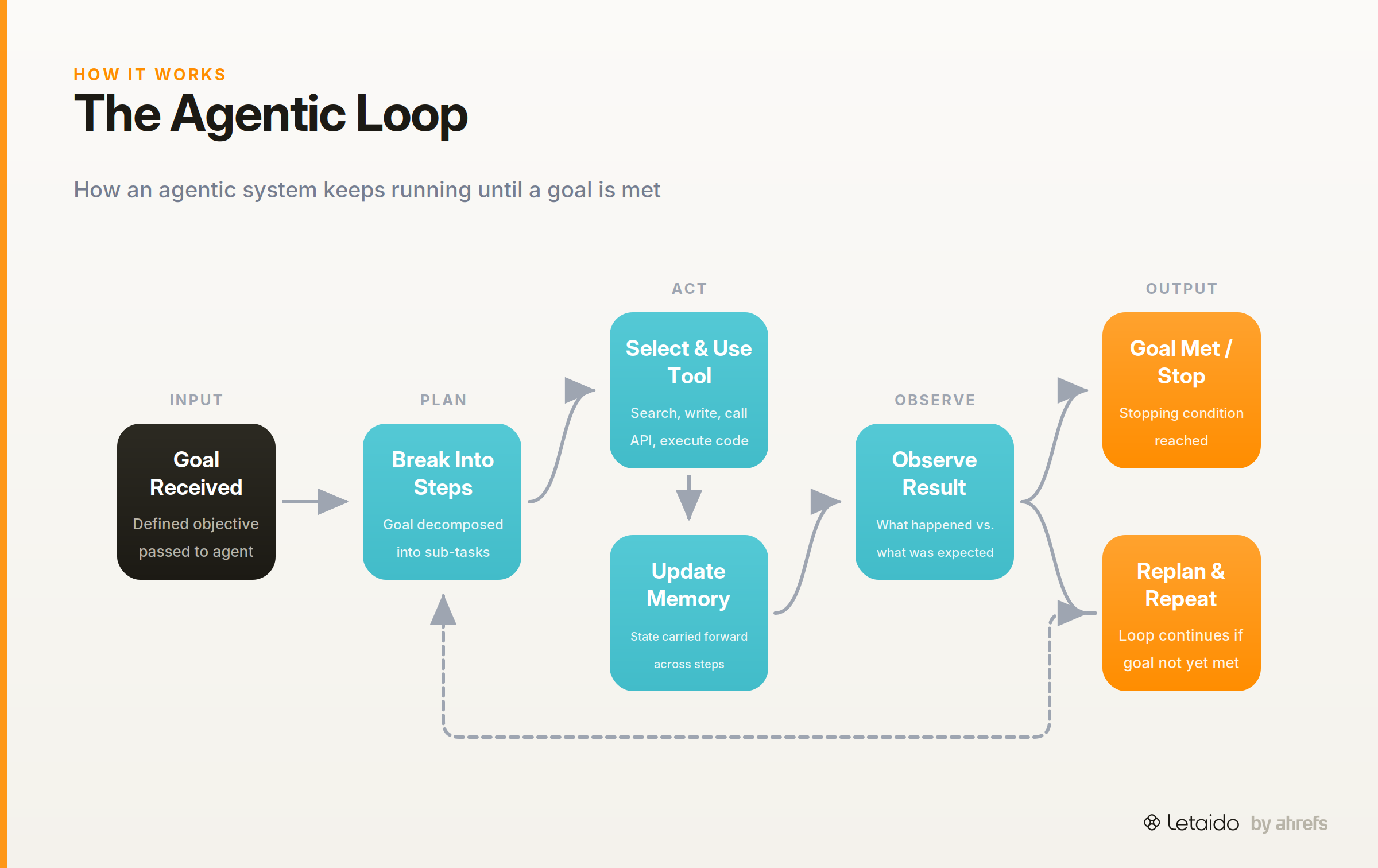
The mechanical enablers are tool definitions (structured descriptions of what external actions the agent can take, such as running a search or writing to a file), code execution (the ability to run logic rather than just generate it), and memory (carrying state forward across steps). These three components are what convert a language model into something that can act.
A Working Definition
Simon Willison, whose work on agentic patterns is widely cited by practitioners, defines it concisely: agentic engineering is the practice of designing and building systems in which an AI model takes a sequence of actions autonomously to complete a longer-horizon task.
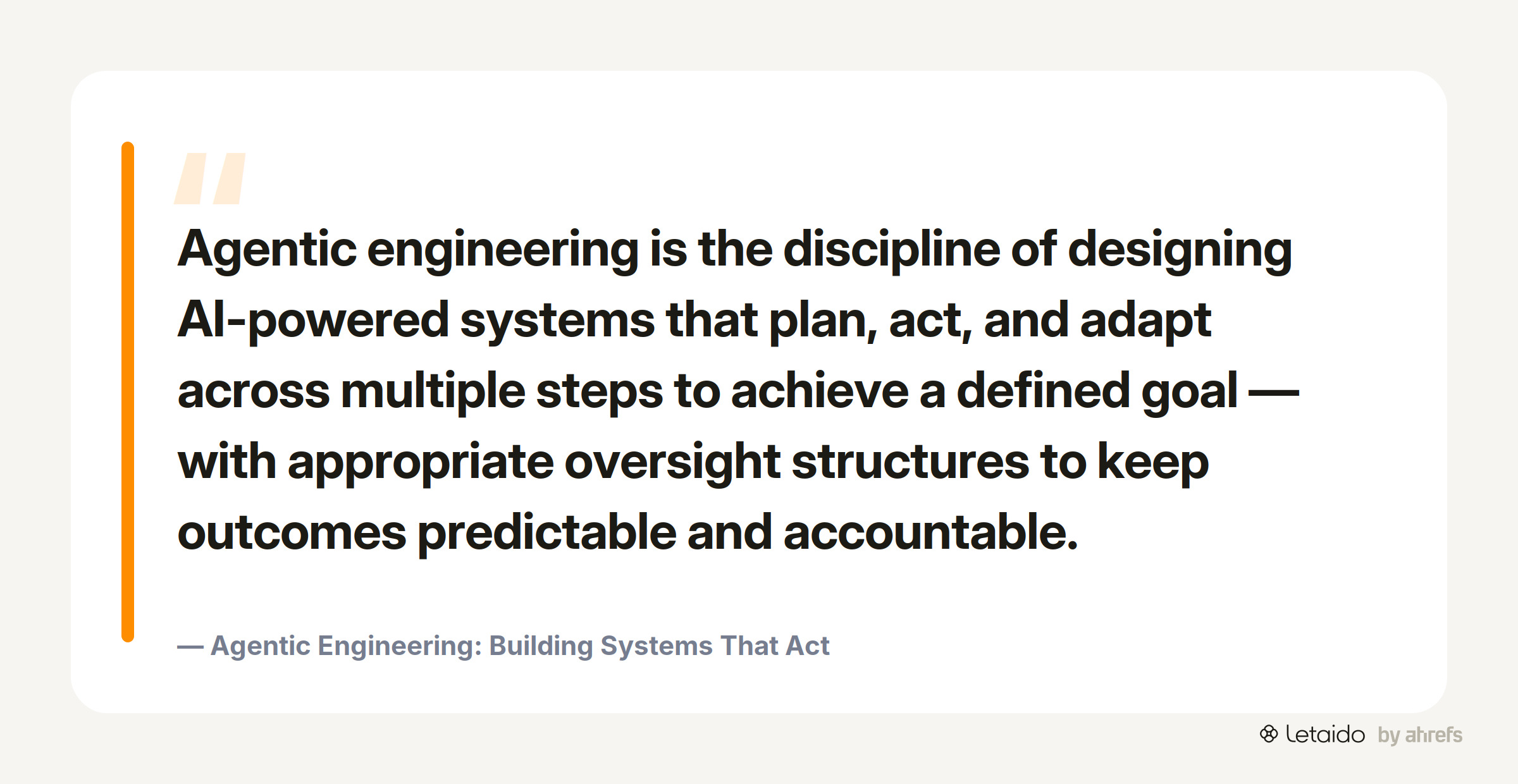
A slightly expanded working definition: agentic engineering is the discipline of designing AI-powered systems that plan, act, and adapt across multiple steps to achieve a defined goal — with appropriate oversight structures to keep outcomes predictable and accountable.
The word "discipline" matters. It signals that this is not just a feature of a model or a clever prompt — it's a set of design decisions, testing standards, and governance choices that determine whether an agentic system is reliable in production.
What Plain LLM Use Cannot Do
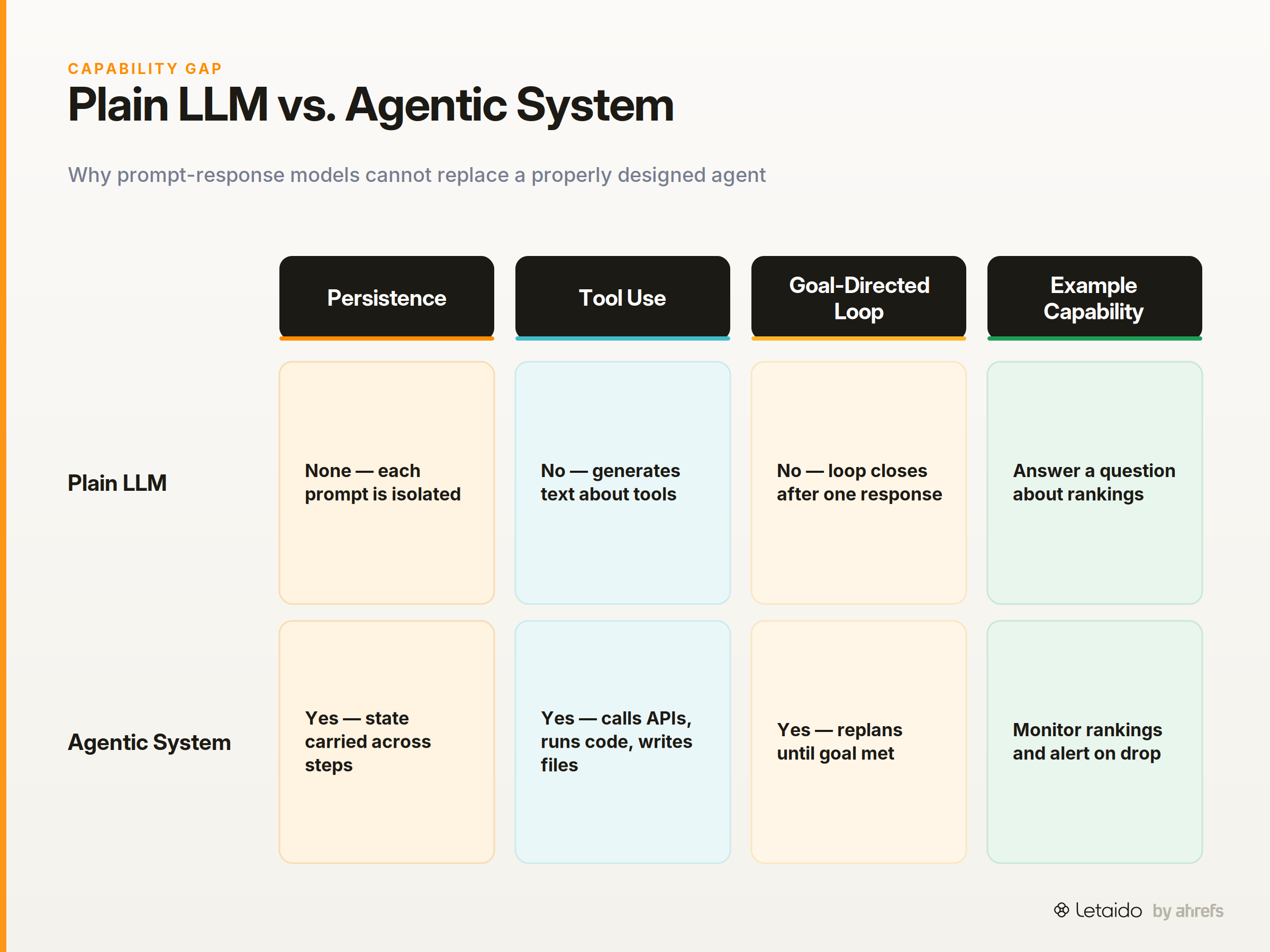
A single-turn LLM interaction has no persistence, no tool useTool useLetting a model call external functions — search, a database, an API — so it can act on the world instead of only describing it., and no goal-directed iteration. Ask it to monitor your rankings and alert you when a page drops: it can't. Ask it to run a weekly content gap analysis against live SERPSERPThe search engine results page — the full set of organic listings, ads, and features returned for a query. data and post results to Slack: it can't. Ask it to audit your site on a schedule and track which issues recur: it can't.
These are not hard problems for a well-designed agentic system. They are impossible for a prompt-response model with no loop, no memory, and no tools. That gap is exactly what agentic engineering closes.
The Augment → Automate → Deprecate Framework
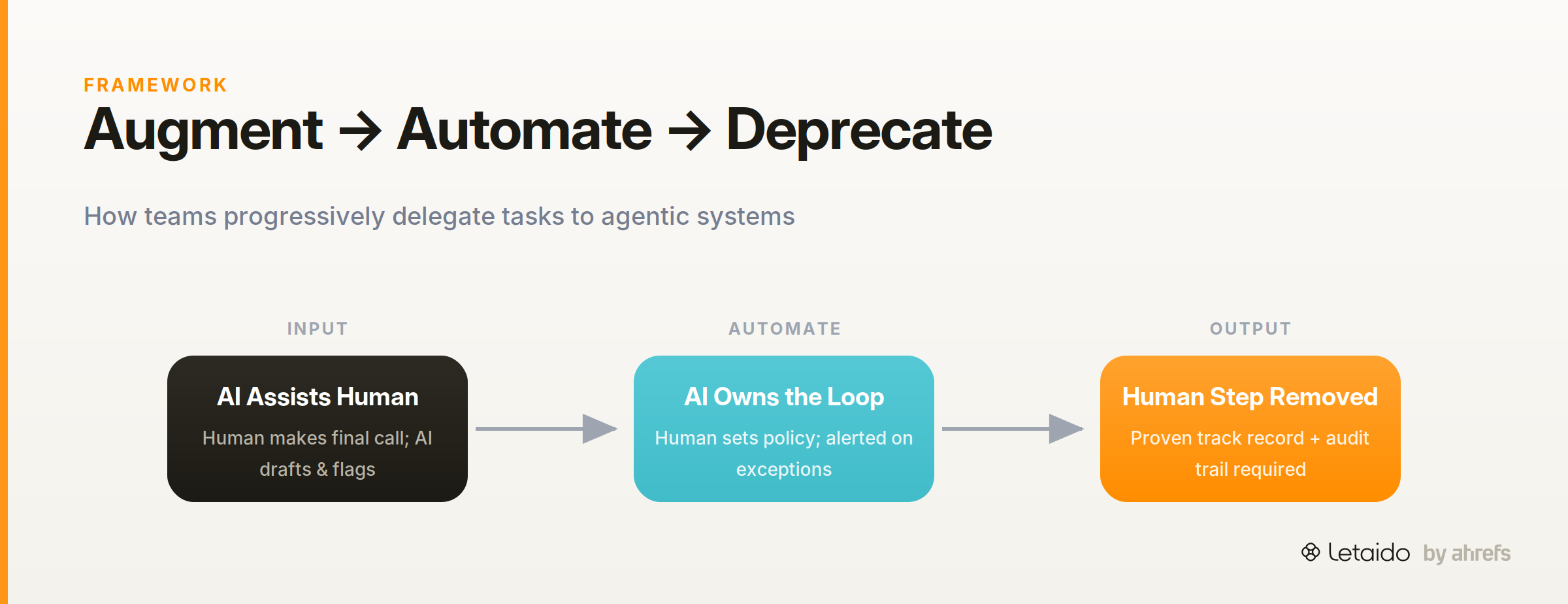
One of the most practical organizing frameworks in agentic engineering is a three-tier ladder that helps teams decide how much to delegate to a system at any given point. The tiers are not permanent categories — a task can move from Augment to Automate to Deprecate as confidence in the system grows.
Augment: AI Assists Human Judgment
At this tier, a human still makes the final call. The agentic system prepares, drafts, flags, or retrieves, and a person acts on the output.
A content strategist who gets an AI-generated content brief, reviews it, edits the angle, and approves it is working in Augment mode. The AI reduces the time and cognitive load; the human retains accountability for the decision. This is the right starting point for high-judgment tasks where errors are costly and the system is still being calibrated.
Automate: AI Owns the Loop, Human Monitors
Here, the system runs the task end-to-end. A human sets the policy, reviews exceptions, and is alerted when something falls outside defined thresholds — but does not touch the routine execution.
A rank-tracking agent that checks a keyword set daily, compares positions to a baseline, and sends a Slack alert only when a page drops more than five positions is running in Automate mode. The human team doesn't log in every morning to check the dashboard; they hear about it when it matters. The agent owns the loop; the human owns the guardrailsGuardrailsThe checks around a model — validation, allowlists, human review — that constrain what its output is allowed to do downstream..
Deprecate: Retire the Human Step Entirely
At this tier, a step that was previously human-handled is removed from the workflow entirely, because the system has proven reliable enough that the oversight step itself adds no value.
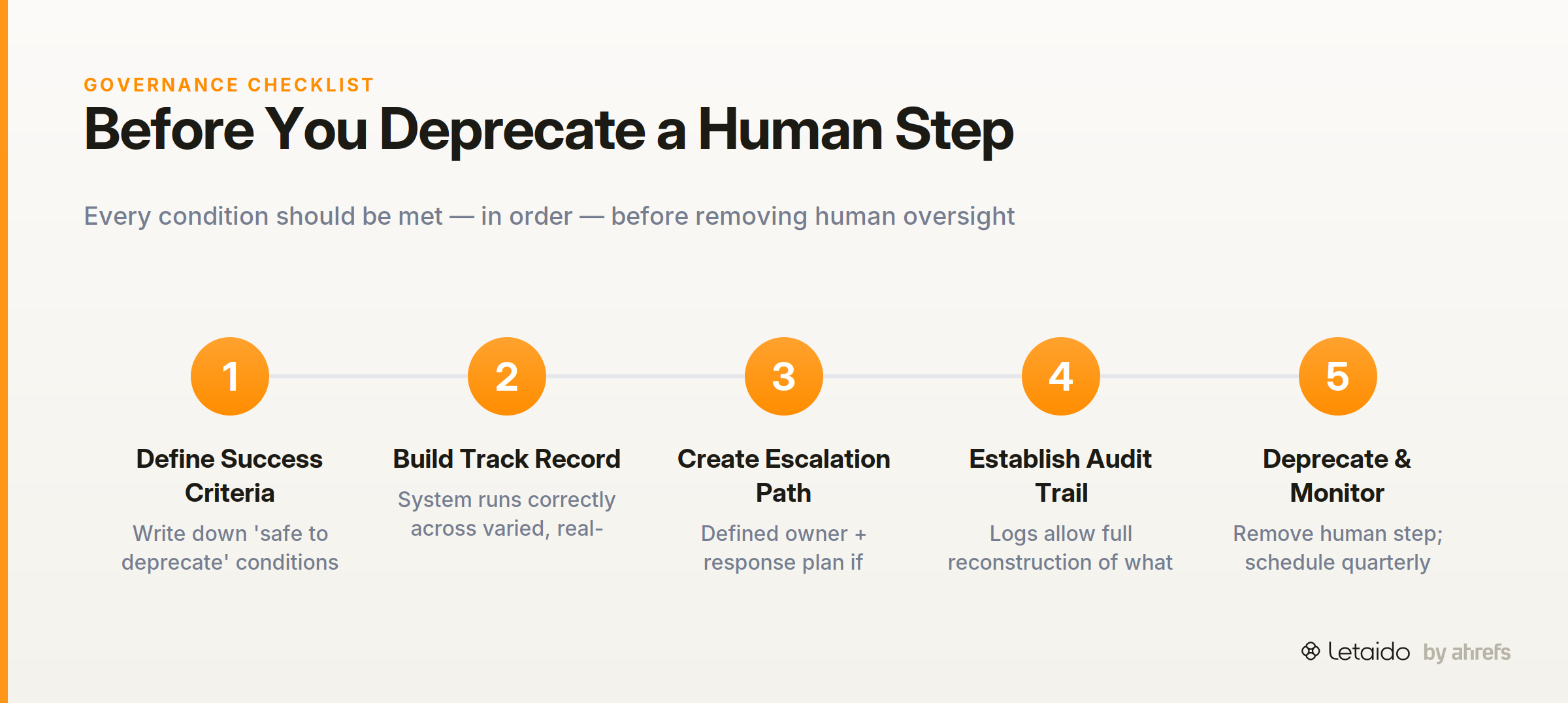
Deprecating a human step is a governance decision, not just a technical one. Before deprecating, you should have a track record of the system running correctly across varied conditions, a defined escalation path if something breaks, and audit trails that let you reconstruct what happened. The criteria for "safe to deprecate" should be written down before you start building, not inferred after the fact.
Here's how the ladder maps to common marketing ops tasks:
| Task | Tier | What "human" does |
|---|---|---|
| Draft content brief from SERP data | Augment | Reviews, edits, approves |
| Weekly keyword ranking report | Automate | Reviews exceptions; adjusts thresholds |
| Competitor backlink alerts | Automate | Reviews flagged changes, decides response |
| Monthly site crawl for broken links | Automate | Reviews summary; spots patterns |
| Tagging new blog posts with metadata | Deprecate (if rules are stable) | Audits quarterly |
Agentic Engineering vs. Vibe Coding (and What Else It Is Not)
The term "agentic engineering" is often used loosely alongside related phrases like vibe coding, AI-assisted development, and agentic programming. These are not synonyms. Understanding the distinctions helps you know which standard applies to the work you're doing.
Vibe Coding: Fast, Disposable, Acceptable for Prototypes
"Vibe coding" refers to the practice of using an AI model to generate working code quickly, with little formal review, relying on the output being good enough for the current purpose. The intent is speed, not rigor. The code is often prototype-quality: it works, but it may not handle edge cases, it lacks tests, and it would need substantial rework before going into a production system.
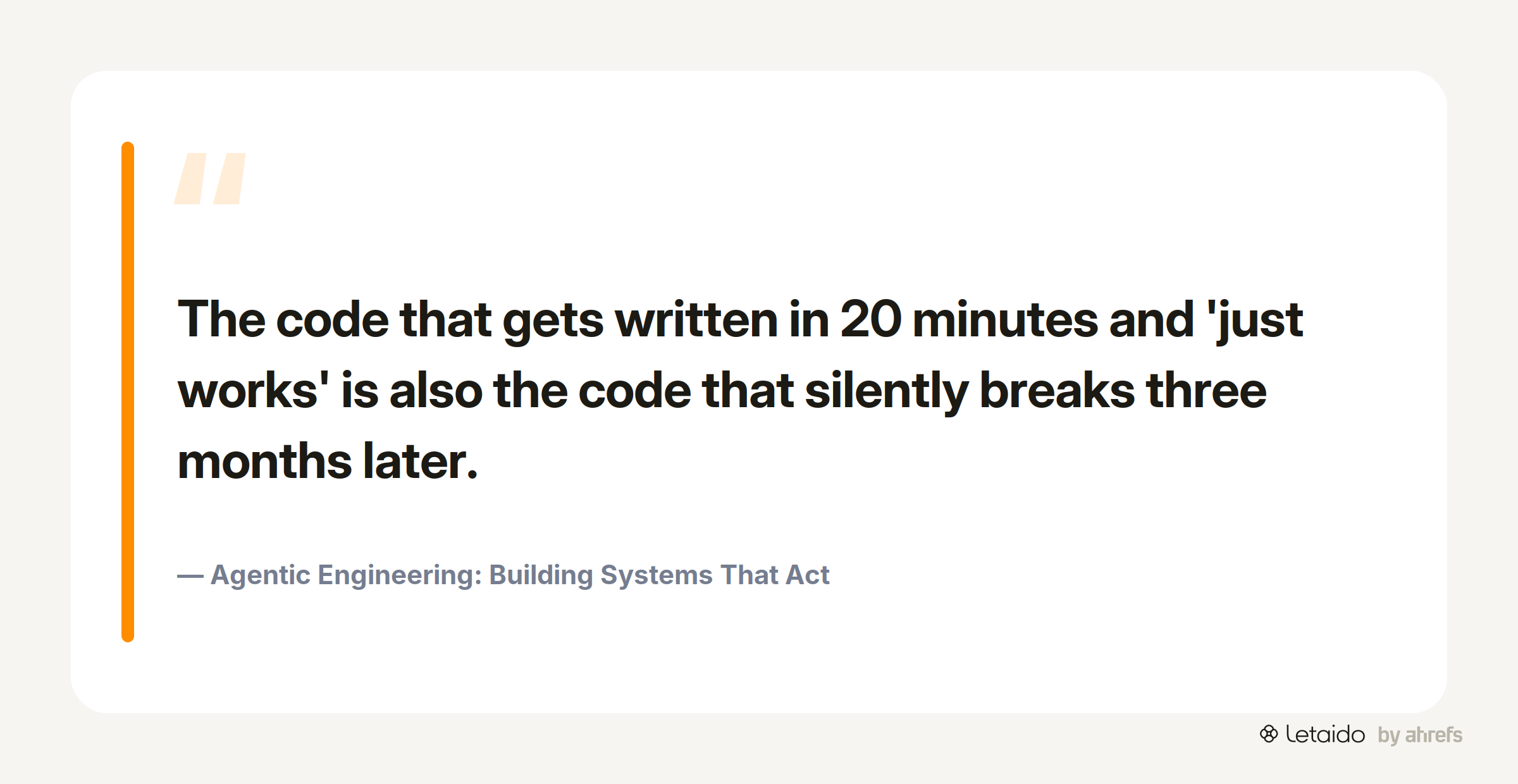
Vibe coding is a reasonable approach for a personal script, a quick internal tool, or a proof-of-concept. It becomes a liability when the output gets promoted into a system other people depend on without being brought up to production standards. The code that gets written in 20 minutes and "just works" is also the code that silently breaks three months later.
Agentic Engineering: Production-Ready, Governed, Accountable
Agentic engineering applies engineering discipline to AI-powered systems that will run in production. That means testing expectations are defined before the system ships, code-review requirements exist and are followed, the system's behavior is reproducible, and there's a clear owner when something goes wrong.
The distinction is not about the tools used or even how much AI was involved in writing the code. It's about the standards applied to the output. An agentic system built to production standards will have observable behavior, defined failure modes, and governance structures that make it safe to operate at scale.
Where LLM-Generated Code Fits — and Where It Breaks Down
LLM-generated code is probabilistic output, meaning the same prompt run twice can produce different code, and neither version is guaranteed correct. For simple, well-defined tasks with clear test criteria, LLM-generated code can meet production standards quickly. For complex logic with subtle edge cases, the quality ceiling is lower than it appears.
The practical problem is technical debt (accumulated shortcuts and undocumented decisions that make a codebase harder to change over time). AI-assisted programming can introduce technical debt faster than human-written code because the AI does not have context about the broader system it is modifying, may generate plausible-looking but subtly wrong logic, and does not flag its own uncertainty. Ownership of that debt needs to be assigned explicitly — it doesn't disappear because the code was generated.
Comparison Table
| Dimension | Vibe Coding | AI-Assisted Development | Agentic Engineering |
|---|---|---|---|
| Primary intent | Speed, exploration | Productivity | Reliable production systems |
| Output standard | Prototype quality | Varies; review required | Production-ready |
| Accountability | Individual author | Team review | Defined ownership + audit trail |
| Governance | None | Lightweight | Formal: guardrails, testing, escalation |
| When to use | Personal scripts, POCs | Feature work, with review | Systems that run autonomously at scale |
What Agentic Systems Look Like in Practice
Abstract definitions only carry you so far. This section shows what the architecture and workflows of agentic systems actually look like, from their structural components to real-world examples in marketing operations.
Core Components: Tool Definitions, Modular Architecture, and RAG
Every agentic system is built from a small set of structural primitives.
Tool definitions tell the agent what external actions it can take: query a database, call an API, run a web search, write a file, post a message. The agent selects among its tools based on what the current step requires. The quality and specificity of tool definitions directly determines how reliably the agent acts.
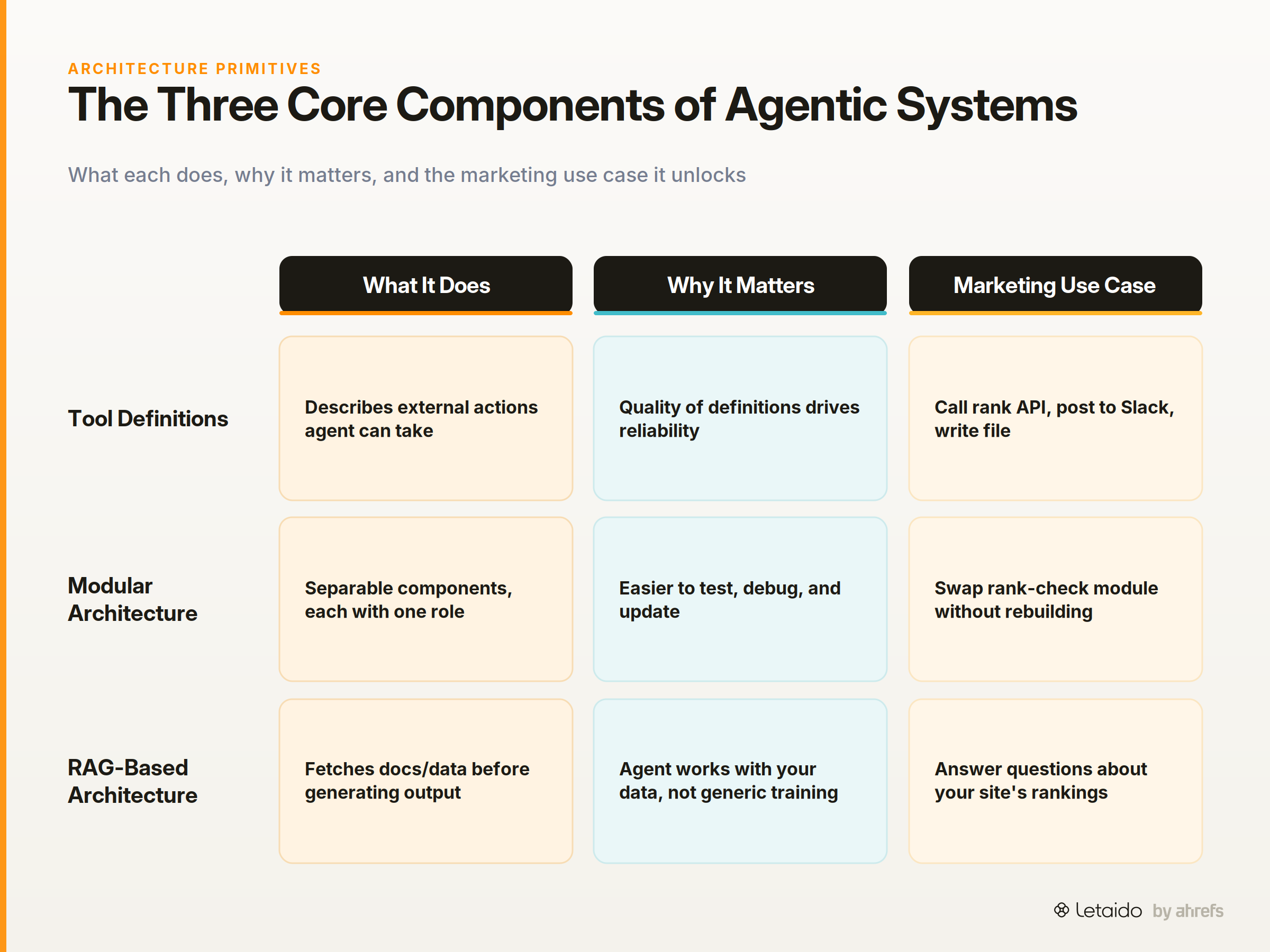
Modular architecture means the system is composed of separable components, each responsible for a specific function, rather than one monolithic block. Modular systems are easier to test, easier to debug, and easier to update when one component needs to change.
RAG-based architectures (Retrieval-Augmented Generation, where the agent fetches relevant documents or data before generating a response) allow the system to work with current, specific information rather than relying solely on what the model was trained on. For marketing use cases, this is what allows an agent to answer questions about your site's data rather than producing generic output.
Google Gemini Agents illustrate how these components come together at the infrastructure level. The platform provisions a sandboxed Linux environment where the agent reasons, executes code, manages files, and browses the web autonomously — all from a single API call. As the Google AI for Developers documentation describes it: "A single API call provisions a Linux sandbox where the agent reasons, executes code, manages files, and browses the web autonomously."
How Agentic Workflows Chain Together
A single-agent loop looks like this: receive goal, plan steps, select tool, execute, observe result, update plan, repeat until done. Multi-agentMulti-agent systemSeveral specialised agents working together on one job, each owning a step, coordinated by a planner or a shared workflow. systems chain multiple loops together, with each agent specialized for a different function.
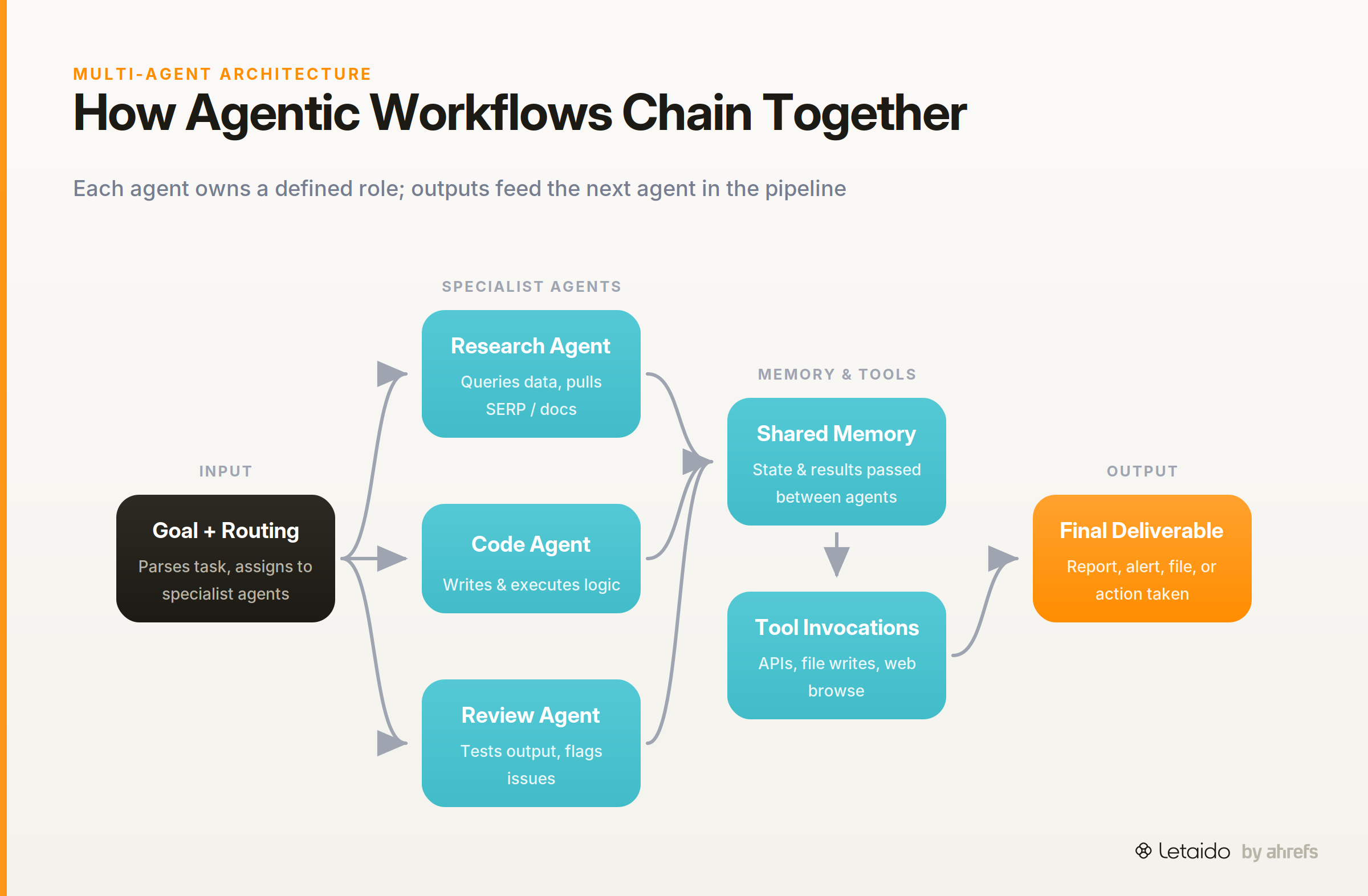
AutoGen, Microsoft's open-source multi-agent orchestration framework, coordinates networks of agents through structured conversations and a message-routing runtime. Each agent handles a defined role — one might do research, another write code, a third review and test. A documented production system using AutoGen patterns at scale deployed 22 specialized agents across a software development lifecycle, each covering a distinct task from requirements parsing to test execution.
Microsoft's Agent Framework handles the lower-level plumbing: LLM integration, tool invocation, session state, multi-turn memory, and graph-based workflow orchestration in a single SDK. As one practitioner summarized: "Much simpler than rolling your own. A lot of the complex machinery — the agent loop, tool invocation flow, message history handling — is already implemented for you."
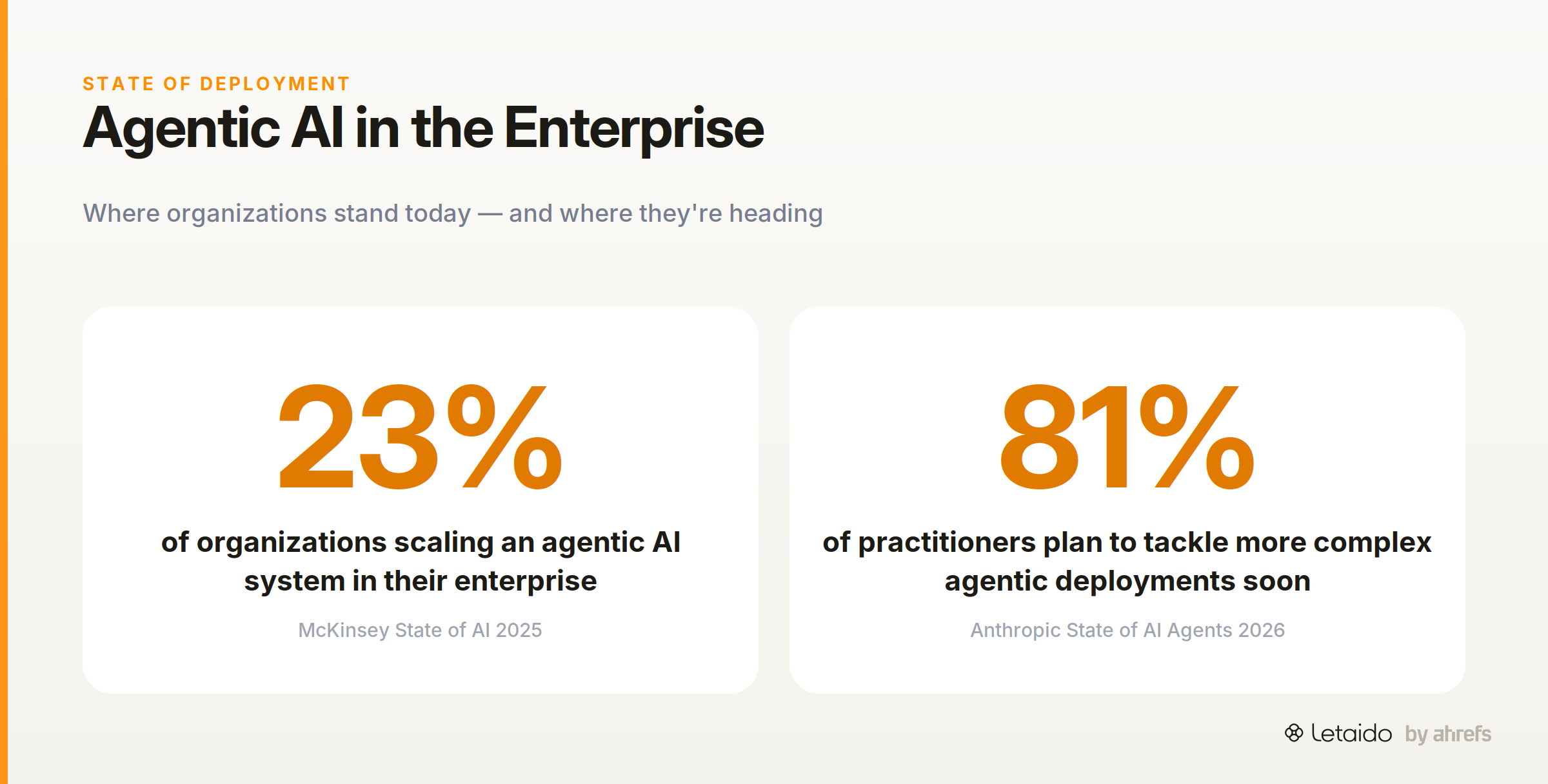
The scale of production deployment is still maturing. According to McKinsey's 2025 State of AI report, 23% of organizations are scaling an agentic AIAgentic AIAI that plans and executes multi-step work toward a goal, choosing its own next action, rather than returning one response to one prompt.Read: What Is Agentic AI? A Plain-English Guide system somewhere in their enterprise. According to Anthropic's 2026 State of AI Agents report, 81% of practitioners plan to tackle more complex deployments in the near term — which means the multi-agent architectures that feel advanced today are the baseline most teams are moving toward.
Marketing-Grounded Examples: SEO Monitor, Content Gap Reporter, Competitive Dashboard
Three agentic workflows that illustrate what this looks like for a marketing team:
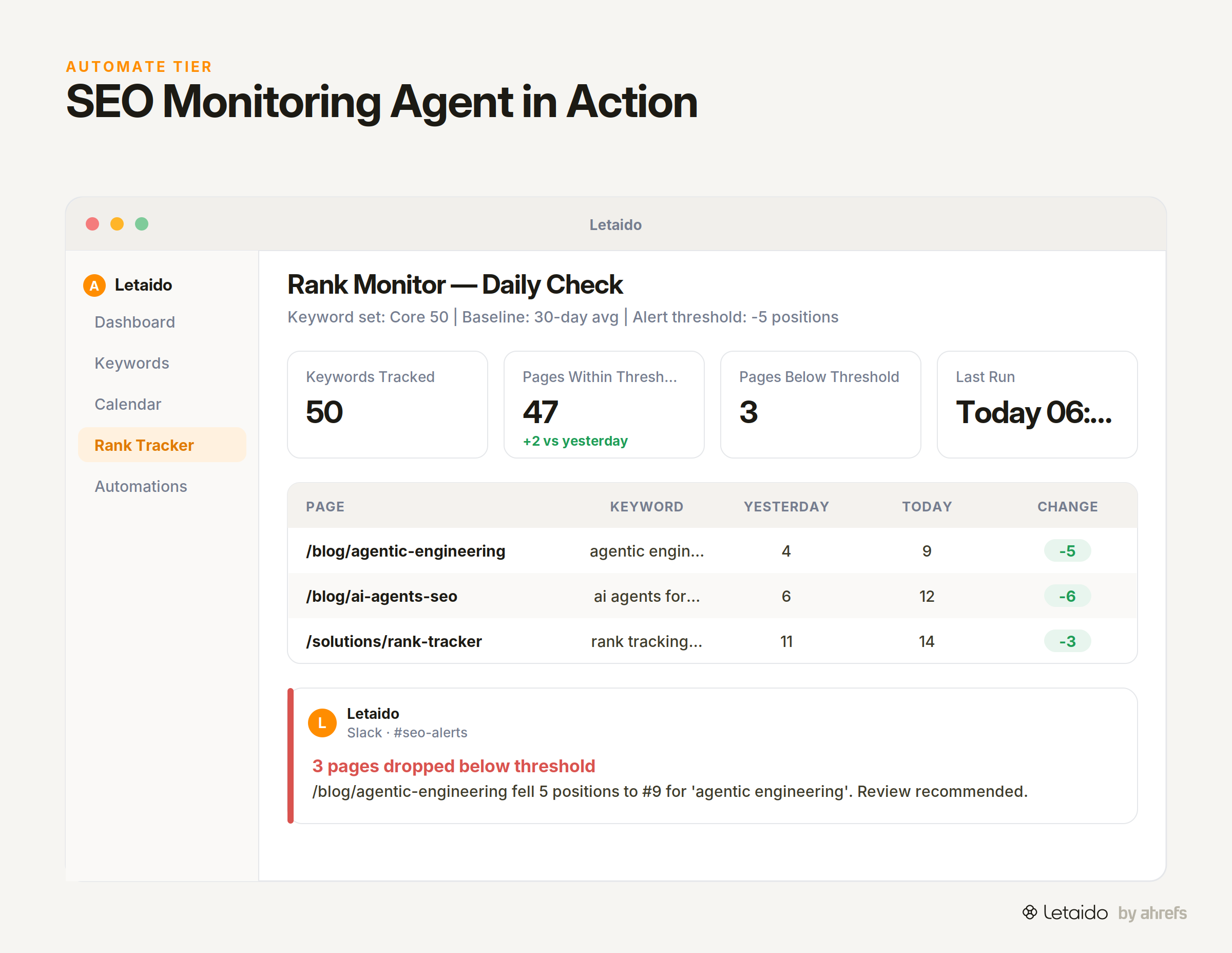
SEO monitoring agent. The agent runs a daily check against a defined keyword set, pulls rank data, compares against a stored baseline, and posts a Slack message only when a page drops below a set threshold. No human checks the dashboard every morning. The human team gets a message when the situation requires attention. This is Automate-tier in the Augment → Automate → Deprecate framework.
Content gap reporter. The agent performs keyword clustering against a full keyword database, identifies clusters where the site lacks coverage or where existing pages underperform, and generates a prioritized brief for each gap. A content strategist reviews and adjusts the brief before work begins — Augment-tier, with the AI eliminating two to three hours of manual analysis per cycle.
Competitive dashboard. The agent monitors competitor backlink profiles, new content, and ranking shifts on a scheduled basis, compiles a summary, and publishes it to a shared workspace. The team sees current competitive data without anyone running the research manually. The system handles the loop; the team handles the decisions the data surfaces.
Letaido is built on exactly these patterns. Letaido has full access to Ahrefs data, can run keyword research and content gap analysis without consuming API units, generates data-grounded content briefs from live SERP structure, and tracks rankings with threshold-based Slack alerts. Scheduled automations run at any interval — daily rank checks, weekly audits, monthly competitive recaps — and results surface in Slack, Notion, HubSpot, or wherever your team works. The underlying system is agentic engineering applied to a marketing operations context: the agent owns the loop, the marketer sets the policy and acts on exceptions.
Try this prompt in Letaido:
Run a content gap analysis against our top three competitors using Ahrefs data.
Cluster the keyword gaps by topic, prioritize by traffic potential, and generate
a one-page brief for the top three clusters. Post the output to our Slack channel.
How Organizations Adopt Agentic Engineering
Most organizations are earlier in this transition than the headline numbers suggest. Kong's 2025 Agentic AI in the Enterprise report found 90% of respondents report their organization is actively adopting AI agents — but Gartner's 2025 survey found only 15% of IT application leaders are considering, piloting, or deploying fully autonomous agents. The gap between "adopting" and "running autonomous systems in production" is where most teams are right now.
Crossing that gap is an organizational challenge as much as a technical one.
Start with Governance, Not Tools
The instinct when adopting new technology is to start with tool selection. For agentic systems, that's backwards. A governance framework should be in place before any agent runs in production, because the questions governance answers — who owns the system, what it's authorized to do, how failures are detected, and how accountability is assigned — determine which tools are appropriate, not the other way around.
A minimal governance framework for an agentic system covers four things: scope (what is the agent authorized to do, and what is explicitly out of scope), ownership (who is accountable when the system produces a wrong output), audit trails (what records are kept of the agent's actions and decisions), and escalation paths (what happens when the system encounters a situation outside its defined parameters).
Build Your Internal Playbook
A playbook makes governance operational. Before an agentic workflow goes into production, the team should have written answers to the following questions.
What does "done" look like for this workflow, and how is it verified? What tests confirm the system is behaving as intended? Who reviews the output, and on what cadence? What constitutes a failure, and who gets notified? What's the rollback procedure if something goes wrong?
These questions feel administrative, but they are the difference between a system that compounds errors silently and one that surfaces problems before they cause real damage.
Configure Guardrails and Human Oversight Checkpoints
Guardrail configurations are the technical implementation of governance policy. They include thresholds that trigger alerts, fallback behaviors when the agent encounters an unexpected state, and approval gates that pause execution and request human input before a consequential action.
In Automate-tier workflows, guardrails are what keep "human monitors" from meaning "human never looks until it breaks badly." A well-configured guardrail surfaces the exception; the human handles the exception; the agent continues with the routine.
Common Failure Modes and How to Avoid Them
Several failure patterns appear consistently in production agentic systems. Understanding them in advance is easier than diagnosing them after the fact.
Accountability gaps occur when an agentic system produces a wrong output and no one can clearly answer who is responsible — the engineer who built it, the manager who approved it, or the vendor whose model powered it. The fix is to assign ownership explicitly before deployment, not after a failure.
Silent failures happen when the system encounters an error, handles it gracefully from the agent's perspective, and continues — but the output is wrong or incomplete, and no one is notified. The fix is to make failures visible: log unexpected states, send alerts for outputs that fall outside expected ranges, and review a sample of outputs manually on a regular schedule.
Scope creep in autonomous systems describes the gradual expansion of what an agent does beyond what it was designed to do, often because it was given broad tool access and found efficient paths that weren't anticipated. The fix is tight tool scope at design time and periodic reviews of what the agent actually did versus what it was intended to do.
What an Experimentation Culture Actually Requires
An experimentation culture is not the same as moving fast and ignoring failures. In an agentic engineering context, it means running new workflows in constrained conditions first, treating unexpected outcomes as data rather than embarrassments, and having a clear path from "experiment" to "production" that includes a governance checkpoint.
According to PwC's May 2025 survey of 300 senior executives, 88% plan to increase AI-related budgets in the next 12 months due to agentic AI. Budget is accelerating faster than operational maturity at most organizations. The teams that will get the most from that investment are the ones building governance infrastructure now, before they need it urgently.
Where Agentic Engineering Is Heading
The field is moving quickly, but some patterns are solidifying while others remain genuinely unsettled. The distinction matters for anyone making investment or adoption decisions today.
Patterns That Are Solidifying
Tool-calling standards are converging. The pattern of giving an agent a structured list of available tools, letting it select and invoke them, and feeding the results back into the reasoning loop is now consistent across every major framework and model provider.
Human-in-the-loop checkpoints are becoming standard governance practice rather than optional. The Anthropic 2026 report signals that even as organizations plan more complex deployments, they are building oversight structures into those deployments rather than removing them.
Evaluation harnesses — test suites that verify an agentic system's behavior across representative scenarios before deployment — are emerging as a minimum standard for production systems. Simon Willison's Agentic Engineering Patterns guide covers several of these conventions in practical detail.
The Expanding Scope of Autonomous Systems
The trajectory is clear: single-task agents are giving way to multi-agent systems that handle end-to-end workflows across longer time horizons. According to Capgemini's 2025 research, gen AI adoption surged from 6% in 2023 to 30% in 2025. The next phase — operational agents running persistent workflows — is where that adoption momentum is heading.
What remains unsettled is reliability at scale. Multi-agent systems introduce compounding failure risk: an error in an early step propagates through downstream agents, often in ways that are difficult to detect until the final output is reviewed. Evaluation frameworks for multi-agent reliability are still maturing.
What This Means for Non-Engineers Who Operate These Systems
The emerging role in marketing and ops organizations is not "person who uses AI tools." It's closer to agentic system operator: someone who designs workflows, sets governance policy, configures thresholds and escalation paths, and iterates on agent behavior based on output quality — without necessarily writing code.
This requires a working model of how agentic systems are structured (the components covered in this guide), judgment about what belongs in each tier of the Augment → Automate → Deprecate framework, and the operational discipline to build governance structures before they're urgently needed. It is a new skill set, and it is genuinely valuable.
Where to Go Next
The resources below are starting points organized by what you're trying to learn. Each one adds something distinct.
Foundational Reading
Simon Willison's Agentic Engineering Patterns guide is the most practical short introduction to the discipline. Willison is a practitioner-writer who keeps definitions grounded in what systems actually do; this is the right first read if you want the concepts without the enterprise gloss.
Bassim Eledath's 8 Levels of Agentic Engineering offers the most thorough leveling framework currently available in the SERP. It is dense and developer-centric, but the progression from simple tool use to fully autonomous multi-agent systems is a useful mental model for calibrating where your current work sits.
Anthropic's 2026 State of AI Agents report provides the most current practitioner-survey data on adoption patterns, use cases, and where organizations are investing. Useful for calibrating expectations against what real teams are actually doing.
Tools and Frameworks Worth Exploring
Google Gemini Agents is a strong starting point if you want to experiment with agentic capabilities without heavy infrastructure setup. A free tier is available; the managed agent harness provisions a sandboxed environment with web browsing, code execution, and file management. Suitable for exploratory work before committing to a framework.
Microsoft Agent Framework is an open-source SDK that handles the infrastructure layer — agent loops, tool invocation, session memory, workflow orchestration — so you're building on a tested foundation rather than from scratch. The trade-off: it requires more engineering investment to configure than a managed service.
AutoGen is the right tool for multi-agent orchestration experiments. It supports conversable agents, tool/function calling, code execution, and an event-driven runtime for distributed agent systems. Open source and installable via pip. One practitioner note worth keeping in mind: "I spent three days getting AutoGen to do what CrewAI does in an afternoon" — it rewards investment but has a real learning curve.
Letaido as Agentic Engineering Applied to Marketing
If you work in SEO, content, or marketing ops, Letaido is the most direct way to put the concepts in this guide into practice. Letaido is a marketing agent with full Ahrefs data access that builds and runs keyword research workflows, content briefs, rank monitoring with Slack alerts, site audits, competitive analysis, and scheduled reporting automations — all without consuming Ahrefs API units.
The system embodies the Augment → Automate → Deprecate model directly: some workflows surface analysis for a human to review and act on (Augment); others run on a defined schedule and notify the team only when thresholds are crossed (Automate); routine data collection tasks run entirely in the background (Deprecate). The team sets policy; the agent runs the loop.
Letaido is $99/month, including $50 in AI credits. An Ahrefs subscription is needed only for workflows that pull Ahrefs data. There's a trial available if you want to test a specific workflow before committing.
Agentic engineering is the discipline that determines whether AI investment produces reliable systems or just impressive demos. The shift from "AI tool that answers" to "system that acts" is technical, but the decisions that make it work — governance, ownership, oversight, testing standards — are organizational. Understanding the discipline is the prerequisite for designing and operating these systems well, regardless of whether you write a line of code.