
Context engineering is a term you'll hear more and more as AI agentsAI agentA system that combines a language model with tools and a goal, so it can decide what to do next and act — not just generate text.Read: What Are AI Agents? Definition, Types, and Examples move from demos into production. It's worth understanding precisely, because it describes something that determines whether those agents are useful or not.
Here's what it means and why it matters if you run any kind of AI-powered marketing workflow.
The One-Sentence Definition
Context engineering is the deliberate design of everything an AI model receives before it acts — instructions, memory, retrieved knowledge, and available tools — so it behaves reliably across many tasks, not just in a single exchange.
The model's weights don't change between your runs. The only variable you control is what you put in front of it. Context engineering is the discipline of making that input consistent, complete, and intentional.
Context Engineering vs. Prompt Engineering
These two terms get conflated constantly, but they operate at completely different levels. A prompt is a message you send; context is the environment the model inhabits when it reads that message. The table below shows where they diverge.
Prompts Are Messages. Context Is the Environment.
| Dimension | Prompt engineering | Context engineering |
|---|---|---|
| Scope | Single input, single output | The full information environment across all runs |
| Persistence | One-time; rewritten each session | Persistent; survives across sessions and agent steps |
| Who owns it | The person typing the prompt | The team or system that configures the agent |
| What it governs | The quality of one answer | The reliability of the agent's behavior at scale |
Prompt engineering optimises a single exchange. You write a better question, you get a better answer. Context engineering governs how an AI agent (a model that takes actions, not just answers questions) behaves across hundreds or thousands of automated runs without a human in the loop for each one.
What Context Is Actually Made Of
Context isn't a single thing you pass to a model. It's assembled from four distinct buckets, each serving a different purpose.
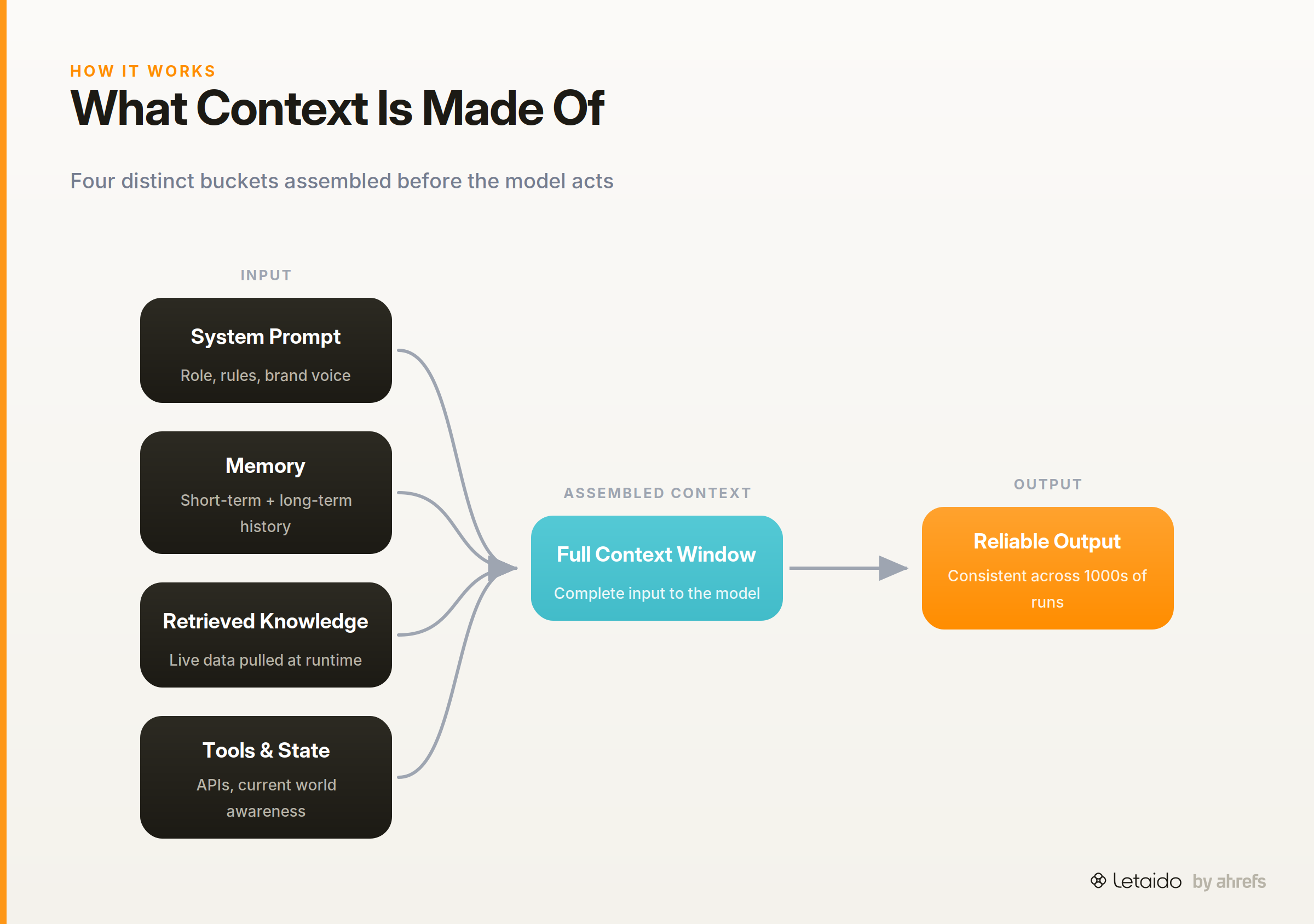
- Instructions / system promptSystem promptThe standing instruction that sets a model's role, rules, and tone for an entire session, separate from the user's individual messages.Read: System Prompts: What They Are and How to Write Them . The standing rules the agent follows: its role, its constraints, its output format, the brand voice it must maintain.
- Memory. Short-term memory covers what happened earlier in the current session. Long-term memory covers what the agent learned or produced in previous runs — retained and retrieved across time.
- Retrieved knowledge (RAGRetrieval-augmented generationFetching relevant documents at query time and feeding them to the model, so answers are grounded in your own content instead of the model's memory.). Information pulled in at runtime from external sources: a knowledge base, a live database, search results, or proprietary data. RAG stands for retrieval-augmented generation, meaning the model fetches relevant facts rather than relying on what it learned during training.
- Tools and state. The actions the agent can take (run a query, call an API, write a file) and its current awareness of the world (today's date, the user's account status, the last output it produced).
Strip any one of these and the agent is operating blind in that dimension.
What Bad Context Produces — and What Good Context Fixes
The difference is easiest to see with a concrete example. Imagine you're using a content agent to write a campaign brief.
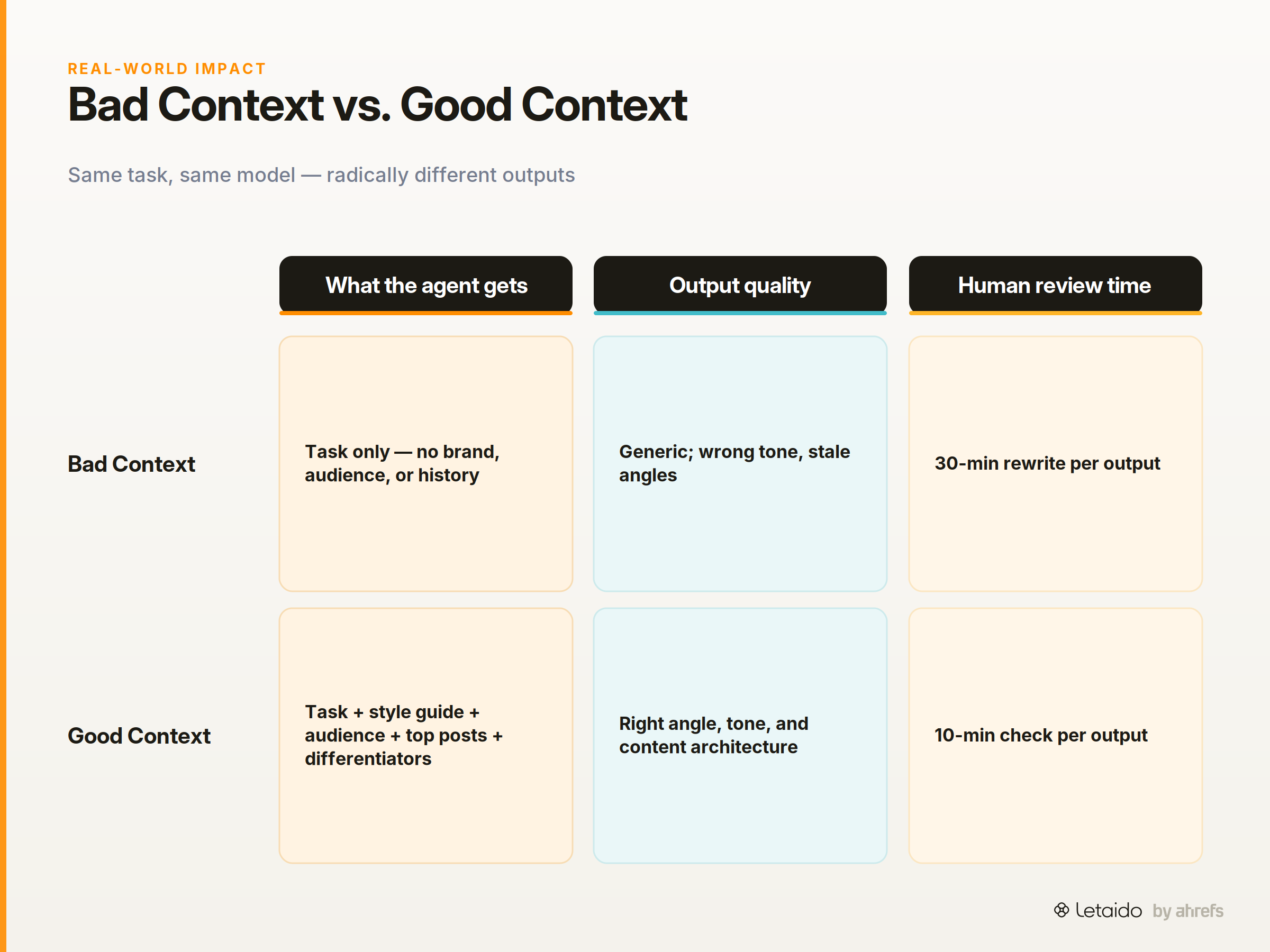
Bad context: The agent receives only the task: "Write a brief for a blog post about email deliverability." No brand guidelines. No target audience definition. No information about what's already performed well. No awareness of your product's positioning.
The agent produces something plausible but generic. The audience framing is off. The tone doesn't match your brand. Two of the recommended angles are things you published last quarter. A human has to rewrite most of it.
Good context: The agent receives the task, your brand style guide, the audience segment (mid-market marketing ops managers), last month's five highest-traffic posts, your product's key differentiators, and the brief for the previous piece in the series.
The output arrives with the right angle, the right tone, and references that fit your existing content architecture. The human review is now a 10-minute check rather than a 30-minute rewrite.
The task was identical. The model was identical. The context was not.
Why Context Engineering Matters More at Scale
A single prompt exchange has one failure point. If the answer is wrong, you notice immediately and try again.
An autonomous agent running 24/7 has a different failure profile. Each step in a multi-step workflow consumes the output of the previous step. If the context at step one is slightly off — wrong audience assumption, stale data, missing brand constraint — that error doesn't stay isolated. It gets baked into step two's input, then step three's, then the final output that gets published or sent.
This compounding effect is why context engineering is the quality-control layer for agent-powered systems, not prompt cleverness. You can write a beautiful prompt and still get consistent failures if the surrounding context is thin or wrong. Conversely, a simple prompt inside a well-engineered context tends to produce reliable output run after run.
What Poor Context Costs a Marketing Team
Poor context isn't an abstract problem. It shows up as concrete, costly outputs.
Brand voice drift happens when the agent has no style guide or prior examples to anchor to. Each output sounds slightly different, and over dozens of automated pieces, you end up with content that doesn't cohere.
Wrong audience framing gets baked into every downstream output when the agent has no audience definition. A brief written for enterprise buyers becomes the foundation for a nurture email sequence — and the whole sequence inherits the wrong frame.
Hallucinated data occurs when the agent lacks access to real, current figures and fills the gap with plausible-sounding but invented statistics. In marketing content, those numbers can end up published.
Before adopting any AI agent for your stack, ask these questions: Where does the agent get its information about my brand? What does it retain between runs? When I update my positioning or audience, how does that change propagate to the agent's context?
If a vendor can't answer all three, the context engineering is probably happening ad hoc — which means the quality is, too.
How Letaido Handles This
This isn't a theoretical problem for Letaido — it's the core design decision. Letaido ships with live Ahrefs data access baked in, persistent memory of prior outputs across sessions, and brand context you configure once and the agent carries forward. That architecture is context engineering in practice, not a feature bolted on.
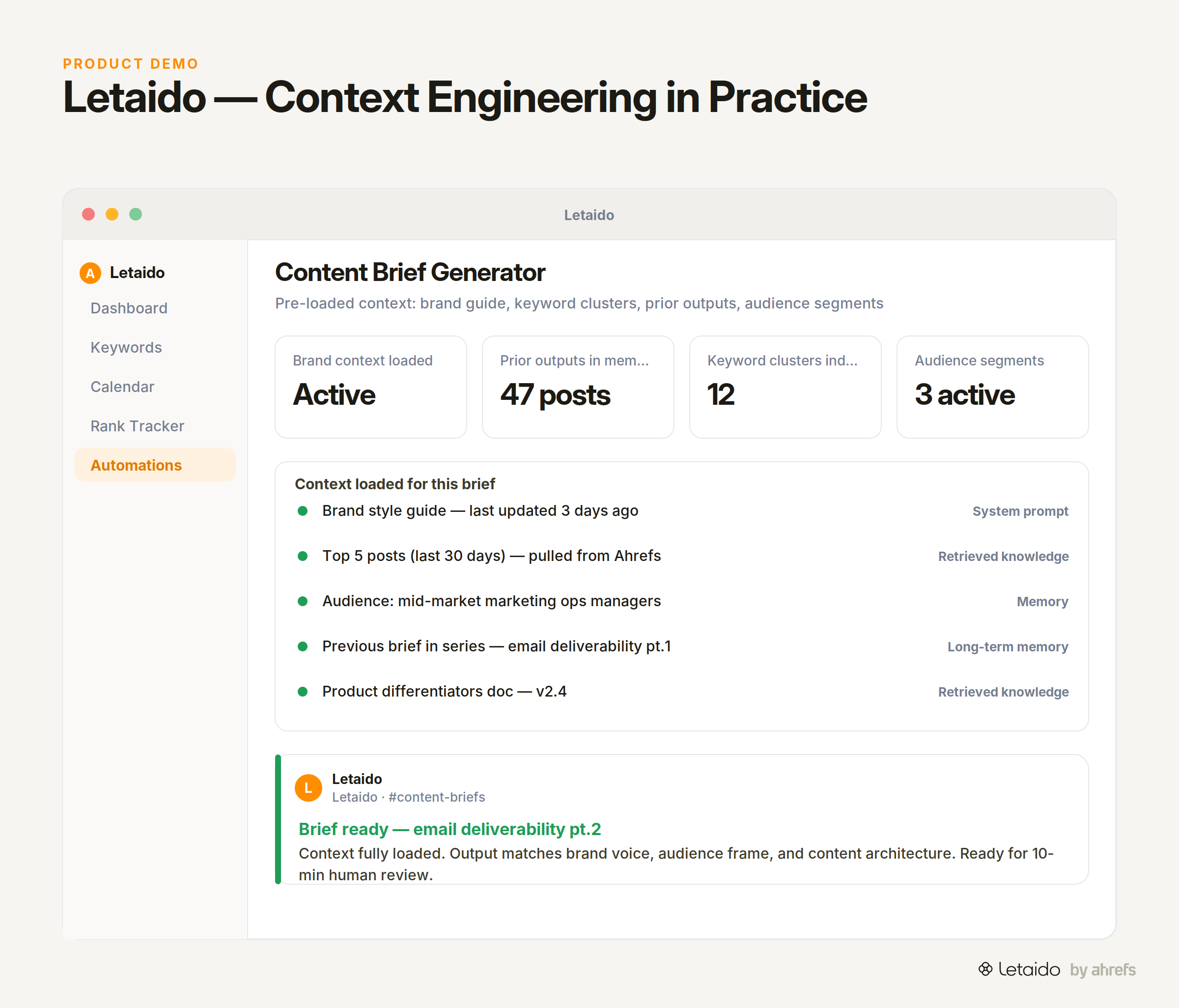
When Letaido writes a content brief, it isn't starting from a blank slate. It already knows your top-ranking pages, your keyword clusters, what you published last month, and the audience segments you care about. The context is pre-loaded and maintained — which is why the outputs are consistently usable rather than consistently in need of rescue.
If you want to see how that plays out in practice, start a free trial of Letaido and run it on your own content workflow.