The word "subagent" started showing up in AI discussions sometime in 2025 and hasn't stopped since, according to Anthropic's Trustworthy agents in practice. If you've seen it in Anthropic's docs, a developer's README, or a marketing team's Slack thread and wondered what it actually means — this is the article for you.
The explanation below is written for marketing and ops practitioners: people who use Claude daily, evaluate agentic tools, and want to understand how subagents work well enough to use them (or commission someone else to build them). You don't need to read API documentation to follow along.
What Is a Claude Subagent?
A Claude subagent is a Claude model instance that receives a bounded task from an orchestrating agent, completes it using a specific set of tools, and returns the result. Think of it as a delegated worker: it doesn't decide what to do next; it executes what it was asked to do.
The distinction between an agent and a subagent is the clearest place to start.
Agent vs. Subagent — the Distinction That Matters
An agent is a Claude model running in an autonomous loop. Anthropic's own research defines it as "an AI model that directs its own processes and tool useTool useLetting a model call external functions — search, a database, an API — so it can act on the world instead of only describing it. when accomplishing a task." The agent receives a high-level goal, decides how to pursue it, uses tools, observes the results, and keeps going until it's done.
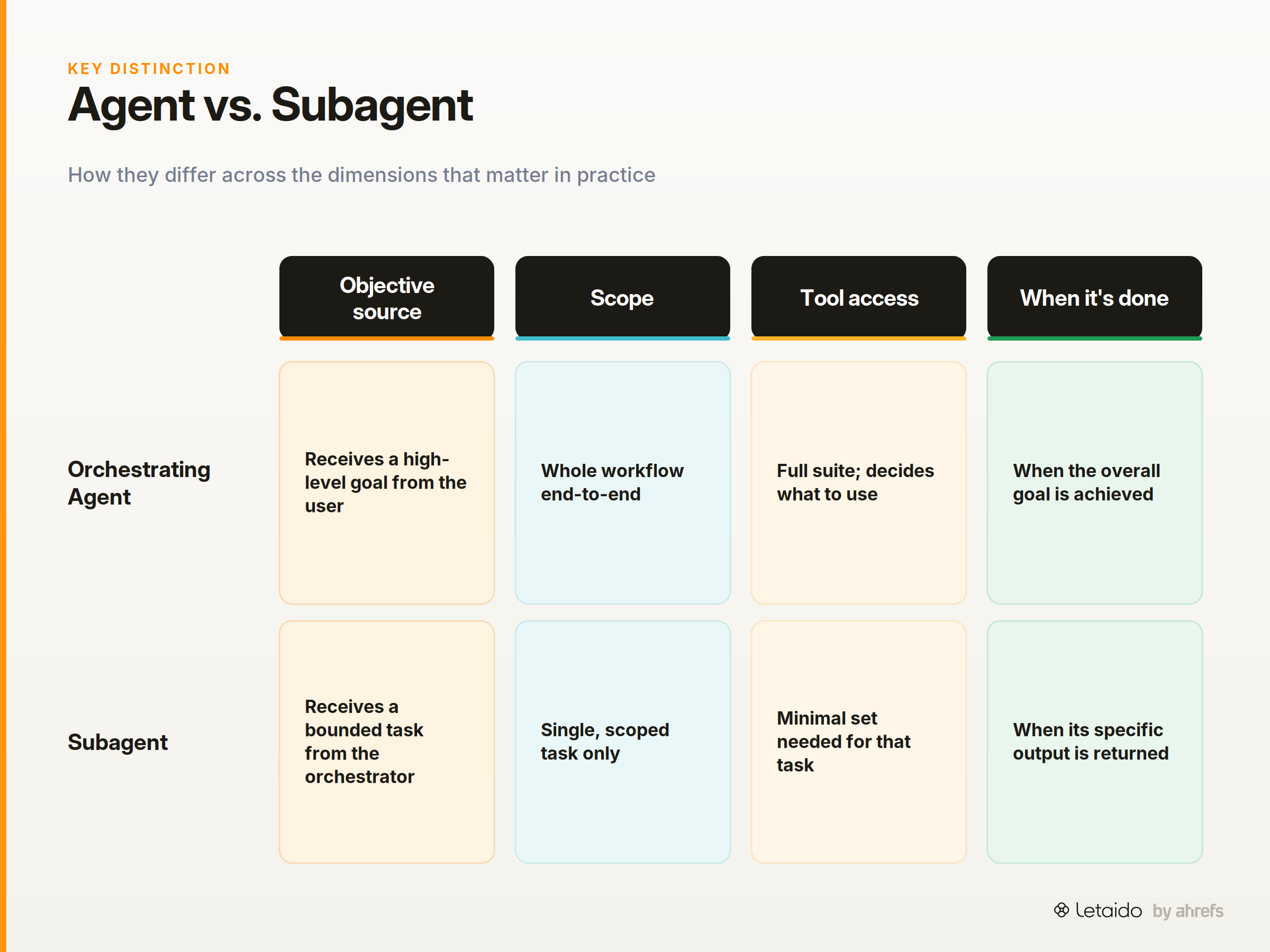
A subagent is also a Claude model instance — but it's spawned by an orchestrator and given a narrower brief. It doesn't choose its own objective; it receives one. When it finishes, it hands the result back up the chain.
The practical difference is scope. An orchestrator might handle the whole workflow: "research competitors, write a brief, and post a Slack summary." Each of those tasks can become a subagent: one searches, one writes, one posts. The orchestrator coordinates; the subagents execute.
Where the Term Comes From
"Subagent" is Anthropic's own architecture term, not borrowed from third-party frameworks. It appears throughout Claude Code's documentation, Anthropic's engineering posts, and the Claude Agent SDK. You may see similar concepts described as "child agents" or "worker agents" in other frameworks, but when you're reading Anthropic material, "subagent" has a precise meaning: a Claude instance operating under orchestrator-level delegation.
How Orchestrator → Subagent Delegation Works
The orchestrator-subagent model has a specific control flow. Once you understand it step by step, the whole system becomes much easier to reason about — including where things can go wrong.
The Control Flow, Step by Step
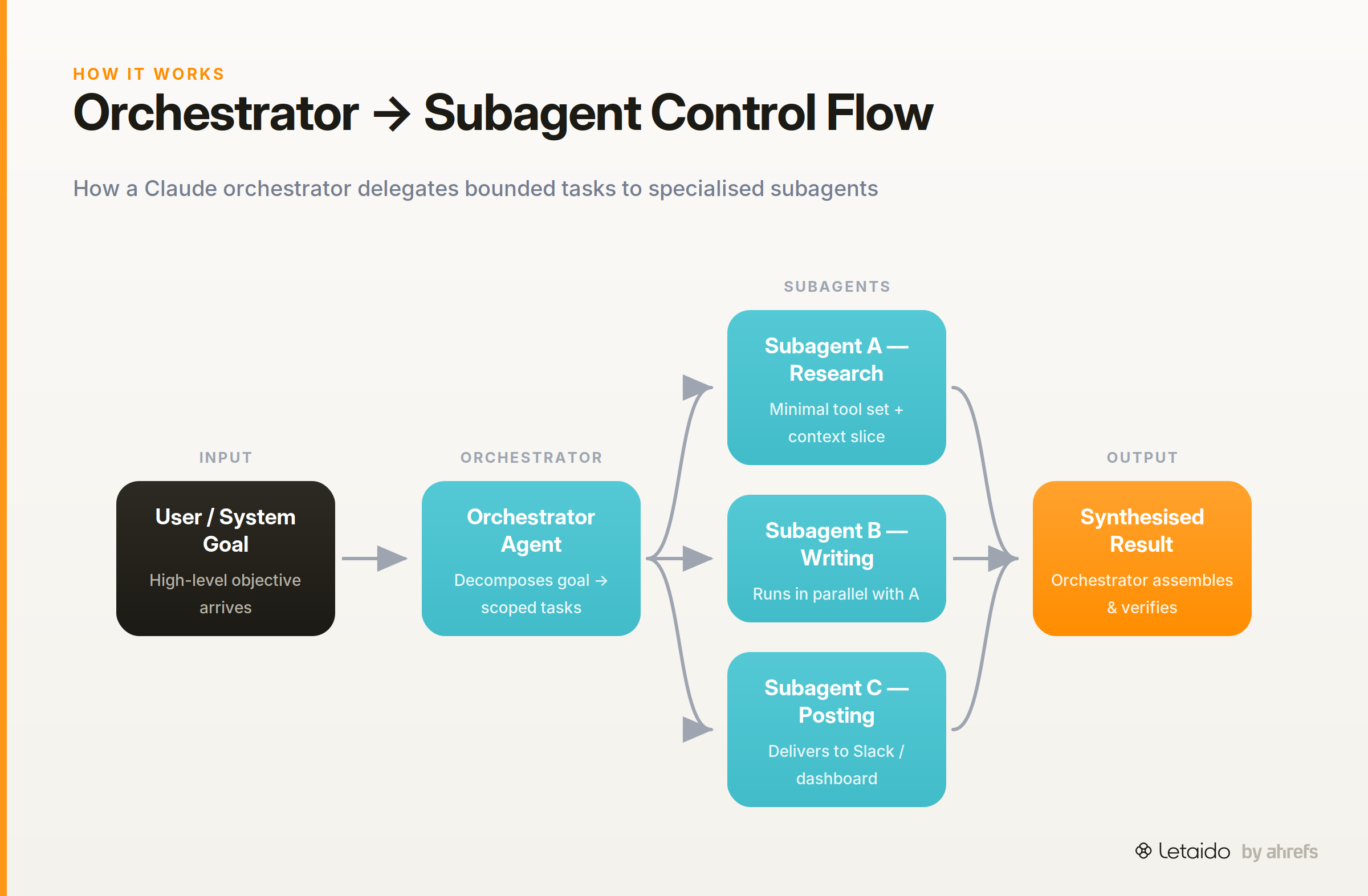
Here's how a typical orchestrated workflow unfolds:
[User / System Goal]
        │
        ▼
[Orchestrator Agent]
  • Receives the goal
  • Decomposes into tasks
  • Spawns subagents with scoped instructions
        │
   ┌────┴────┐
   ▼         ▼
[Subagent A] [Subagent B]  ← run in parallel
  (research)  (writing)
   │         │
   └────┬────┘
        ▼
[Orchestrator collects outputs]
        │
        ▼
[Synthesised result → Slack / Dashboard / Draft]
The orchestrator doesn't just fire and forget. It collects each subagent's output, evaluates whether it meets the task requirements, and decides what to do next — whether that's synthesising a final output, retrying a subagent, or escalating to a human.
Claude Code makes this concrete: its documented pattern involves spinning up a backend subagent while the main agent builds the frontend, letting both workstreams run simultaneously rather than waiting for one to finish before starting the other.
What the Orchestrator Passes to Each Subagent
The orchestrator doesn't hand a subagent the entire conversation history. It passes three things: a system promptSystem promptThe standing instruction that sets a model's role, rules, and tone for an entire session, separate from the user's individual messages.Read: System Prompts: What They Are and How to Write Them scoped to that specific task, a tool list limited to what the subagent actually needs (for example, a GitHub connector or an MCPModel Context ProtocolAn open standard for connecting AI models to external tools and data sources through one consistent interface instead of bespoke integrations. search tool), and a context window slice containing only the relevant information.
This scoping is deliberate. The orchestrator uses hooks to trigger specific actions at defined points in the workflow, such as running tests after a code change or linting before a commit. Background tasks keep long-running processes active without blocking the orchestrator's progress on other work. Together, hooks and background tasks are the mechanism that keeps complex multi-agentMulti-agent systemSeveral specialised agents working together on one job, each owning a step, coordinated by a planner or a shared workflow. workflows from grinding to a halt.
Why Split Work Across Subagents?
Breaking a workflow into subagents adds architectural complexity, so there needs to be a clear payoff. There are two: doing more at once, and doing each piece better.
Parallelism — Do More at Once
A single agent working sequentially hits a straightforward ceiling: it finishes task one, then starts task two, then starts task three. A subagent architecture removes that bottleneck. Multiple subagents run simultaneously, so a three-task workflow doesn't take three times as long.
This isn't theoretical. An Anthropic webinar on Claude Code foundations demonstrated how teams scale "a single agent into a fleet", moving from sequential execution to parallel workstreams. The scale of adoption supports the claim: Anthropic's analysis of approximately 400,000 Claude Code sessions from October 2025 to April 2026 shows this is how real teams are actually building. Practitioners aren't just experimenting with subagent patterns in notebooks; they're running them continuously.
Specialisation — Give Each Agent Exactly What It Needs
The second payoff is quality. A subagent with a tightly focused system prompt and a minimal tool set makes fewer errors than a generalist agent asked to do everything.
The analogy to hiring is apt: you get better results from a specialist who knows the brief precisely than from a generalist who has to hold every constraint in their head at once. Each subagent "knows" only what it needs to know. That reduced scope also lowers tokenTokenThe unit models actually read and generate — roughly a word-piece. Context limits and API pricing are both measured in tokens. overhead, because the subagent isn't processing irrelevant context on every step.
Trust Levels and Safety in Subagent Chains
This is the section most introductory articles skip. It's also the section you most need to read before deploying anything in production.
Anthropic has explicit guidance on how trust flows through multi-agent chains. The core question is: how much authority does an instruction carry when it arrives from a subagent rather than directly from a human?
Anthropic's Trust Hierarchy for Subagents
Anthropic's model treats instructions at three trust levels. The operator (system prompt) carries the highest trust: it's set by the person building the workflow. The user (human turn messages) carries medium trust. Messages arriving from a subagent are treated at human-turn trust by default, unless the operator's system prompt explicitly elevates them.
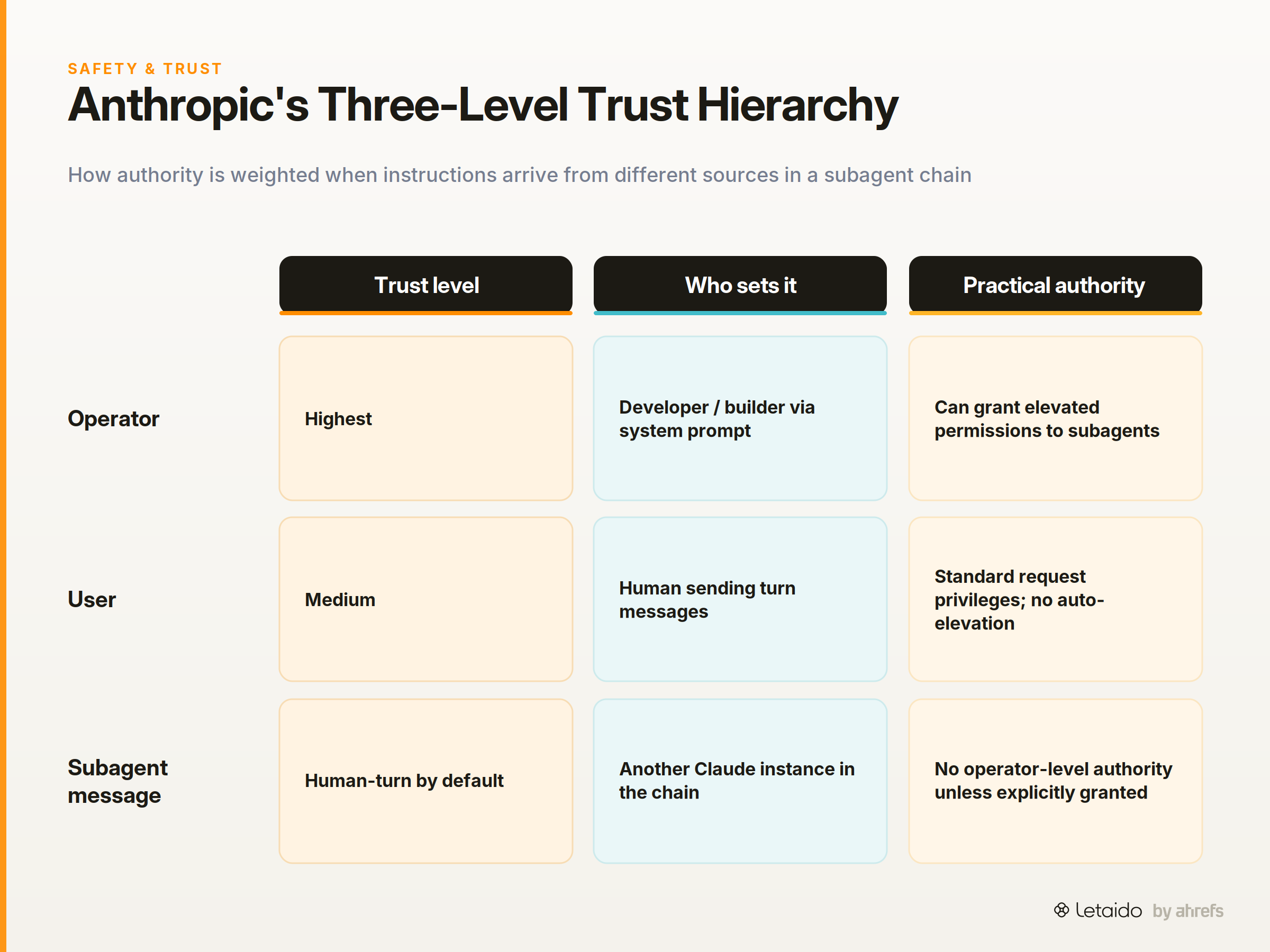
The practical implication: an instruction that arrives via another Claude agent doesn't automatically inherit operator-level permissions just because it's coming from "within" the system. If your orchestrator tells a subagent to take an irreversible action, that subagent should still apply the same caution it would apply to any user-level request.
Anthropic's engineering post on how they contain Claude across products describes the philosophy behind this: the goal is to limit the blast radius if any part of the chain behaves unexpectedly.
Prompt Injection Risks and How to Mitigate Them
Prompt injection is when malicious content in the environment, such as a webpage a subagent reads, a document it processes, or an API response it receives, contains instructions designed to override the subagent's original task. The injected text tries to hijack the subagent's behaviour from within its input.
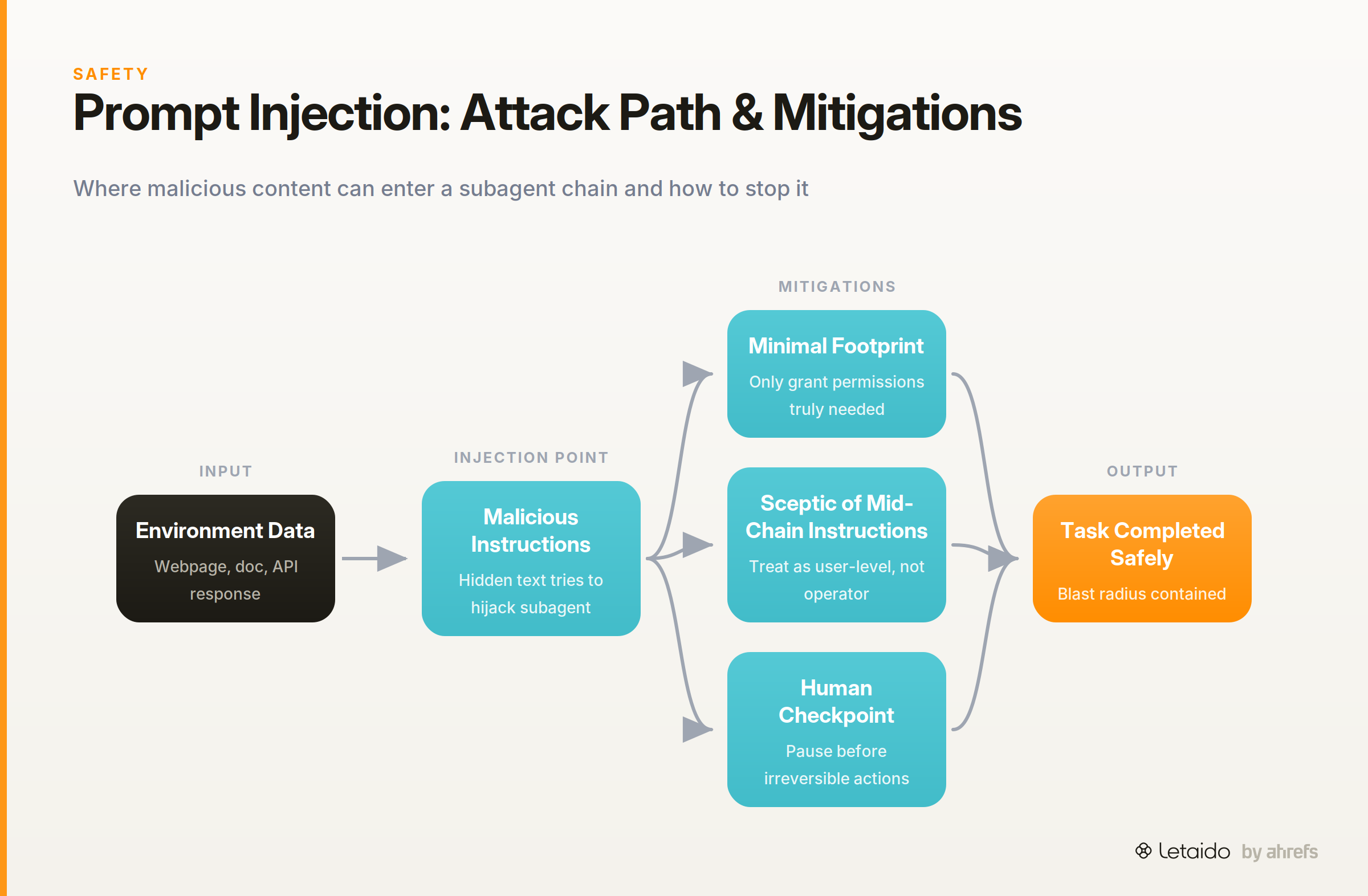
Anthropic's recommended mitigations are straightforward. First, minimal footprint: only request the permissions each subagent genuinely needs. A research subagent doesn't need write access to your CMS. Second, scepticism toward unexpected instructions: if a subagent receives instructions mid-chain that weren't in its original system prompt, it should treat them with user-level (not operator-level) trust. Third, human checkpoints for irreversible actions: before a subagent sends an email, posts publicly, or modifies a database, build in a confirmation step.
None of this requires advanced engineering. It's mostly a matter of scoping your system prompts carefully and building pauses into workflows that can cause real-world harm if they go wrong.
What Claude Subagents Are Actually Used For
Enough architecture — here's what subagent workflows look like when they're doing something a marketing or ops team actually cares about.
SERP Monitoring and Competitive Tracking
A monitoring subagent checks rank positions on a defined schedule, compares them against a baseline, and fires a Slack alert when a page crosses a threshold in either direction. The orchestrator decides when to run the check and what to do with the result; the subagent does the specific work of pulling and comparing data.
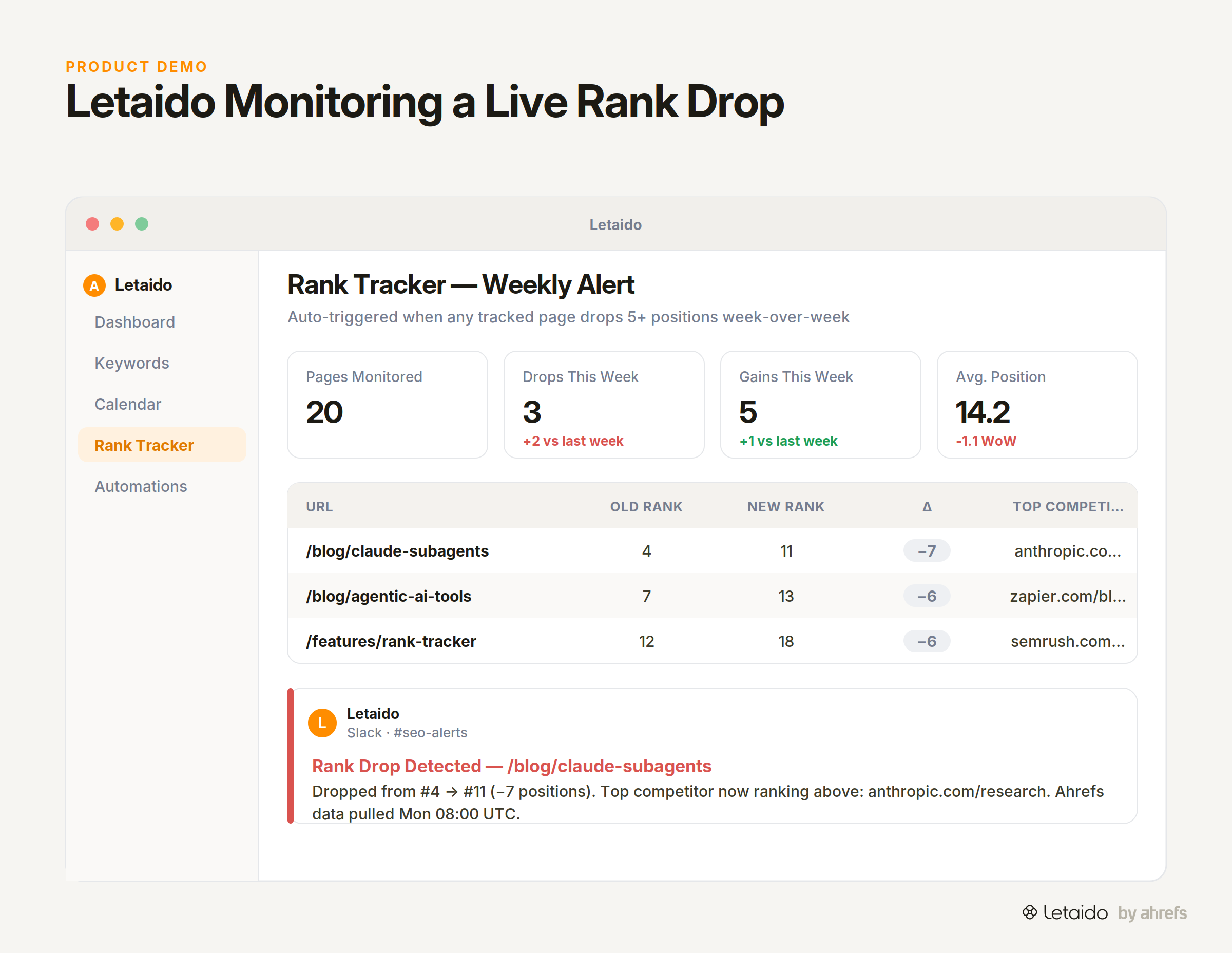
Letaido maps directly to this pattern: rank tracking with threshold alerts is a built-in capability, with Slack as a native delivery connector. You describe what you want to track and how you want to be notified; the orchestration layer handles the rest.
Try this prompt:
Monitor the top 20 pages on [domain] weekly using Ahrefs data.
If any page drops more than 5 positions week-over-week, send me
a Slack message with the URL, the old rank, the new rank,
and the top competitor now ranking above it.
Automated Reporting and Dashboards
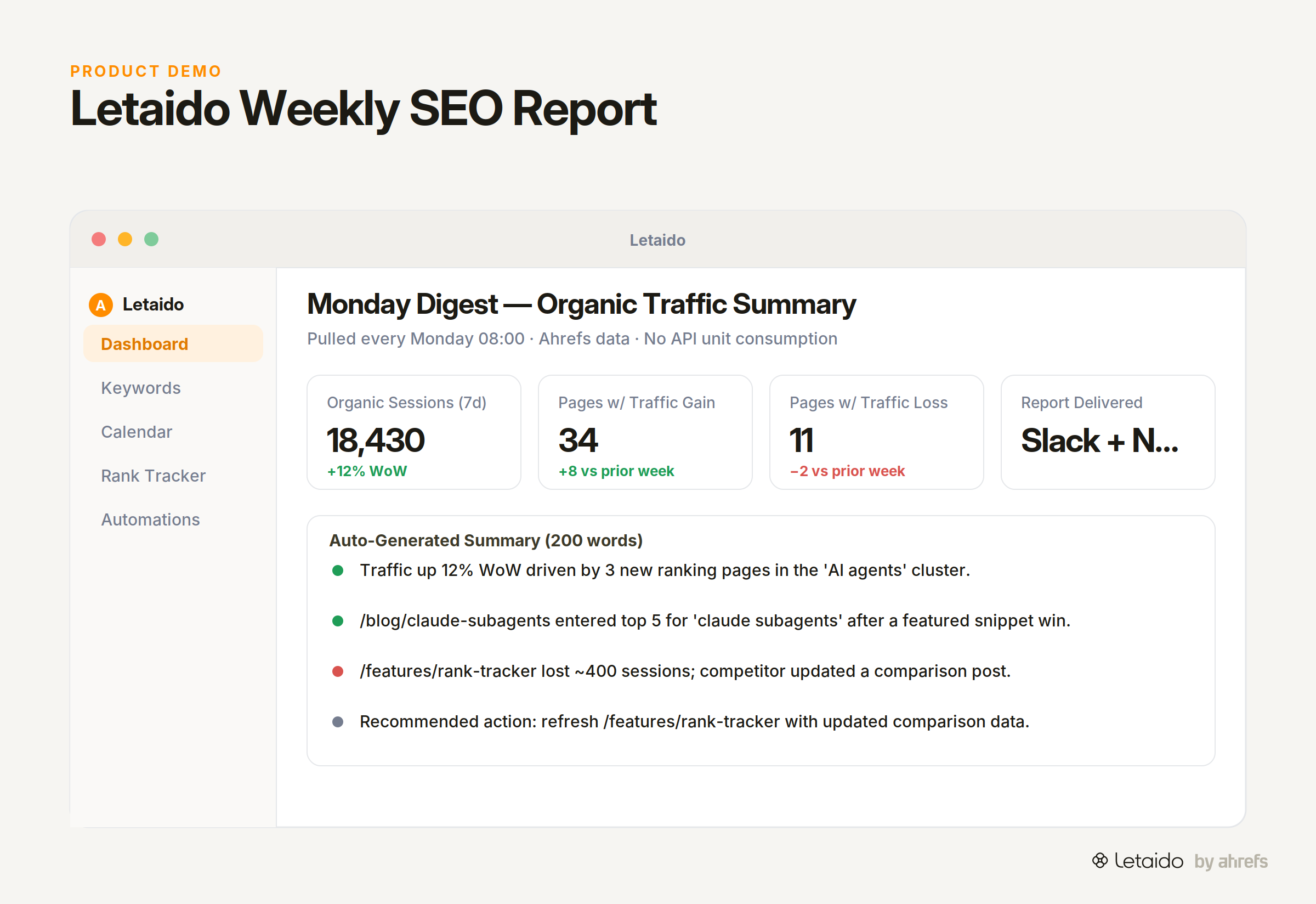
An orchestrator pulls Ahrefs data, delegates formatting and interpretation to a report-writing subagent, and a third subagent pushes the output to a live dashboard or a Notion page. The human receives a finished report; they never see the intermediate steps.
Letaido handles this with full Ahrefs data access and no API-unit consumption, so you can run comprehensive reports on a schedule without worrying about hitting limits on every call.
Try this prompt:
Every Monday at 8 AM, pull the previous week's organic traffic
changes for [domain] from Ahrefs. Write a 200-word summary of
what moved and why, then post it to the #seo-team Slack channel
and save a copy to the [Notion page URL].
Content Pipelines — Brief to Draft to Review
The orchestrator runs a SERP analysis, delegates keyword clustering to one subagent and brief generation to another, then routes the brief to a draft subagent. Each agent works on its slice in parallel; the orchestrator assembles the final output.
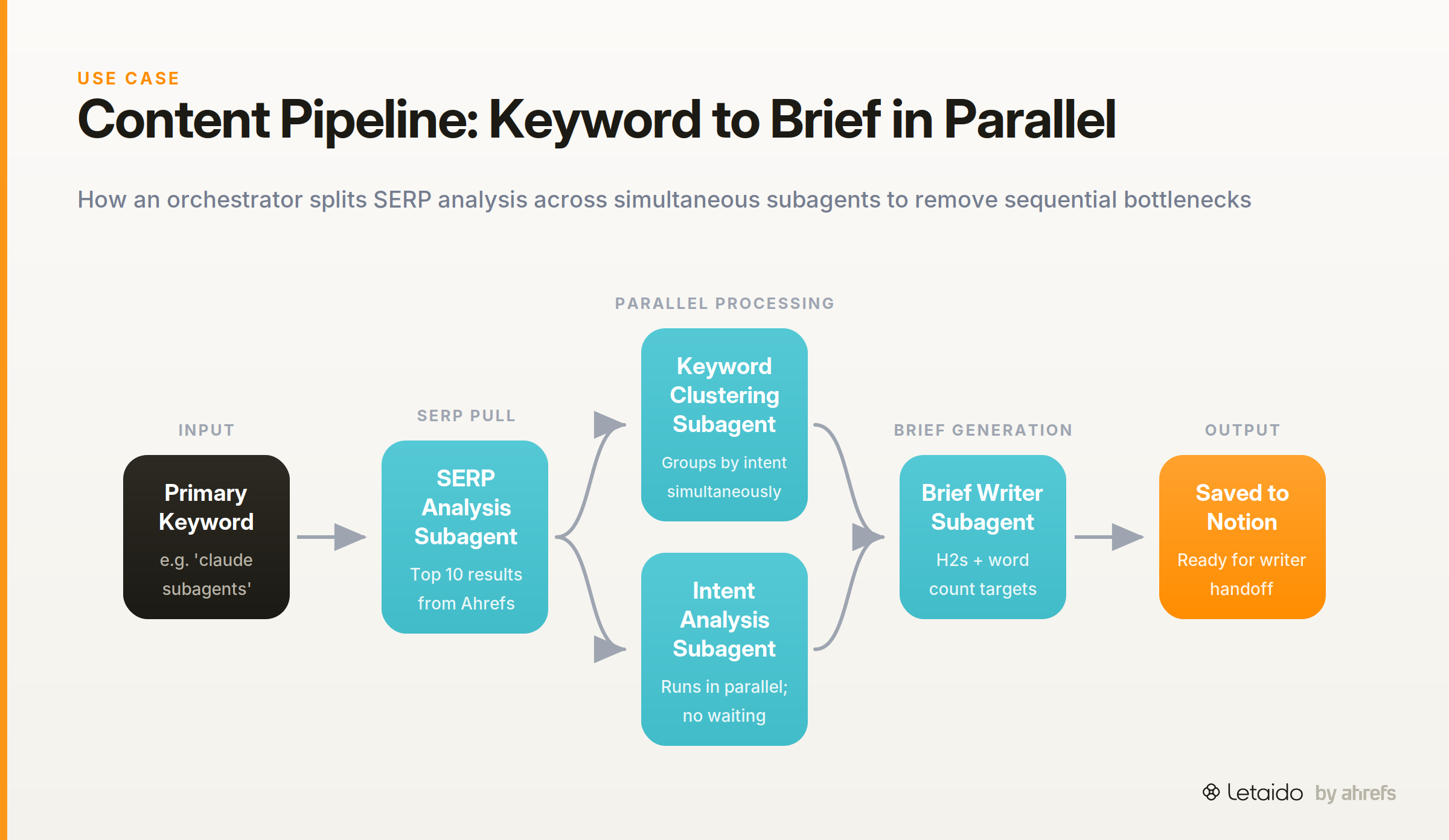
This mirrors Claude Code's parallel subagent pattern: just as one subagent can build a backend API while another builds the frontend, one subagent can cluster keywords while another analyses intent, with neither waiting on the other.
Try this prompt:
Given the primary keyword [keyword], pull the top 10 SERP results
from Ahrefs, cluster related keywords by intent, generate a
structured content brief with H2 sections and target word count,
then save it to [Notion database].
Digest and Alert Automation
A scheduled orchestrator assembles a weekly digest: one subagent pulls ranking changes, another checks backlink movements, a third formats the output and sends it via Slack or email. No one has to remember to run it.
Letaido's native Slack and Mailchimp connectors serve as the delivery layer here. The subagents do the analysis; the connectors handle distribution.
Try this prompt:
Every Friday at 4 PM, create a weekly digest that includes:
(1) top 5 ranking improvements and declines for [domain],
(2) any new backlinks from DR40+ domains acquired this week,
(3) one recommended action for next week. Send it to [Slack channel].
Start Using Subagents Without Writing Orchestration Code
You don't need to be a developer to benefit from subagent architecture. There are two paths in, depending on how much you want to configure versus how much you want pre-built.
Native Anthropic Options
Claude.ai with Projects gives you a persistent context layer where Claude can maintain memory across conversations. It's a reasonable starting point for light orchestration: structured prompts, document uploads, and tool connections through the Claude interface.
Claude Code is the more powerful native option, running in your terminal and using the Anthropic model APIs to plan, delegate, and verify tasks. It supports subagents, hooks, background tasks, and MCP tool connections natively. Accessibility has improved: [Anthropic's engineering data shows that Claude Code users approve 93% of permission prompts, which suggests the day-to-day friction is lower than the "terminal-based tool" framing might imply. And as of mid-2026, Xcode 26.3 integrates the Claude Agent SDK directly, bringing subagents, background tasks, and plugins into the IDE for development teams who live in that environment.
As Simon Last, a Co-founder using Claude Code, put it: "Claude Code is moving our team up a level: we decide what needs to happen, and smooth the process so it can build and verify end-to-end." That captures the division of labour well: you define the goal, the agent handles the execution.
That said, getting a Claude Code subagent workflow running for a marketing use case still requires meaningful setup: terminal access, API credentials, prompt engineeringPrompt engineeringThe practice of writing and refining model instructions to get reliable, repeatable output — structure, examples, and constraints rather than clever wording.Read: What Is Prompt Engineering? (And Why Marketers Need It) for each agent, and ongoing debugging when the chain misbehaves.
Use an Agent Workspace Instead
If you want the orchestration layer pre-built, an agent workspace is the honest alternative. Letaido handles the orchestration infrastructure — scheduling, connectors (Slack, HubSpot, Notion, Airtable, Mailchimp, and more), and Ahrefs data access — so you describe what you want rather than building the plumbing.
The pricing is flat at $99/month including "$50 in AI credits", with an Ahrefs subscription needed only for Ahrefs data pulls. If you want subagent-style workflows without becoming an infrastructure engineer, that's the trade-off: less control, significantly faster setup.
Limitations to Know Before You Commit
Subagent architecture is genuinely useful. It also has real costs and failure patterns you should understand before relying on it in production.
Latency stacks across hops. Each subagent call adds round-trip inference time. A five-agent chain is five inference calls deep, potentially plus tool calls at each step. For real-time use cases, this matters. For scheduled background workflows, it usually doesn't.
Cost multiplies with parallelism. Running subagents in parallel is faster than running them sequentially, but it's not cheaper. You're paying for multiple inference calls instead of one. For high-frequency automations, model and token costs can add up quickly.
Debugging is non-linear. When something breaks mid-chain, the failure often surfaces in the orchestrator's final output but originates two or three subagents back. Build logging at every handoff point. Without it, root-cause analysis becomes genuinely difficult.
Context management is your responsibility. Each subagent receives only what the orchestrator explicitly passes to it. Under-scope the context and the subagent lacks what it needs to do the task well. Over-scope it and you burn tokens unnecessarily. Getting this balance right takes iteration.
None of these are reasons to avoid subagents. They're reasons to design workflows carefully rather than treating "more agents" as a default improvement.
Quick-Reference Glossary
A reference for the terms that appear throughout this article and in Anthropic's documentation.
| Term | Plain-English definition |
|---|---|
| Orchestrator | The top-level Claude agent that receives a goal, decomposes it into tasks, spawns subagents, and synthesises their outputs into a final result. |
| Subagent | A Claude model instance spawned by an orchestrator to complete one bounded task. It receives a scoped system prompt, a limited tool set, and relevant context — not the full conversation. |
| Tool call | An instruction from a Claude model to use an external capability — for example, searching the web, reading a file, querying an API, or posting to Slack. Tool calls are how agents interact with the world beyond the conversation window. |
| MCP (Model Context Protocol) | Anthropic's open standard for connecting Claude to external tools and data sources. MCP connectors allow subagents to interact with services like GitHub, Notion, and Airtable without custom integration code. |
| System prompt | The instructions set by the operator (the person or team building the workflow) that define an agent's or subagent's role, constraints, and available tools. Carries the highest trust level in Anthropic's hierarchy. |
| Trust level | How much authority Claude gives to a set of instructions based on where they come from. Operator (system prompt) = highest trust. User (human turn) = medium trust. Subagent messages = human-turn trust by default, unless explicitly elevated. |
If you've read this far, you understand how Claude subagents work, why the architecture exists, and where the real-world friction lives. The next question is usually: how do I actually use this?
If you're comfortable in a terminal and want full control, Claude Code and the Claude Agent SDK are the native Anthropic path. If you'd rather start with the orchestration layer already built — Ahrefs data, scheduling, and native connectors included — Letaido is worth a look. The prompts in the examples section above work in Letaido directly; no setup required beyond describing what you want.