Generative AI takes a prompt and produces an output: text, an image, a snippet of code. Agentic AI takes a goal and pursues it: breaking the work into steps, calling tools, checking its own progress, and looping until the task is done. Both are real, both are useful, and most teams are using only one of them while calling it an "AI strategy." Here's a clear breakdown of what separates them and what that distinction means in practice.
What Is Generative AI?
Generative AI is the approach most people encountered first. You type something in; a model generates something back. Understanding it well is the prerequisite for understanding why agentic AI is a meaningful step change, not just a marketing rebrand.
How the inference loop works
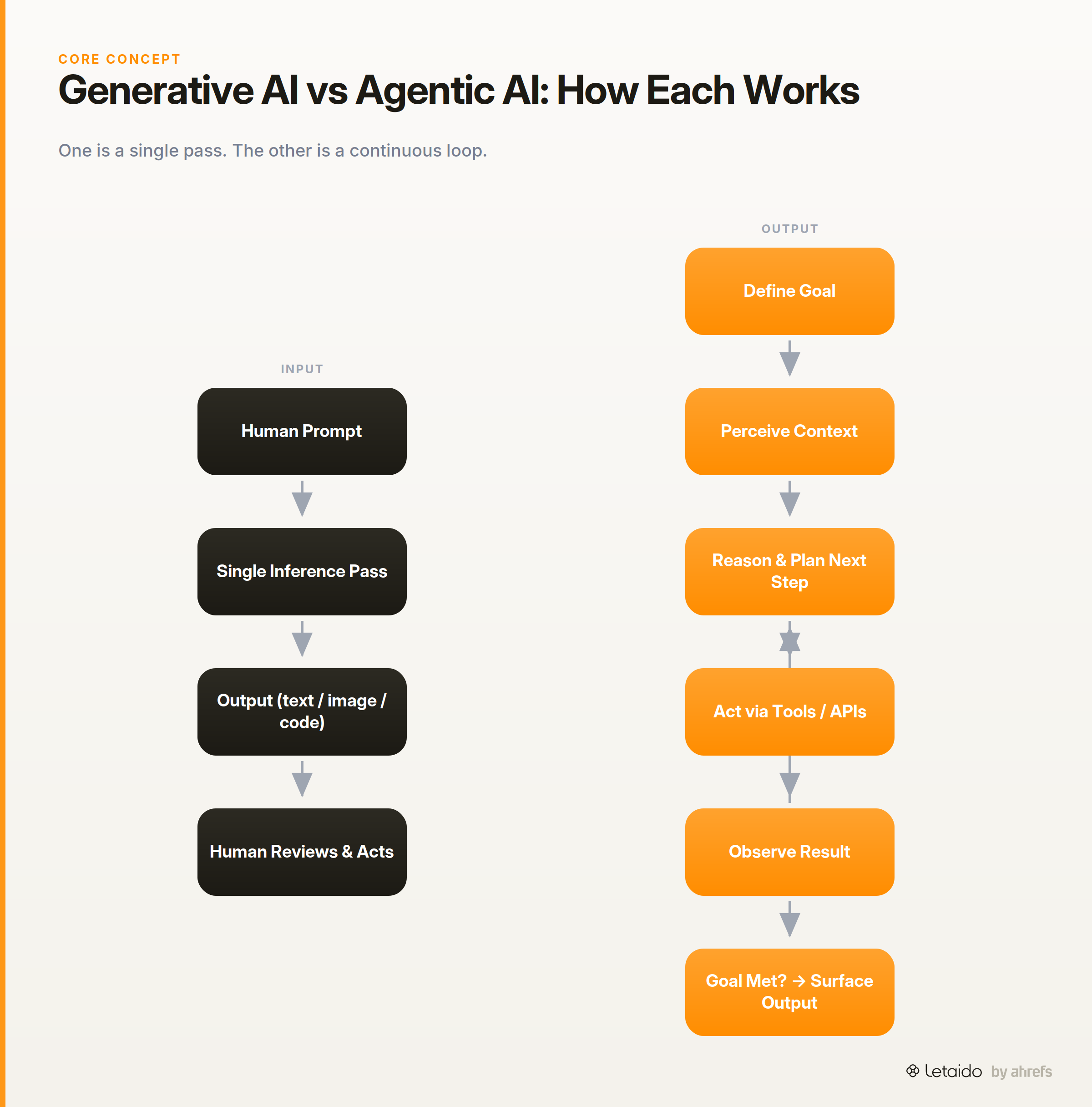
Every generative AI model works the same basic way: you send in text, the model processes it, and it sends back the most statistically likely response based on everything it was trained on. The model has no memory of prior conversations unless you explicitly paste them into the prompt. It makes statistical predictions based on patterns learned during training, then stops. The next prompt starts the process over from scratch.
This is why ChatGPT forgets who you are the moment a new session begins unless persistent memory features are enabled. The underlying mechanism is inherently stateless: one input, one output, no thread connecting them.
What generative AI produces
Generative AI excels at producing content: blog drafts, email subject lines, ad copy, code snippets, SQL queries, synthetic datasets for model training, and personalized product recommendations derived from user signals baked into the prompt.
For a marketer, this covers a lot of valuable ground. You can ask a model to draft three intro paragraphs in different tones, generate ten subject-line variants for an A/B test, or turn a rough bullet list into a structured brief. The output quality is high. The ceiling is that you have to initiate, review, and act on every single output yourself.
Where generative AI fits in your workflow
Generative AI is the right tool for creation tasks that benefit from human editorial judgment at the end. Write a first draft, a human edits it. Generate ten headlines, a human picks one. The model adds leverage to creative work without removing the human from the loop.
Where it breaks down is anything that requires memory across sessions, tool calls to live systems, or sequential execution of dependent steps. Generative AI can write instructions for pulling a rank report; it cannot pull the report, parse the results, and alert you when something drops. That is agentic AI's domain.
What Is Agentic AI?
Agentic AI describes systems that do not just produce outputs but pursue goals. The difference is not a matter of model quality; it is a difference in architecture and operating mode.
How the agent loop works
Where generative AI runs one inference cycle and stops, an agentic AI system runs a continuous problem-solving loop: perceive context, reason over the current state against a goal, act via tools or subagents, observe the result, then reason again. This cycle repeats until the task is complete or a stopping condition is met.
Retrieval-augmented generationRetrieval-augmented generationFetching relevant documents at query time and feeding them to the model, so answers are grounded in your own content instead of the model's memory. (RAG) is often part of this loop: the agent queries live data sources at each step rather than relying solely on what was baked into training. Reinforcement learning techniques can further refine agent behavior over repeated runs. The result is a system that adapts to what it discovers mid-task rather than committing to a single answer up front.
What makes an AI agent "agentic"
Several properties together define an agentic system:
- Autonomy: the agent decides its next action based on goal state, not on receiving a new prompt.
- Goal-oriented behavior: the agent works toward a defined objective across many steps, not a single response.
- Tool and API integration: the agent calls external systems — search, databases, APIs, code executors — to gather information and take actions.
- Memory across steps: the agent maintains state between actions, so step four has access to what steps one through three discovered.
- Real-time adaptation: when a step fails or returns unexpected data, the agent adjusts rather than halting.
- Delegation to sub-agents: complex goals get broken into subtasks assigned to specialized agents running in parallel or in sequence.
Amazon Bedrock Agents illustrates this at the infrastructure level: it uses foundation-model reasoning to decompose a user request into steps, call the appropriate APIs and knowledge bases, retain conversational memory across the interaction, and trace its own reasoning for debugging. Google's Agent Development Kit (ADK) provides similar scaffolding as an open-source Python/TypeScript framework, letting developers compose multi-agentMulti-agent systemSeveral specialised agents working together on one job, each owning a step, coordinated by a planner or a shared workflow. workflows and deploy them to Vertex AI, Cloud Run, or GKE.
Where agentic AI fits in your workflow
Agentic AI owns repeating, multi-step processes end-to-end. Monitoring tasks, research pipelines, reporting cycles, competitive analysis — anything with a defined goal and a predictable set of steps is a candidate. Once configured, an agentic system runs with minimal human intervention, surfacing outputs and alerts rather than waiting for a prompt.
The practical implication for marketing and ops teams: you stop spending time executing the process and start spending time deciding what to do with the results.
Generative AI vs Agentic AI: Core Differences at a Glance
| Dimension | Generative AI | Agentic AI |
|---|---|---|
| Operating mode | Single inference loop | Continuous perceive → reason → act → learn loop |
| Autonomy | None: requires a human prompt for each output | High: pursues goals across steps without re-prompting |
| Memory | Stateless between sessions | Persistent state and shared memory across tasks |
| Tool use | None natively: generates text about tools | Native: calls APIs, databases, code executors |
| Human oversight | Required at every step | Configurable: human-in-the-loop or fully automated |
| Typical output | Text, images, code, data | Completed workflows, decisions, alerts, filed reports |
| Example marketing task | Draft a blog intro | Monitor rankings → detect a drop → pull competing pages → post Slack alert |
Key Differences Explained
The table above summarizes the dimensions; the sections below explain why each one matters operationally. Together, they cover the questions that come up most often when teams try to figure out which technology applies to a specific problem.
Autonomy and goal-directed behavior
Generative AI responds to what you ask; agentic AI pursues what you want. The distinction is subtle in a single interaction and enormous at scale.
When you prompt a generative model to "analyze our top-performing content," it produces an analysis. If you want a different angle, you re-prompt. Each pass requires your attention. An agentic system given the goal "identify content that has lost ranking position this month and flag candidates for refresh" will execute the full research cycle, not once but on a defined schedule, without you initiating it each time.
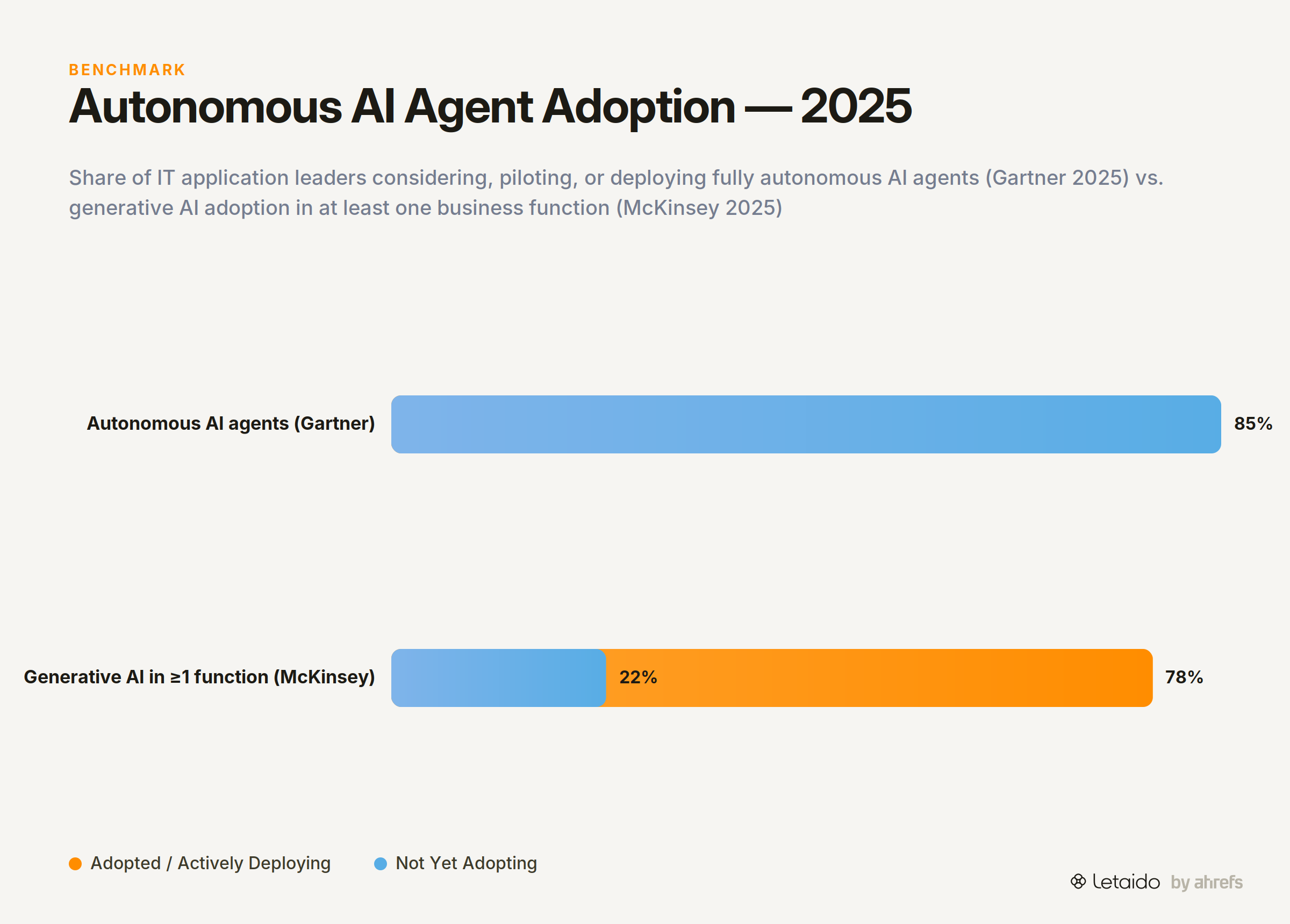
According to Gartner's 2025 survey, only 15% of IT application leaders are currently considering, piloting, or deploying fully autonomous AI agentsAI agentA system that combines a language model with tools and a goal, so it can decide what to do next and act — not just generate text.Read: What Are AI Agents? Definition, Types, and Examples . The technology is real and in production, but adoption is still early. Teams that understand the capability now are building process advantages before the tooling commoditizes.
Single-turn vs multi-step execution
This is the core operational split between the two paradigms.
A generative model takes one prompt, produces one answer, and is done. A prompt like "write a content brief for 'technical SEO audit'" produces a brief. Whether the topic is worth targeting, what questions the SERPSERPThe search engine results page — the full set of organic listings, ads, and features returned for a query. actually answers, how the competitor pages are structured — none of that context is gathered automatically.
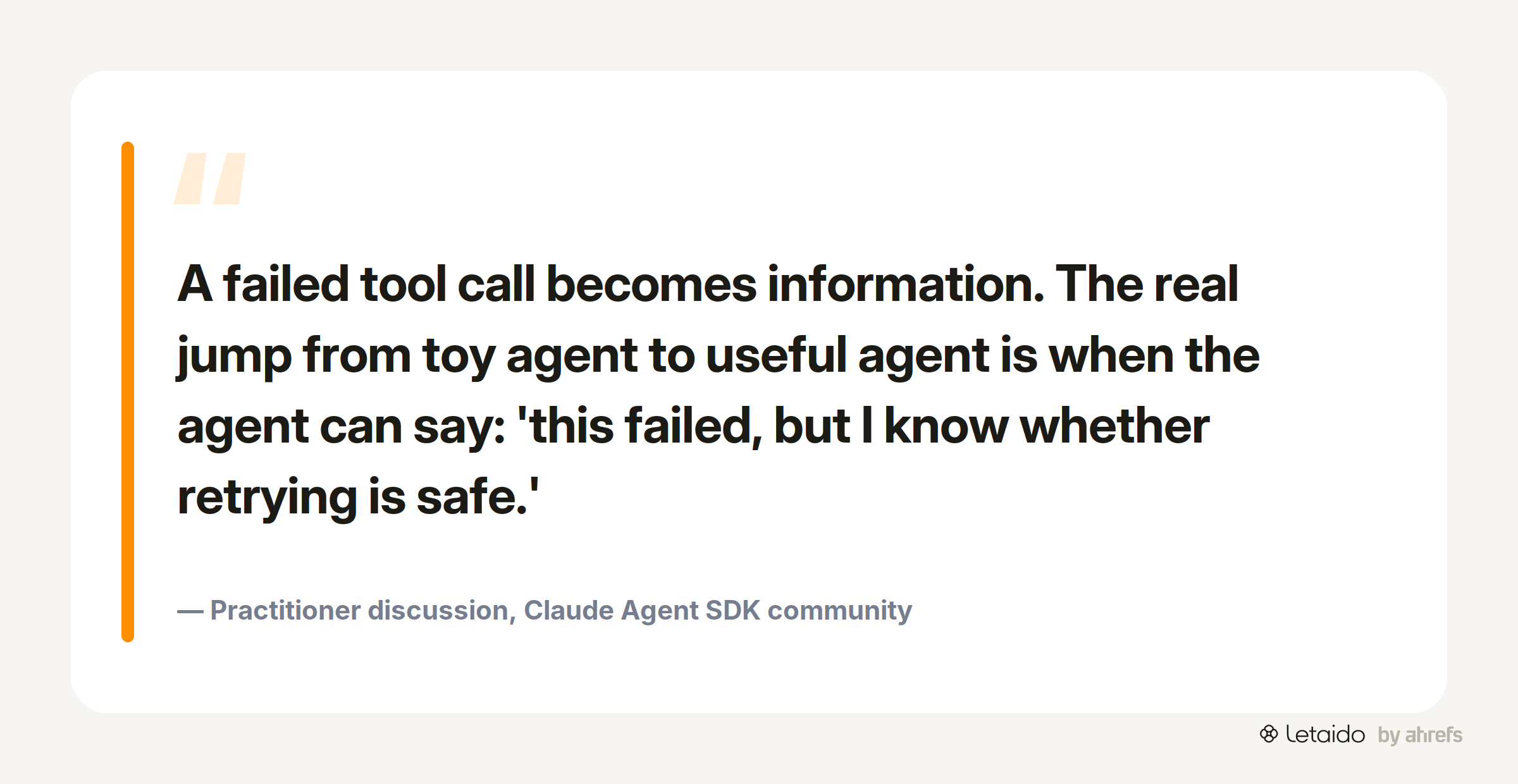
An agentic system decomposes that goal into steps: check search volume and difficulty, analyze SERP structure, identify content gaps against competitors, generate the brief with those inputs. It executes the steps in sequence and handles failures mid-task. As a practitioner noted in a discussion about the Claude Agent SDK: "a failed tool call becomes information. The real jump from toy agent to useful agent is when the agent can say: 'this failed, but I know whether retrying is safe.'" That error-recovery capability is what makes multi-step execution reliable rather than brittle.
Memory, context, and state
Generative AI is stateless between sessions by default. Every conversation starts blank. You can work around this by pasting prior context into the prompt, but that is a manual workaround, not a systemic solution.
Agentic AI maintains shared memory stores and persistent context across tasks. An agent monitoring your site's ranking performance remembers last week's baseline, compares it against this week's data, and identifies meaningful delta. It is not starting from scratch each time. This persistent state is also what enables coordination across sub-agents: a research agent and a reporting agent can share a memory store so the report draws on what the research step actually found.
Tool and API integration
The clearest practical difference: generative AI generates text about an action; agentic AI takes the action.
Ask a generative model to "check if page X dropped in rankings" and it will tell you how to check. An agentic system makes the API call, retrieves the data, and reports back — or triggers an alert, or updates a dashboard, or opens a ticket in Linear. This difference is what enables automation. Amazon Bedrock Agents, for instance, orchestrates multistep tasks by connecting to APIs and knowledge bases, assembling results into a coherent response without human handoffs between each call.
Use Cases: Where Each Type Wins
Both paradigms are genuinely useful. The mistake teams make is applying generative AI to process problems, or waiting for agentic AI to get better before using generative AI for creation work. Each type has a clear zone of advantage.
What generative AI does best
Generative AI wins on content creation tasks where speed, variety, and quality of language matter: drafting blog posts, writing ad copy, generating code, producing email sequences, creating synthetic training data for downstream models, and building personalized recommendation copy from structured inputs.
For a marketer, this means: first drafts in seconds, headlines at scale, creative variants for testing, and the ability to generate structured content from raw data (turn a keyword list into a topical cluster outline, turn research notes into a formatted brief).
What agentic AI does best
Agentic AI wins on process automation: customer support triage that resolves tier-1 queries end-to-end, workflow management that routes tasks based on live data, proactive monitoring that surfaces signals before a human notices them, logistics and inventory optimization that reacts to demand shifts in real time, and research pipelines that run on a schedule rather than on demand.
According to McKinsey's 2025 global survey, more than 78% of companies are now using generative AI in at least one business function. The next wave — the one that moves the operational needle — is agentic AI taking over the recurring processes those teams have been executing manually around their generative AI tools.
Marketing-specific examples for each
Generative AI in practice: A content marketer pastes a keyword cluster and a target audience definition into a prompt; the model returns a structured content brief with suggested headers, key questions to answer, and a recommended word count. The marketer edits it, approves it, and moves to production. High leverage, human still at the wheel.
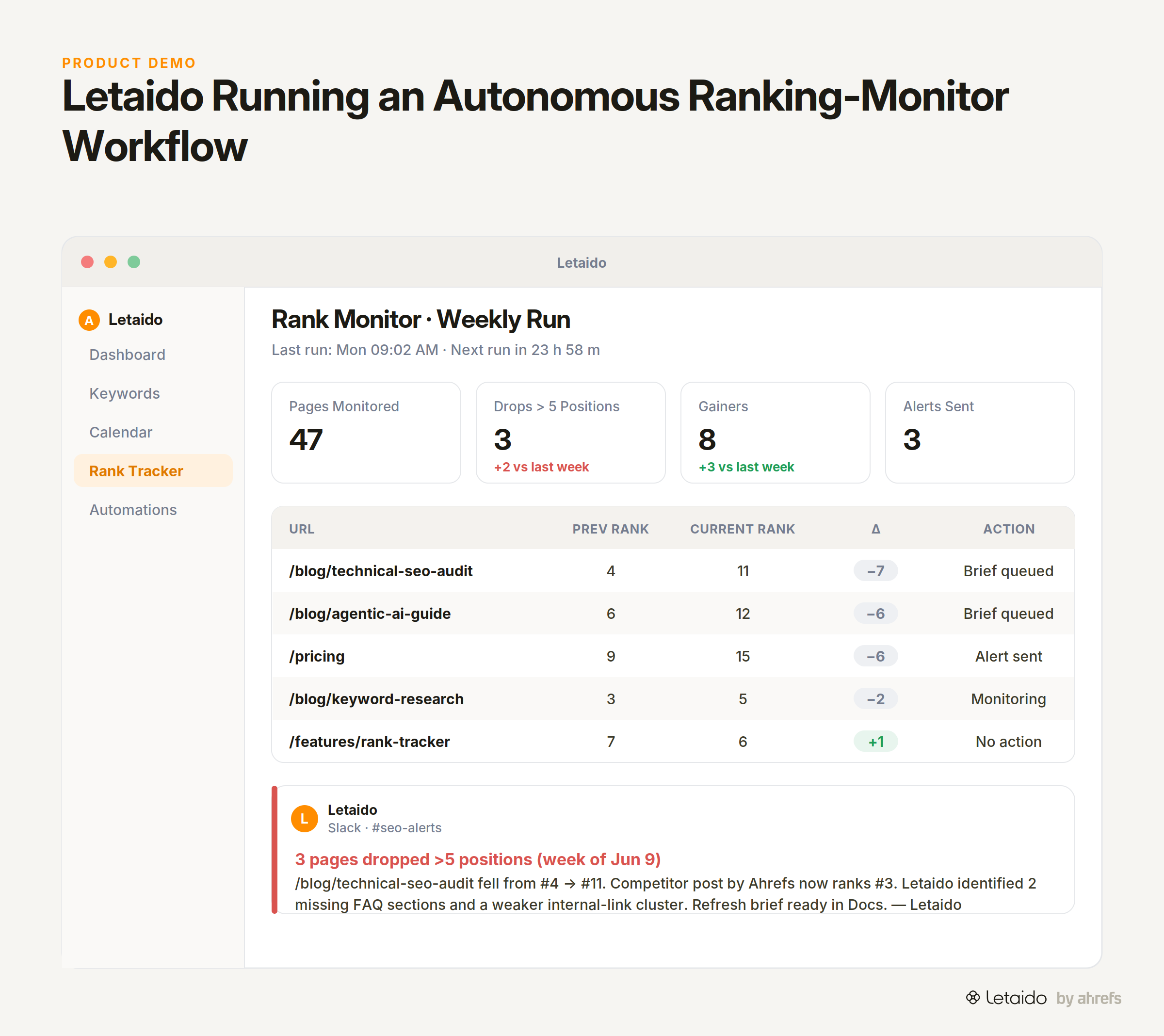
Agentic AI in practice: An agent monitors a set of target URLs for ranking changes every 24 hours. When a page drops more than five positions, the agent pulls the competing pages that moved up, identifies structural and content differences, writes a brief summary of the likely cause, and posts it to a Slack channel with a recommended next action. The marketer sees a decision-ready output in Slack on Monday morning without having assembled any of it manually. This is the kind of workflow Letaido runs continuously, pulling from Ahrefs data to ground every recommendation.
Workflow Impact: What Agentic AI Means for Your Team
Understanding the conceptual difference is useful. Understanding what it changes about your team's daily operations is what determines whether you act on it. The sections below cover the transition from manual AI use to configured agent workflows.
From "prompt and paste" to autonomous workflows
Most teams today run what could fairly be called a "prompt and paste" workflow: open a chat interface, ask something, get an answer, copy it into a doc, do the next thing. This is valuable — it's faster than writing from scratch — but it scales with human attention. Every output requires someone to initiate a prompt and move the result somewhere useful.
An autonomous workflow inverts this. You define the goal and the conditions once. The agent executes, monitors, and escalates on its own schedule. A rank-tracking workflow does not wait for someone to remember to check rankings; it checks, detects the threshold breach, and delivers the output. Task delegation and feedback loops replace the manual copy-paste cycle.
Orchestrate agents, don't just prompt them
Single-agent systems handle single tasks. For complex goals, the architecture that works is multi-agent orchestration: a meta agent receives a high-level goal, breaks it into subtasks, assigns each to a specialist agent, and assembles the results.
This is the model both Agentforce and Microsoft Agent 365 implement inside existing enterprise toolchains. Agentforce connects agent responses to Salesforce CRM data and Flow actions; Agent 365 provides a centralized control plane for inventorying and governing agents across Microsoft 365, with access control via Entra and data governance via Purview. The underlying idea is the same: agents are not standalone chatbots but coordinated workers operating inside a managed infrastructure. As one Salesforce community member put it, "the main upside is that Agentforce lives inside Salesforce, so you don't have to bolt on another external AI tool."
What a real agentic marketing workflow looks like
Here is a concrete example of how Letaido runs an agentic marketing workflow in practice, without a human initiating each step.
A rank-tracking threshold is configured: if any target page drops more than five positions in a 24-hour window, the workflow triggers. Letaido pulls the current ranking data from Ahrefs, identifies which competing pages moved up, extracts the structural differences (new backlinks, content additions, schema changes), writes a plain-language summary of the likely cause, and posts it to a designated Slack channel with a recommended action. The finding is simultaneously logged to a Notion page for the team's weekly SEO review.
This runs continuously, 24/7. The marketer who built the workflow does not check rankings manually. They receive a decision-ready brief when something actually changes. The research, data pull, analysis, and documentation happen inside the agent loop.
Try this prompt in Letaido:
Monitor the following URLs for ranking drops greater than 5 positions
over a 24-hour period. When a drop is detected:
1. Pull the Ahrefs data for the URL and its top 3 new competitors.
2. Identify structural differences (content length, backlinks, schema).
3. Write a 3-sentence summary of the likely cause.
4. Post the summary and a recommended action to #seo-alerts in Slack.
5. Log the finding to the [SEO monitoring] Notion database.
Run this check daily at 8 AM.
Risks and Governance Considerations
Both paradigms carry real risks. Neither is dangerous in the science-fiction sense, but both can cause operational and reputational damage if deployed without appropriate controls.
Generative AI risks
The primary risks with generative AI are well-documented: hallucinationHallucinationA confident, fluent model output that is simply false. It's a property of next-token prediction, not a bug to be patched out. (the model produces confident, plausible-sounding false claims), data bias (outputs reflect skews in training data), misinformation at scale (bad content can be generated cheaply and in volume), and legal exposure from training-data provenance (copyright and privacy questions around what models were trained on are still being litigated). For marketers, the practical mitigation is human review before publication and clear policies on what content types require fact-checking before use.
Agentic AI risks
Agentic AI introduces a different risk profile. Over-automation is the most operationally significant: an agent acting on a flawed premise does not make one bad decision, it executes a sequence of bad decisions before a human notices. Broad tool permissions create security exposure — an agent with write access to production systems can cause damage if it misinterprets a goal or is fed adversarial inputs. Privacy risks are real when agents query live data sources that contain sensitive information, particularly in healthcare, financial services, or HR contexts.
Proportionate risk management here means starting with narrow permissions, reviewing agent outputs during a probationary period, and escalating to broader autonomy only after the agent's judgment on a task has been validated.
Keep humans in the loop
Human-in-the-loop checkpoints are not a sign that agentic AI is immature; they are a design choice that reflects appropriate caution for a given task's stakes. A rank-tracking alert that posts to Slack needs no human approval mid-task. An agent that automatically publishes content or sends customer emails should have a human approval gate before the final action.
The Claude Agent SDK explicitly provides a permissions and guardrailsGuardrailsThe checks around a model — validation, allowlists, human review — that constrain what its output is allowed to do downstream. framework for tool calls, giving developers fine-grained control over what an agent can invoke and under what conditions. Audit trails are the other essential control: every action an agent takes should be logged with enough context to reconstruct its reasoning. This is not a governance white paper requirement; it is what lets you diagnose a bad outcome and fix the prompt or the permission scope that caused it.
Which Type Does Your Team Actually Need?
The answer comes down to the nature of the work, not the ambition of the team.
If your work is creation-heavy — you need drafts, copy, briefs, and structured content on demand — generative AI covers most of what you need today. A capable model accessed through a good interface will handle the high-leverage parts of the writing and editing cycle. You do not need an agent for work that a good prompt handles well.
If your work is process-heavy — you run recurring audits, monitor metrics, generate weekly reports, or manage workflows that require pulling data from multiple sources and acting on it — agentic AI is the right fit. The value is not in the quality of a single output; it is in removing your team from the execution loop entirely.
If your work is both, the right architecture is layered: agentic AI handles execution (the monitoring, the data pull, the routing) and generative AI handles output quality (the copy it drafts, the brief it writes, the summary it generates at the end of the pipeline). In practice, most agentic systems include generative AI components. The distinction is in what orchestrates what.
The honest framing: most marketing and ops teams are ready for generative AI and should be building agentic workflows in parallel, not sequentially.
Where Agentic AI Is Heading
The direction is clear: agentic AI is becoming the default operating layer, not an advanced option.
Multi-agent systems are moving from infrastructure experiments to production deployments. Microsoft's rollout of an Agent Store inside Microsoft 365 Copilot — a hub for discovering and deploying agents directly in the workflow — signals that agent coordination is being treated as a platform feature, not a specialist capability. Purpose-built agentic platforms are emerging per vertical: CRM agents inside Salesforce, security agents inside enterprise identity providers, marketing agents inside SEO platforms.
According to Gartner predicts, agentic AI will autonomously resolve 80% of common customer service issues without human intervention by 2029. Governance frameworks and emerging regulations are catching up to deployment reality, with audit requirements and permission scoping becoming standard expectations rather than optional best practices.
For marketers, the window where understanding this distinction gives you a structural advantage over your peers is narrowing. The teams building agentic workflows now are compressing their operational costs and their response time to market signals. The teams waiting for the tooling to mature are watching that gap open.
If the workflow section above made agentic AI feel concrete rather than theoretical, the fastest next step is watching an agent run a live marketing process. Letaido gives your team an agent workspace — Letaido, Ahrefs data access, and the connectors to Slack, Notion, HubSpot, and the rest of your stack — for $99/month. No demo sandbox, no synthetic data: a real agent running your real workflows from day one.