
Anthropic pushed a cheaper agent model into market, while capital and policy both got more explicit numbers. MGX closed a $49 billion AI fund, and OpenAI floated a 5% US stake to ease political pressure.
Model releases & updates
- Anthropic launched Claude Sonnet 5, a cheaper option for running agents with safety improvements. That gives teams another model to compare on cost per task, not just raw capability.
- Anthropic’s Fable and Mythos models got global release after new safety testing changes. Broader availability usually means more enterprise rollout, especially where export rules had slowed adoption.
Money & moves
- MGX closed a $49 billion AI fund with OpenAI and Anthropic backer ties. That is one of the largest AI pools on record, and it keeps capital concentrated around frontier infrastructure and model bets.
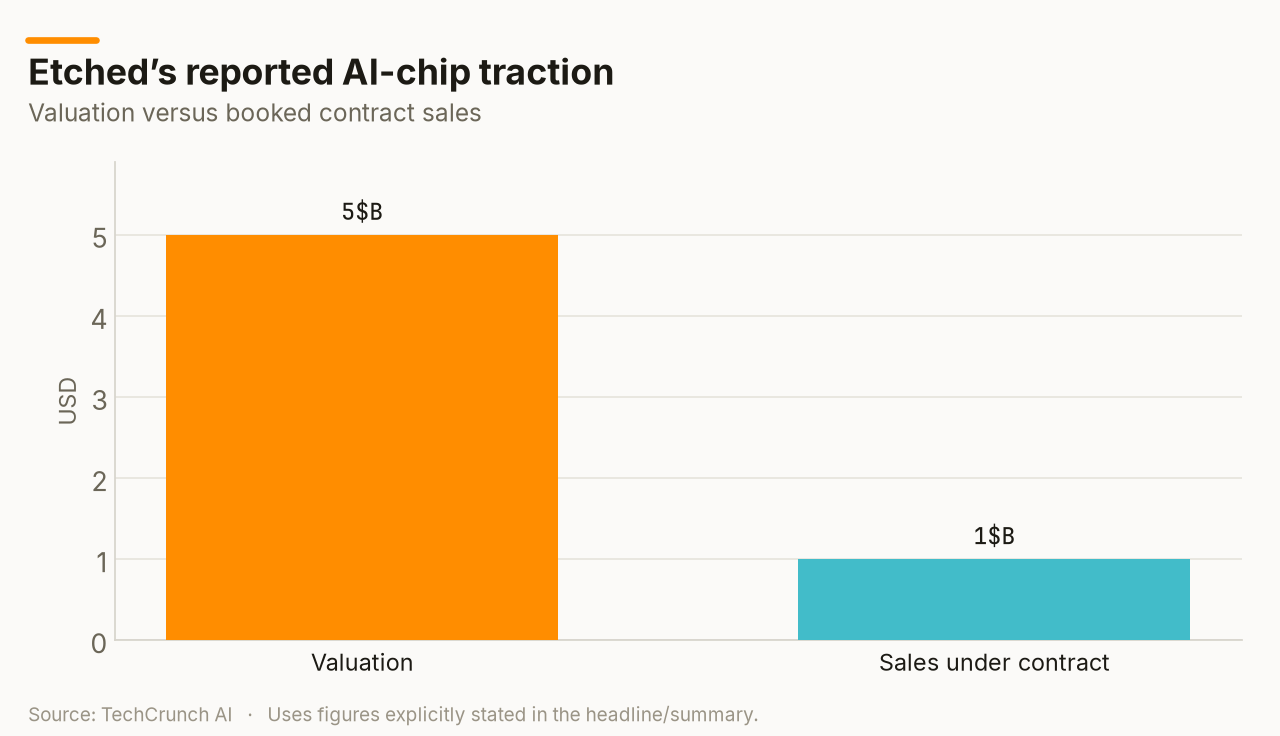
- Etched hit a $5 billion valuation and $1 billion in sales for its AI chip. That is a real commercial wedge against Nvidia, not just a pitch deck story.
- AWS launched a new $1 billion AI unit built around embedded engineers. It signals that cloud vendors now sell implementation help, not just APIs and instances.
- Meta is exploring ways to sell excess AI compute. If it works, spare GPU capacity becomes a revenue line instead of dead weight.
Policy & governance
- OpenAI floated giving the Trump administration a 5% cut of the AI boom. That is a blunt attempt to lower political resistance to AI expansion, and it shows how financial terms are entering governance talks.
- Trump dropped restrictions on Anthropic’s Mythos and Fable models. The practical effect is fewer barriers on where those models can be deployed and sold.
- Midjourney is pushing Hollywood studios to disclose their AI usage in an ongoing legal fight. That could surface who is using generative tools behind the scenes, and on what terms.
- Anthropic said export controls on Claude Fable 5 and Mythos 5 were lifted. Less friction on exports usually means faster international distribution for frontier models.
Research
- Safety Testing LLM Agents at Scale: From Risk Discovery to Evidence-Grounded Verification proposes a scalable safety-testing framework for agents. That matters because agent deployments need repeatable checks, not one-off red-team demos.
- Expert Evaluation of Clinical AI Tools on Real Point-of-Care Clinical Queries benchmarks tools on 620 real clinical questions. Real queries are harder than synthetic tests, so this is closer to what clinicians actually face.
- OSWorld2.0 expands computer-use benchmarking for long-horizon tasks. That raises the bar for agents that have to work across many steps, windows, and app states.
- HARC studies harmfulness and refusal directions for safety alignment. The practical angle is better control over when models refuse versus when they comply.
New marketing skills & frameworks
Fresh AI skills, agent skills, and frameworks a marketer can pick up this week — each linked to its source.
- Paid Media Audit With Live Data (ds-paid-audit): Connects directly to Google Ads, Meta, and LinkedIn without exporting data to run structured audits that detect budget waste, audience overlap, and creative fatigue. — DataSlayer
- AI-Optimized Answer Engine Strategy (AEO): A new competency focusing on optimizing content, images, and video for AI-generated answers in Google AI OverviewsAI OverviewsGoogle's generated answer block above the organic results. It summarises sources and often removes the reader's reason to click through., ChatGPT, and Perplexity rather than traditional search links. — Clayton Johnson
- Vibe Coding for Marketing Agents: Enables marketers to build custom ROI calculators, scrapers, and autonomous marketing agents using AI code tools like Claude Code without writing traditional code. — YouTube
How this digest is made
This roundup is generated by Letaido, an AI agentAI agentA system that combines a language model with tools and a goal, so it can decide what to do next and act — not just generate text.Read: What Are AI Agents? Definition, Types, and Examples that runs the whole pipeline automatically. Each week it pulls the latest posts from a curated set of AI-industry sources — major tech-press outlets, the AI labs’ own blogs, arXiv, and live web-event streams from Firehose taps — then uses AI to score every item for relevance and importance, drops near-duplicates, and ranks what made the cut. This issue was drawn from 701 stories across 10 sources; 18 made the final digest. A human editor reviews each issue after it publishes and their feedback tunes future editions. Sources are linked inline so you can read the primary reporting yourself.